Hindutva organisations now want Gyanvapi-like excavation in Srirangapatna; submit plea to DC
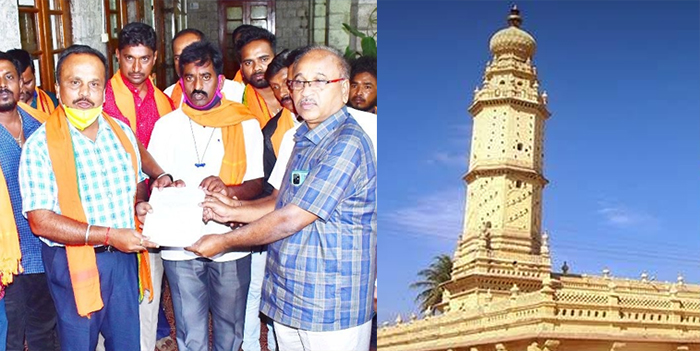
Mandya: In the wake of the controversies over Varanasi’s Gyanvapi mosque, fringe Hindutvava organisations including Vishwa Hindu Parishad and Bajrang Dal have sought for the videography survey and excavation of Jamia Masjid at Srirangapatna on Friday.
The twin right wing organisations have urged the Deputy Commissioner in an appeal that a mosque was built by demolishing Shri Anjaneyaswami temple at the entrance of the Srirangapatna fort in AD 1787 by Tipu Sultan while citing page no. 493, 494 of Mysore State gazetteer.
In an alarming note, the appeal urged that the prayers, madrasas and other activities of the mosque be taken to a standstill while requesting for the removal of people residing in the mosque for carrying out the excavation.
The appeal also warned of the possible protests that will be held if the excavations are not permitted.
Vishwa Hindu Parishad district secretary C K Balakrishna, co-secretary Puneeth, incorporator Basavaraju, retired ASP Balaramegowda, Damadahalli D K Keshava, Shrikanthaswamy and others were present while submitting the appeal.
Let the Truth be known. If you read VB and like VB, please be a VB Supporter and Help us deliver the Truth to one and all.
India, Jamaica agree to boost trade, skilled mobility: Jaishankar
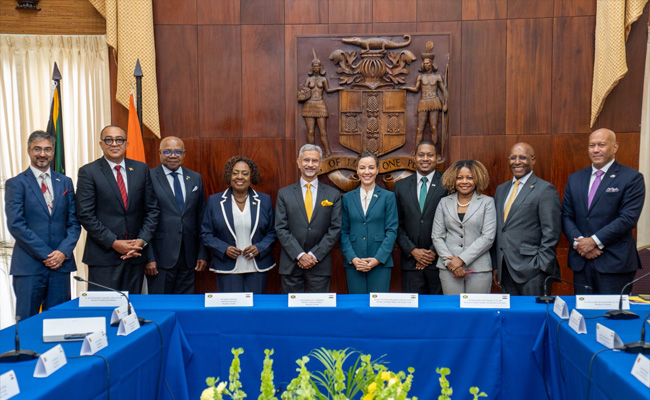
Kingston (PTI): India and Jamaica agreed to further strengthen trade linkages and explore cooperation for recruitment and mobility of skilled professionals, including healthcare workers and teachers, External Affairs Minister S Jaishankar said.
Addressing a joint press conference here after talks with his Jamaican counterpart Kamina J Smith on Monday, Jaishankar said the discussions were comprehensive, and they reviewed the entire gamut of bilateral ties, identifying new avenues to deepen the partnership.
"We signed several important agreements and discussed effective implementations of MOUs which have been recently concluded in the fields of digital transformation, cultural exchange, sports and digital payments to ensure tangible outcomes on the ground," he said.
India recognised Jamaica's growing role as a logistics hub and gateway to the Caribbean for trade and investment, Jaishankar said.
ALSO READ: Actor Santhosh Nair killed in road accident in Pathanamthitta
"We agreed to further strengthen trade, business and investment linkages, explore cooperation for recruitment and mobility of skilled professionals, including nurses, healthcare workers and teachers," he said.
The two sides also discussed expanding cooperation in defence and security, healthcare, digitisation, agriculture, education and infrastructure, the minister said.
Highlighting development cooperation as a key pillar of ties, Jaishankar noted the successful completion of the Improving Rural Livelihoods Project in Kitson Town in March 2026, implemented with Indian assistance of USD 1 million under the India-UN Development Partnership Fund, benefiting over 200 individuals and impacting thousands more.
He said India is also discussing the feasibility of establishing an artisan empowerment hub in Jamaica and reiterated support for the country's recovery following Hurricane Melissa.
As part of humanitarian assistance, India has supplied relief material, deployed a medical team and is in the process of providing 30 dialysis units. It is also sending 40 fishing boats and 200 GPS units to aid recovery efforts.
The ministers reaffirmed close cooperation in multilateral fora and discussed issues such as reformed multilateralism, climate justice and priorities of the Global South.
India appreciated Jamaica’s support for its candidature for a non-permanent seat at the UN Security Council for 2028-29.
Both sides strongly condemned terrorism in all its forms and called for early finalisation of the Comprehensive Convention on International Terrorism.
Jaishankar also highlighted growing people-to-people ties, noting the popularity of yoga and Ayurveda in Jamaica and the contribution of the Indian diaspora to the country’s development.
He announced a contribution of two million Jamaican dollars towards celebrations marking 181 years of the arrival of Indians in Jamaica on India Heritage Day.
According to the website of the High Commission of India in Kingston, Jamaica has an Indian diaspora of around 70,000 people whose forefathers came mostly from Uttar Pradesh and Bihar as indentured labour between 1845 and 1917. Some also came from South India.
The diaspora constitutes around 3 per cent of Jamaica's population and continues to nurture an abiding interest in Indian culture, music, dance and history, serving as a cultural bridge between the two countries. May 10 is observed as India Heritage Day in Jamaica.
Later in the day, Jaishankar interacted with Jamaica’s industry and business leaders, underlining the need to deepen economic engagement as countries diversify partnerships globally.
“Emphasised that as we all diversify and seek reliable partners, the imperative to deepen India-Jamaica business ties is that much stronger,” he said in a social media post, noting that the potential for bilateral and regional economic cooperation should be "explored more vigorously".
He also appreciated Industry Minister Aubyn Hill for convening the interaction with business leaders.
Jaishankar arrived in Kingston on Saturday, marking the first leg of his nine-day tour of Jamaica, Suriname, and Trinidad and Tobago, aimed at further strengthening India's strategic and cultural ties with the Caribbean nations.