In BJP's model money is in hands of select rich, while Cong gives to poor: Rahul Gandhi
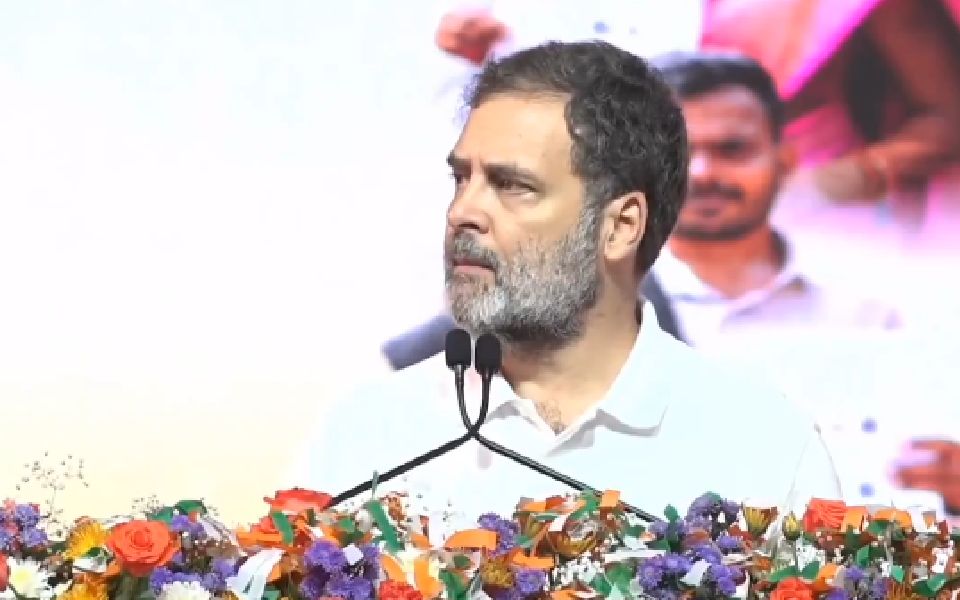
Hosapete (Karnataka), May 20 (PTI): Leader of Opposition in the Lok Sabha, Rahul Gandhi, on Tuesday said that the BJP follows a model under which select rich people get entire money and resources, whereas in the Congress' model, money is put into the bank accounts and the pockets of the poor.
The Congress leader asserted that the party's government in Karnataka has implemented the "sixth guarantee" promised to the people, by distributing over one lakh title deeds to the beneficiaries.
He was speaking at an event to mark Karnataka Congress government's two years in office, during which over 1.11 lakh title deeds were distributed to eligible beneficiaries, whose "undocumented habitations" have been declared as revenue villages.
"Congress party government has completed two years. During the election, we made you promises. We had promised five guarantees. The BJP people said that the Congress party will not be able to fulfill it. The Prime Minister said this won't be done," Gandhi said.
Listing out the five guarantee schemes implemented by the government, he said, "We have told you that we will put money into the bank account of Karnataka's poor. Today, thousands of crores of rupees are being put directly into your bank account. This money, you use for the education of your children, for your health. This is what we wanted -- your money comes back to your pocket."
"The BJP wants only select people to get India's entire money, but we want the money to go to the pockets of poor, backward, dalits, adivasis -- directly. When we put money into your pockets, that money goes into the market and because of this production increases and the money gets injected into villages, as you spend this money in your villages, towns and cities, and Karnataka's economy benefits from it," he added.
Stating that in the BJP's model, the entire money is given to two-three billionaires, the Congress leader said these billionaires don't spend money in villages or towns, but they buy assets in London, New York and other places.
"Your money goes into the hands of a select few under the BJP's model. In their model, employment gets finished, but in our model, employment gets generated. In their model, if you are ill, you will be under debt, in our model, you will have money in your pockets and you will get treated. You will give lakhs of money to private schools, colleges and universities for education under their model and face debt, while in our model we give you money," he added.
AICC president Mallikarjun Kharge, Chief Minister Siddaramaiah, Deputy Chief Minister D K Shivakumar, party general secretary Randeep Singh Surjewala, host of party leaders and ministers were present at the event.
The Congress government's five guarantee schemes are -- 200 units of free power to all households (Gruha Jyoti), Rs 2,000 monthly assistance to the woman head of every family (Gruha Lakshmi), the additional 5 kg of rice to every member of a BPL household (Anna Bhagya), Rs 3,000 every month for unemployed graduate youth and Rs 1,500 for diploma holders for two years (Yuva Nidhi), and free travel for women in public transport buses (Shakti).
Noting that there were many people in Karnataka who had land but did not have property rights over it, and Dalit and adivasi hamlets were not even considered as revenue villages, and they lacked government facilities, Gandhi said he had discussed it with Kharge, Siddaramaiah and others during election, and wanted those who have such lands in the state, to also have property right over it.
"I'm happy today we have succeeded in fulfilling our sixth guarantee. Over one lakh families are today being given title deeds by the Karnataka government. We have taken a major step in fulfilling former PM Indira Gandhi's dream," he said.
Pointing out that 2,000 habitations are being declared as revenue villages in the state, Gandhi said he has also asked to ensure that there is a digital registry.
"Poor may not be able to get their land record. They won't get their documents despite several years. That is why I have said there should be a digital registry in the 21st century. You may have a physical copy, but whenever in need, you should be able to take a digital copy," he said.
Highlighting that the "sixth guarantee" will benefit the poor, belonging to Lambani, Banjara, Soliga, Bovi, among other communities, Gandhi further said there are 50,000 families, who still don't have property rights, and "I want that within six months they too are given title deeds."
"About 2,000 revenue villages have been declared. I want 500 more new revenue villages to be declared. There should be no one in Karnataka who doesn't have property rights over their land. We want Karnataka to become the first state in the country where whoever has the land also has right over it," he said.
The Congress had promised five guarantees, but has implemented six, and they were most needed for Karnataka's future, as it benefits crores of families, he added.
कर्नाटक में चुनाव के वक्त हमने 5 गारंटी दी थीं, लेकिन आज 6 पूरी की हैं। एक लाख से ज़्यादा परिवारों को उनकी ज़मीन का मालिकाना हक़ दिया गया है।
— Rahul Gandhi (@RahulGandhi) May 20, 2025
यह कर्नाटक के भविष्य के लिए सबसे महत्वपूर्ण गारंटी है, जिससे करोड़ों परिवारों को, खासकर गरीबों, दलितों और आदिवासियों को, सीधा फायदा होगा।… pic.twitter.com/1vSqELdPoN
Let the Truth be known. If you read VB and like VB, please be a VB Supporter and Help us deliver the Truth to one and all.
Ordinance issued to increase number of Supreme Court judges from 34 to 38
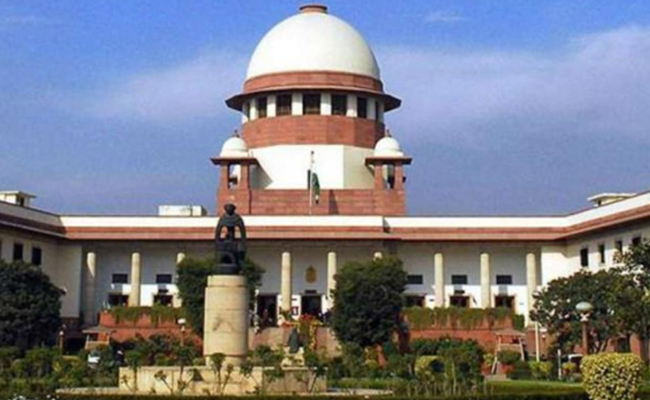
New Delhi (PTI): The government has promulgated an ordinance to increase the strength of the Supreme Court from the present 34 judges to 38, including the Chief Justice of India.
The law ministry notified the ordinance on Saturday, which amended the Supreme Court (Number of Judges) Act, 1956, to increase the sanctioned strength of the top court.
So far, the sanctioned strength of the top court was 34, including the Chief Justice of India (CJI). Now, the number of judges has been increased by four, taking the sanctioned strength to 38.
The top court will now have 37 judges, other than the CJI.
With the apex court having two vacancies at present, and the ordinance coming into force immediately, the Supreme Court Collegium will now have to recommend six names for appointment as judges in the top court.
A bill will be brought in the Monsoon Session of Parliament to convert the ordinance – an executive order – into a law passed by Parliament.
The Union Cabinet had cleared a draft bill on May 5 to increase the number of apex court judges.
The strength of the Supreme Court was last increased from 30 to 33 (excluding the CJI) in 2019.
The Supreme Court (Number of Judges) Act, as originally enacted in 1956, put the maximum number of judges (excluding the CJI) at 10.
This number was increased to 13 by the Supreme Court (Number of Judges), Amendment Act, 1960, and to 17 by another amendment to the law.
The Supreme Court (Number of Judges) Amendment Act, 1986, augmented the strength of judges from 17 to 25, excluding the CJI.
A fresh amendment in 2009 further increased the strength from 25 to 30.
Article 124(3) of the Constitution lists the qualifications required to become a Supreme Court judge.
An Indian citizen who has either served as a high court judge for at least five years, or as an advocate for 10 years, or is a distinguished jurist, can be appointed to the top court.
The strength of the Supreme Court is increased based on the recommendations of the CJI, who writes to the Union law minister. After consulting the finance ministry, the Department of Justice under the law ministry moves the Cabinet with a draft bill.