India set to give new energy to global aviation market: PM Modi
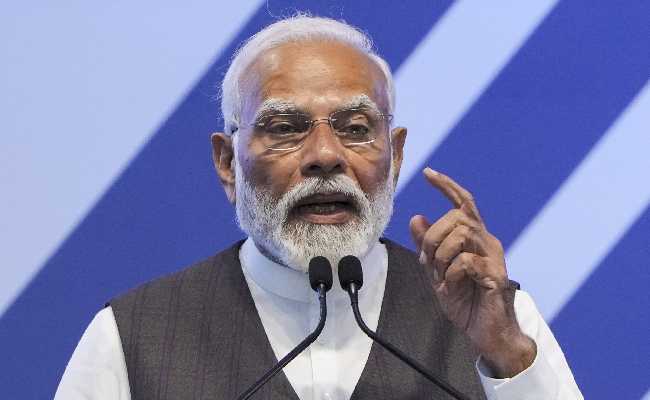
Bengaluru (PTI) Prime Minister Narendra Modi on Friday lauded the strides made by India in aviation and aerospace and the growing role of women in the sector, while asserting that the country will spur the global aviation market.
In his address after inaugurating aircraft maker Boeing's new global engineering and technology centre campus near here, he said women were leading in the aviation and aerospace sector, be it fighter or civil aircraft. They constituted about 15 per cent of the total pilots in India, which was three times the global average.
The time for women-led development has come, Modi said. India, he said, has become the third major domestic aviation market in the world and, in a decade, the number of passengers will double.
The 'UDAN' scheme has played a vital role in enhancing the domestic aviation market, the PM said. Due to the growing demand, airlines in India have ordered hundreds of aircraft. "India is set to give new energy to the global aviation market" he said.
Further, "we gave priority to connectivity infrastructure making India a well connected market", Modi said.
Taking a dig at the Congress, he said earlier India was unable to transform its potential into performance.
The PM also launched the Boeing Sukanya Programme. The company said the initiative aims to support the entry of more girl children from across India into the country's growing aviation sector.
The 43-acre state-of-the-art Boeing India Engineering and Technology Centre (BIETC) campus is the planemaker's largest such investment outside the US, the company said. It has been built at a cost of Rs 1,600 crore.
The campus at Hightech Defence and Aerospace Park in Devanahalli on the city outskirts will become a cornerstone for partnerships with vibrant startups, private and government ecosystem in India, and will help develop next-generation products and services for the global aerospace and defence industry, Boeing said.
The Boeing Sukanya programme will provide opportunities for girls and women from across India to learn critical skills in the science, technology, engineering and maths (STEM) fields and train for jobs in the aviation sector, a company statement said.
For young girls, the programme will create STEM Labs at 150 planned locations to help spark interest in related careers. It will also provide scholarships to women who are training to be pilots. Investments will support flight training curriculum, obtaining certifications, funding for simulator training, and career development programmes, Boeing said.
"We are honored and privileged to support Prime Minister Modi's transformative vision for India, and we are grateful to have him dedicate the Boeing campus to foster aerospace innovation in the country," said David L Calhoun, Boeing president and CEO.
Over the years, the statement said, Boeing India has grown its team in engineering and R&D talent to the largest number of employees in any country outside the United States, with more than 6,000 as of December 2023.
Karnataka Governor Thaawarchand Gehlot, Chief Minister Siddaramaiah, Leader of the Opposition in Legislative Assembly, R Ashoka, and Boeing Chief Operating Officer, Stephanie Pope, were among those present on the occasion.
Let the Truth be known. If you read VB and like VB, please be a VB Supporter and Help us deliver the Truth to one and all.
Over 17,000 people went missing in Delhi in 2024: NCRB

New Delhi (PTI): A total of 23,058 people, comprising 9,482 men and 13,576 women, were reported missing in Delhi in 2024, according to the latest National Crime Records Bureau (NCRB).
Of the total, 5,491 were children below the age of 18 — 1,571 boys, 3,920 girls.
The city recorded 17,567 fresh adult missing persons cases in 2024, comprising 7,911 men and 9,656 women.
According to the NCRB data, released on Wednesday, 14,637 men, 18,238 women and six transgender persons were still missing from previous years.
At the latest count, in 2024, Delhi had a total of 55,939 missing persons cases — 24,119 men, 31,814 women and six transgender persons.
In 2024, police traced or collected 28,392 missing persons, including 12,182 men, 16,208 women and two transgender persons.
Only half of the men and half of the women who went missing could be traced.
A total of 27,547 missing persons – 11,937 men, 15,606 women, four transgender persons — were yet to be untraced by the end of the year, the data showed.
The data also revealed that 5,352 children from previous years remained untraced at the beginning of 2024.
The number of still missing boys was 1,621, and the number of missing girls was 3,729. Two transgender children were yet to be found.
After adding the pending cases from previous years, the total number of missing children cases handled in 2024 rose to 10,843.
The police traced or recovered 6,762 missing children — 2,030 boys, 4,732 girls.
The recovery rate stood at 63.6 per cent for boys and 61.9 per cent for girls, while no transgender child was traced.
By the end of 2024, a total of 4,081 children remained untraced, 1,162 of them boys, 2,917 girls, and two transgender children.