Indigenous jet trainer demonstrates capability to carry out six turn spins

Bengaluru, Jan 6: The Intermediate Jet Trainer (IJT), designed and developed by Hindustan Aeronautics Limited for stage II training of IAF pilots, has successfully demonstrated the capability to carry out six turn spins to the left hand and right hand sides.
The IJT, conceived by HAL as a replacement to the ageing Kirans of IAF fleet, had completed demonstration of its capabilities in terms of altitude and speed envelope, load factor, satisfactory stall characteristics and limited armament capability as required by IAF, much earlier, an HAL statement said on Thursday.
The only pending task was spin testing.
During the course of spin testing, in 2016, the aircraft departed from controlled flight which brought the programme to a temporary halt, it said. However, HAL decided to proceed further to complete the spin testing.
The capability to enter and recover from spin is a necessity for a trainer aircraft in order to familiarise the trainee pilot to recognise departure from controlled flight and the actions required to recover from such situations, the statement noted.
"Achieving satisfactory characteristics during spin and an assured recovery from spin form a part of very crucial flight tests due to its unpredictability", it said.
The spin flight testing is inherently a high risk manoeuvre and therefore progresses incrementally turn by turn. Due to the complex interplay of aerodynamic and inertia forces, the motion of the aircraft in spin is unpredictable and flight testing is the only way to assess the acceptability or otherwise of its characteristics.
Subsequent to the temporary halting of flight tests in 2016, HAL undertook major modifications like shifting the vertical tail aft on the airframe and increasing the rudder area and flight testing resumed in April 2019.
These modifications entailed the use of a new Anti-Spin Parachute system (ASPS) which is mandated for the safety of the aircraft and test crew during spin flight testing. The new ASPS was integrated into the aircraft in July 2020 and the successful streaming of the parachutes were demonstrated in September 2020.
HAL could commence the stall and spin testing of the IJT in its new modified configuration in November 2020, it was stated.
HAL's Director (Engineering and R&D), Arup Chatterjee said that by demonstrating its capability to have six turn spins on both sides the IJT has achieved a major milestone.
He hoped that with the completion of spin certification of HTT-40 and the progress achieved in IJT, HAL will soon have the state-of-the-art trainers for stage I and II training of IAF pilots.
The Intermediate Jet Trainer designed and developed by HAL for stage –II training of IAF pilots has successfully demonstrated the capability to carry out six turn spins to the LH and RH sides. @drajaykumar_ias @SpokespersonMoD @DefProdnIndia @gopalsutar @ANI @PTI_News pic.twitter.com/4YPC0596Fx
— HAL (@HALHQBLR) January 6, 2022
Let the Truth be known. If you read VB and like VB, please be a VB Supporter and Help us deliver the Truth to one and all.
Ordinance issued to increase number of Supreme Court judges from 34 to 38
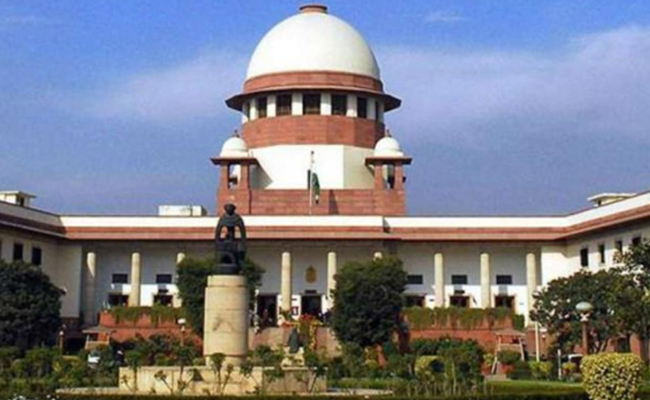
New Delhi (PTI): The government has promulgated an ordinance to increase the strength of the Supreme Court from the present 34 judges to 38, including the Chief Justice of India.
The law ministry notified the ordinance on Saturday, which amended the Supreme Court (Number of Judges) Act, 1956, to increase the sanctioned strength of the top court.
So far, the sanctioned strength of the top court was 34, including the Chief Justice of India (CJI). Now, the number of judges has been increased by four, taking the sanctioned strength to 38.
The top court will now have 37 judges, other than the CJI.
With the apex court having two vacancies at present, and the ordinance coming into force immediately, the Supreme Court Collegium will now have to recommend six names for appointment as judges in the top court.
A bill will be brought in the Monsoon Session of Parliament to convert the ordinance – an executive order – into a law passed by Parliament.
The Union Cabinet had cleared a draft bill on May 5 to increase the number of apex court judges.
The strength of the Supreme Court was last increased from 30 to 33 (excluding the CJI) in 2019.
The Supreme Court (Number of Judges) Act, as originally enacted in 1956, put the maximum number of judges (excluding the CJI) at 10.
This number was increased to 13 by the Supreme Court (Number of Judges), Amendment Act, 1960, and to 17 by another amendment to the law.
The Supreme Court (Number of Judges) Amendment Act, 1986, augmented the strength of judges from 17 to 25, excluding the CJI.
A fresh amendment in 2009 further increased the strength from 25 to 30.
Article 124(3) of the Constitution lists the qualifications required to become a Supreme Court judge.
An Indian citizen who has either served as a high court judge for at least five years, or as an advocate for 10 years, or is a distinguished jurist, can be appointed to the top court.
The strength of the Supreme Court is increased based on the recommendations of the CJI, who writes to the Union law minister. After consulting the finance ministry, the Department of Justice under the law ministry moves the Cabinet with a draft bill.