Interstate river water disputes: Karnataka CM Bommai holds meeting with legal team
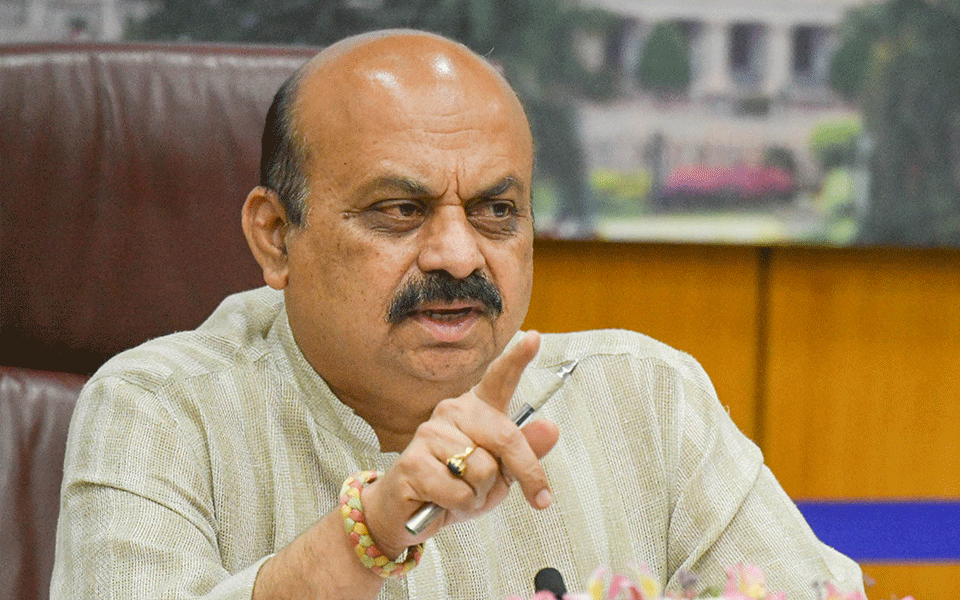
New Delhi(PTI): Karnataka Chief Minister Basavaraj S Bommai on Thursday held a meeting here with legal and technical experts to chalk out strategies for tackling water sharing disputes with neighbouring states.
"Had a detailed discussion with the legal team on Supreme Court cases related to interstate river water disputes. Several issues were discussed," Bommai told reporters after the meeting.
The meeting was held at the Karnataka Bhavan here.
Emerging from the meeting, the CM said he had met senior advocates Mohan Khatri on Wednesday and Shyam Divan this morning and discussed ways to proceed in view of the existing water disputes.
With regard to the Mekedatu project, Bommai said it has been decided to put forth the state government's stand when the case gets listed for hearing next time.
Karnataka has proposed a balancing reservoir at Mekedatu in Ramanagara district, but the Tamil Nadu government has opposed it vehemently.
Further, Bommai said the dispute over Kalasa-Banduri Nala project on the Mahadayi river was also discussed.
The hearing of this case is listed on September 2. The main issues in the special leave petition were discussed in the meeting, he added.
Holding that water projects being implemented in Tamil Nadu are illegal in nature, Bommai said another petition will be filed in the Supreme Court against the neighbouring state and the matter will also be taken up with the Centre.
"Many issues were discussed in the meeting. In a week or so, they will inform us of the progress. Our government is constantly trying to resolve long-pending cases," he added.
Karnataka Water Resources Minister Govind Karajola, Health Minister K Sudhakar, MP Shivakumar Udasi, Water Resources Department Deputy Chief Secretary Rakesh Singh, chief minister's general secretary Manjunath Prasad, Advocate General Prabhu Linga Navadagi and others were present in the meeting.
The CM, on the second day of his visit, plans to call on Union Finance Minister Nirmala Sitharaman and Health Minister Mansukh Mandaviya among others.
Let the Truth be known. If you read VB and like VB, please be a VB Supporter and Help us deliver the Truth to one and all.
Delhi: Father, son held for killing 19-year-old woman in suspected honour killing

New Delhi (PTI): The Delhi Police has arrested a man and his son for allegedly murdering his 19-year-old daughter in west Delhi's Hari Nagar area, an official said on Friday.
The case first came to light on April 1 after a PCR call was received around 2 pm, alleging that a woman had been killed by her family members and her body was being taken for last rites, he said.
The accused, identified as Mohammad Maneer (55), a vegetable vendor, and his son Meraj Ali (19), were arrested in connection with the case, the officer said.
The victim had been in a relationship with a man from her native place for the past two years, which was opposed by her father, Maneer and brother Meraj, he said.
"When the girl did not end the relationship despite objections, the family killed her," the officer said.
On April 1, the police said that when their team reached the spot, they found that the woman's body was being taken for burial.
Acting on the input, the burial process was stopped over suspicion of honour killing.
"Police intercepted the family members and took possession of the body," he said.
Police said that the man who had made the PCR told them that the woman was in love with his cousin.
During the inquiry, police also interacted with the PCR caller, who said his cousin, a friend of the deceased, had informed him about the situation and suspected foul play, prompting him to alert the police control room.
The body of the woman was subsequently shifted to the mortuary of Deen Dayal Upadhyay Hospital for preservation and postmortem.
Police said that both the crime team and the forensic science laboratory (FSL) team were called to inspect the scene and collect evidence.
Police said that, as per the postmortem report, the cause of death was identified as smothering, indicating that the woman was suffocated.
A preliminary inquiry also revealed that the family had initiated preparations for the last rites soon after the woman's death, raising suspicion about the circumstances.
Initial investigation pointed to the family's opposition to the woman's relationship.
"The family members of the woman saw her with the man, and she was taken back home. We got to know that she was beaten up and even locked inside the house for some days," a source said.
Further investigation into the matter is underway, police added.