Is 'second demonetisation' cover-up of wrong decision made earlier, asks Kharge
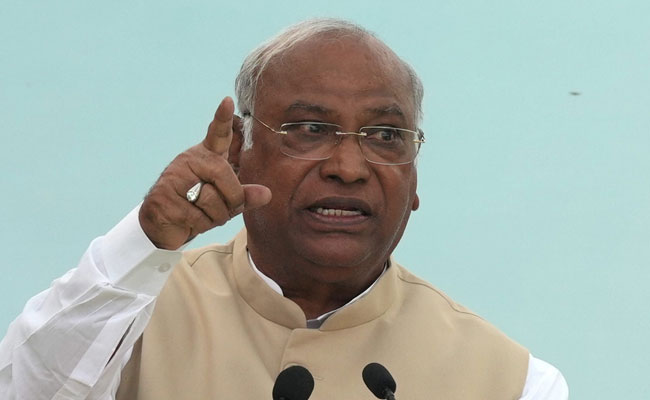
New Delhi (PTI): Opposition leaders on Saturday hit out at the government after the RBI announced the withdrawal of Rs 2,000 currency notes from circulation, with Congress president Mallikarjun Kharge asking if the "second demonetisation" is an effort to cover up the wrong decision made earlier.
He also called for an impartial probe into the entire demonetisation episode.
In a surprise move, the Reserve Bank of India (RBI) on Friday announced the withdrawal of Rs 2,000 currency notes from circulation but gave the public time till September 30 to either deposit such notes in accounts or exchange them at banks.
It said it had asked banks to stop issuing Rs 2,000 notes with immediate effect.
In a tweet in Hindi, Kharge said, "You inflicted a deep wound on the economy with the first demonetisation. Due to this, the entire unorganised sector was destroyed, MSMEs were closed down and crores of jobs were lost."
"Now, the 'second demonetisation' of ?2000 note... Is this a cover-up of a wrong decision? Only an unbiased investigation will reveal the truth of the matter," the Congress chief said.
Independent Rajya Sabha MP Kapil Sibal also attacked the Centre over the decision and recalled Prime Minister Narendra Modi's remarks at the time of the 2016 demonetisation that the magnitude of cash in circulation is directly linked to the level of corruption.
He said, "?2000 notes scrapped. PM to Nation: November 8, 2016, 'The magnitude of cash in circulation is directly linked to the level of corruption'. Cash in circulation: 2016 (17.7 lakh crores); 2022 (30.18 lakh crores). So: Corruption increased! What say you PM ji?"
Sibal was a Union minister during UPA 1 and 2 and had quit the Congress in May last year. He was elected to Rajya Sabha as an Independent member with the Samajwadi Party's support.
Trinamool Congress MP Mahua Moitra said, "No civilised nation puts its people under constant fear of cash turning to toilet paper. Why should we stress about our wallets vaporising every few years?"
"BJP & Modiji's distractions cut no ice. You lost Karnataka. You will lose more states. Also you cannot save Adani," she said.
Reacting to the development, AIMIM chief Asaduddin Owaisi posed five questions to Modi.
"Five questions to Top Economist PM Modi:@PMOIndia. 1. Why did you introduce the 2000 note in the first place? 2. Can we expect 500 note to be withdrawn soon? 3. 70 crore Indians don't have a smart phone, how do they do digital payment?
"4. What is the role of Bill Gates owned Better Than Cash Alliance in making you do Demo 1.0 and 2.0? 5. Is NPCI being hacked by Chinese hackers? If so, what will happen to payements when war happens," he asked.
A host of Congress leaders also slammed the PM over the move.
In a tweet, Congress general secretary organisation K C Venugopal said, "I recollect the prescient words of our former PM Dr. Manmohan Singh, who called demonetisation an act of 'organised loot and legalised plunder' and its implementation was a 'monumental management failure'."
The scrapping of the Rs 2000 note is yet another proof that the Modi government put in zero thought before taking the fateful decision of November 8, 2016 that caused widespread suffering among the poor and middle classes, he said.
"This withdrawal shows they have no foresight and only take shock-and-awe decisions for their political posturing," he said.
Congress' media and publicity department head Pawan Khera took a swipe at Modi, saying the one who could not use the note printed by himself even for seven years asks what the country did in 70 years.
Congress MP Manish Tewari said the RBI's logic behind the withdrawal of Rs 2,000 rupee notes was contrary to the answer given by the Finance Ministry to his Parliament Question on November 18, 2019.
He said, "31st March 2017. Total Currency in Circulation 13.10 Lakh Crores, 500/2000 Rupee notes 9.5 Lakh Crores. 31st March 2018 :Total Currency in Circulation 18 Lakh Crores. 500/2000 Rupee notes 14.46 Lakh Crores-80% of Total Currency in Circulation. 31st March 2019 - Currency in Circulation 21.1 Lakh Crores. 500/2000 Re Notes 17.34 Lakh Crores. 82.2 % of Total currency in Circulation."
Tewari said the question is will Rs 2,000 notes continue to be legal tender after September 30 or not.
The RBI needs to clarify that, he added.
The Rs 2,000 denomination banknote was introduced in November 2016, primarily to meet the currency requirement of the economy in an expeditious manner after the withdrawal of legal tender status of all Rs 500 and Rs 1,000 banknotes in circulation at that time.
The RBI said it has also been observed that Rs 2,000 denomination note is not commonly used for transactions. Further, the stock of banknotes in other denominations continues to be adequate to meet the currency requirement of the public.
"In view of the above, and in pursuance of the 'Clean Note Policy' of the Reserve Bank of India, it has been decided to withdraw the Rs 2,000 denomination bank notes from circulation," it said.
Let the Truth be known. If you read VB and like VB, please be a VB Supporter and Help us deliver the Truth to one and all.
Pro-chancellor of St Aloysius University, Fr Melwin J Pinto SJ passes away at 63
_vb_92.jpeg)
Mangaluru: Fr Melwin J Pinto SJ, Pro-chancellor of St Aloysius University Rector of St Aloysius Institutions, and Vice President of Mangalore Jesuit Educational Society (MJES), breathed his last on Friday, April 10. He was 63.
Born in 1963, Fr Melwin Pinto completed his schooling and college education at St Aloysius before joining the Jesuit order on June 20, 1981. He was ordained as a Jesuit priest on April 14, 1997.
Over the years, he held several academic qualifications, including an MA in English, a Master’s degree in Education, and diplomas in psychology and counselling as well as school administration.
He began his career in education as headmaster of St Joseph’s Primary School and High School in Hassan, serving between 1996 and 1999.
He later founded St Joseph’s Indian PU College and served as its principal until 2007. He subsequently served as headmaster of St Aloysius High School, Mangaluru, from 2007 to 2011, and later as principal of St Joseph’s PU College, Hassan, until 2012.
Fr Melwin Pinto also worked with Vatican Communications and Radio in Rome, contributing to its English desk for Asia and Indian languages.
He later served as superior and director of Fatima Retreat House in Valencia for two years from May 2017, before being appointed as superior of the Jesuit study home ‘Vidyaniketan’ in Dharwad.
He was also closely associated with the development of St Aloysius Institutions and played a key role in securing the status of a Deemed-to-be University. His contribution to the education sector and efforts towards innovation were widely acknowledged. He was known for maintaining close relations with people from all sections of society.
Legislative Council MLA Ivan D’Souza, in a statement, said the demise of Fr Melwin J Pinto was a huge loss to the educational and religious fields and had created a significant void in society.
Dakshina Kannada District in-charge Minister Dinesh Gundu Rao also expressed grief, stating that his service and contributions to education would always be remembered.
Details regarding the funeral are yet to be announced.