JD(S) makes it clear it will not cede Mandya LS seat to Congress
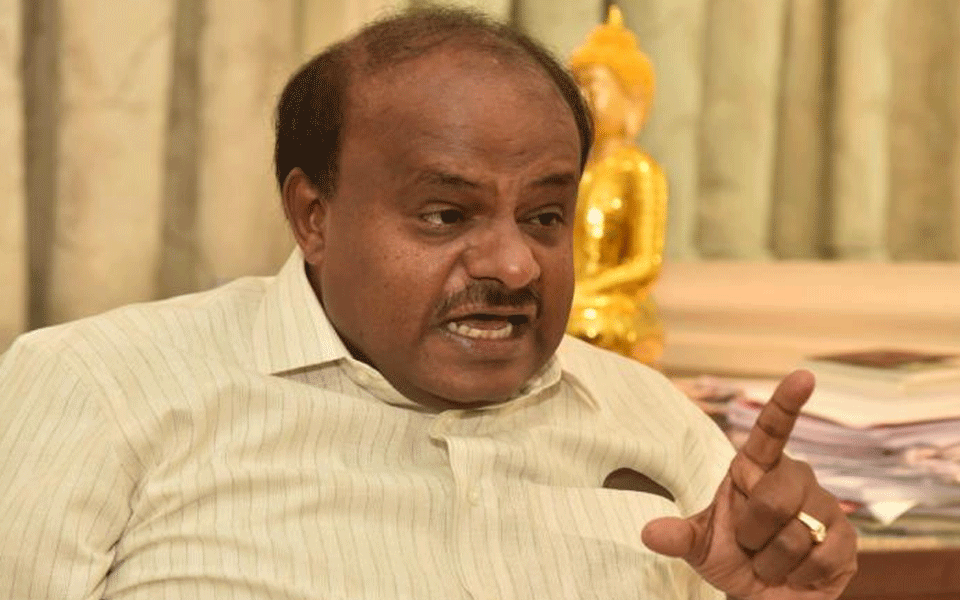
Bengaluru, Feb 1: Amid pressure from within Congress not to cede Hassan and Mandya Lok Sabha seats to its coalition partner, the JD(S) Friday made it clear that it would not let go of the seats that are its party bastions.
Chief Minister H D Kumaraswamy said Mandya was JD(S) stronghold and he cannot go against the feelings of the people and workers, while elder brother and PWD Minister H D Revanna said JD(S) was even ready for a triangular contest in Hassan.
Both Hassan and Mandya, where the BJP's strength is negligible, are currently held by JD(S), which Congress too is eyeing this time.
"If needed, can do it (alliance) or else we are ready for a triangular (contest). We from Hassan had never asked for an alliance. We have the strength to fight," Revanna said.
Speaking to reporters here, Revanna, also the Hassan district in-charge Minister said "...the wish of our family is that Deve Gowda should contest from Hassan and win with the highest lead."
Asked about his son Prajwal Revanna contesting from Hassan, Revanna said the decision of Deve Gowda and Kumaraswamy on the matter would be final.
On several instances, Deve Gowda had indicated that Prajwal contest from Hassan, the party bastion he has been contesting from.
Pointing out that seat sharing is to be decided by national leaders of both parties, Revanna said JD(S) would abide by Deve Gowda and Kumaraswamy's decision on the issue.
Congress sources said that during internal discussions on Thursday,local leaders had asked the leadership not to cede Mysuru and Tumakuru seats and the party be allowed to choose one seat between Hassan and Mandya.
Seat-sharing is expected to be a litmus test for both parties, mostly in old Mysuru region constituencies, where JD(S) has emerged as a dominant force in the recent past and the Congress has its sitting MPs.
On Revannas comments that JD(S) was ready for a triangular contest, Chief Minister Kumaraswamy said such a situation may not arise.
"He might have reacted because of developments in local politics there. Such a situation may not arise," he told reporters.
Kumaraswamy also hit out at a media report that tickets of a movie, staring his son Nikhil Kumaraswamy, were being given out free of cost in Mandya, as he was being projected as party candidate for the Lok Sabha seat there, by a section in JD(S).
He is growing as an actor, he needs encouragement from everyone, I'm saying this as a father, not as Chief Minister," he said as he blamed the media of trying to push his son to politics
He pointed out that Nikhil had stated that Deve Gowda should contest from Mandya, if not from Hassan.
To a question on sections within Congress opining that late actor-turned-politician Ambareesh's wife Sumalatha be fielded from Mandya, Kumaraswamy said "She can contest, no issues. Can you stop anyone from contesting an election in this country? Everyone one has the opportunity.
Maintaining that Mandya was JD(S) stronghold and people have nurtured the party there,he said "Just because someone is contesting, can I go against the feeling of our people? We will decide on it when the time comes....I cannot go against the feeling of my party workers."
Some within the congress feel that that JD(S) will finally concede the seat for Sumalatha, as both Gowda and Ambareesh family share good bonding, party sources said.
Meanwhile, speaking to reporters after meeting a large group of Ambareeshs supporters who had come here to request her to contest the Lok Sabha polls from Mandya, Sumalatha said she needed time to decide about entering politics.
"I dont want to lose this bonding that Ambareesh shared with the people of Mandya. I need to think about it because this is not a small decision to take at haste. I also have to discuss with Congress leaders.
"I had no interest in politics earlier,but if I decide to enter politics, it will only be from Mandya," she said, adding that Ambareesh was associated with the Congress and the family too believed that "the party is theirs."
Ambareesh had represented Mandya, both in Assembly and Parliament from Congress. He had also served as a Minister in both the state and central government.
Let the Truth be known. If you read VB and like VB, please be a VB Supporter and Help us deliver the Truth to one and all.
AIITA welcomes Karnataka’s ban on obscene songs in school events

Bhatkal: The Karnataka unit of the All India Ideal Teachers Association (AIITA) has welcomed the Karnataka government’s decision to strictly ban school children from dancing to obscene songs during educational and cultural programmes in government, aided, and private schools across the state.
AIITA Karnataka State President M. R. Manvi congratulated the government for taking what he termed an important step to preserve the sanctity of education.
“Such decisions to safeguard the dignity of school children and uphold the values of education are the need of the hour. This rule should not be limited to government schools alone but must be strictly implemented in all private educational institutions as well,” he said.
He further urged the government to address other concerns within school programmes.
“The government should not only prohibit obscene dances in the name of school anniversaries, but also ensure that plays and dialogues that incite religious hatred are avoided. Schools should be centres of harmony, not platforms for spreading hatred,” he added.
According to a recent circular issued by the Department of School Education and Literacy, obscene dances are adversely affecting the mental health and moral values of students.
In this regard, schools have been advised to use songs that promote nationalism, positive thinking, the greatness of Kannada culture, and value-based traditions instead of inappropriate content during programmes.
The circular also emphasises that students should be dressed in decent attire.
AIITA also backed the department’s warning that disciplinary action would be taken against head teachers if such guidelines are violated. The association has further demanded that district Deputy Directors of Public Instruction strictly monitor the implementation of these rules.