
JD(S) planning revamp as HD Kumaraswamy goes to Centre; Nikhil likely to be new state chief
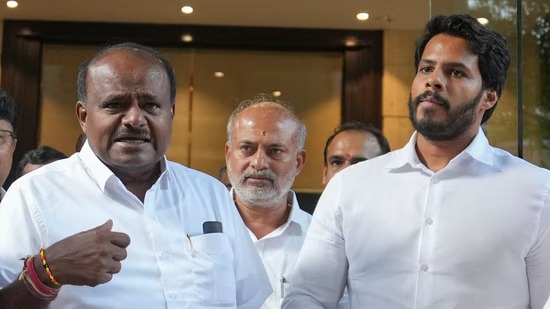
Bengaluru: JD(S) State President HD Kumaraswamy, who is Union Minister for Heavy Industries, is likely to pass the baton as state chief of the party to his son Nikhil Kumaraswamy. The party, therefore, is expecting a revamp after the Sankranti festival on January 14, sources in the JD(S) have said.
The JD(S) will organize a meeting, chaired by HD Kumaraswamy, in the second week of January, and elect the new state president on the occasion. Other issues, including strengthening the party in order to regain its hold over the Old Mysore region as well as parts of North Karnataka, will also be discussed, Deccan Herald has reported.
Incidentally, the senior leaders of the party too are likely to elect Nikhil Kumaraswamy as the new state president of the party, as they wish JD(S) to have more young leaders and attract more youngsters into the party. The seniors, however, have opined that Nikhil Kumaraswamy, who failed in electoral politics, has toured seven districts, but needs to hone his organizing skills.
“There are young legislators and leaders in the party. Their capabilities and network at the grassroots level will be utilized well to strengthen the party at the base,” sources said added. Young legislators like Harish Gowda, Sharanagouda Kandakur, Swaroop Prakash and Samrudhi Manjunath are gaining prominence in the political field, and also backed Nikhil at booth level during the polls. The JD(S), therefore, wishes to utilize their capabilities, the party sources added.
Referring to the support of the Lingayat community in North Karnataka, the sources said that the leaders plan to appoint Sharanagouda Kandakur as the president of Youth Janata Dal, which is now led by Nikhil.
Further, Harish Gowda, MLA from Hunsur constituency, is found to be close to Nikhil although his father and senior legislator of the JD(S) GT Deve Gowda has been maintaining a distance from the party.
Admitting that the party is accused of favouring family politics, the sources have clarified that the JD(S) leaders plan to appoint three working presidents and include members belonging to SC/ST communities and minorities. “The aim is to prove our potential in the upcoming zilla panchayat and taluk panchayat elections,” said a senior JD(S) leader.
Planning to undertake work at grass-root level, the JD(S) is likely to hold elections for the appointment of district and taluk-level leaders for the party.
Let the Truth be known. If you read VB and like VB, please be a VB Supporter and Help us deliver the Truth to one and all.
Talks with Iran ended after 21 hours without reaching agreement, says US Vice President Vance
_vb_41.jpeg)
Islamabad (PTI): US Vice President JD Vance said on Sunday that the Islamabad Talks with Iran failed as the two sides could not bridge the gulf of differences despite hectic efforts spreading more than 21 hours.
Vance addressed a press conference here after “substantive discussions” in direct talks between the two sides -- the first since 1979 at this level --mediated by Pakistan.
“We have been at it now for 21 hours, and we have had a number of substantive discussions, that’s the good news,” Vance said.
“The bad news is that we have not reached an agreement,” he added.
“We have made very clear what our red lines are, what things we are willing to accommodate them on and what things we are not,” the US vice president said, adding that the Iranian delegation had “chosen not to accept our terms”.
He was asked to elaborate the main sticking points of what did the Iranians reject but he refused to go into specifics.
“I won’t go into all the details because I don’t want to negotiate in public after we negotiated for 21 hours in private. But the simple fact is that we need to see an affirmative commitment that they will not seek a nuclear weapon and that they will not seek the tools that would enable them to quickly achieve a nuclear weapon,” Vance said
He said stopping Iran from getting a "nuke" was the “core goal of the US president, and that’s what we have tried to achieve through these negotiations”.
Vance also praised Pakistan Prime Minister Shehbaz Sharif and Chief of Army Staff Field Marshal Asim Munir, terming them “incredible hosts”.
“Whatever shortcomings were in the negotiations were not because of Pakistanis, who did an amazing job and really tried to help us and the Iranians bridge the gap and get to a deal,” he said.
Separately, the spokesperson for Iran’s Ministry of Foreign Affairs, Esmaeil Baqaei, in an X message also confirmed that the two sides failed to make a deal and “numerous messages and texts have been exchanged between the two sides".
“In the past 24 hours, discussions were held on various dimensions of the main negotiation topics, including the Strait of Hormuz, the nuclear issue, war reparations, lifting of sanctions, and the complete end to the war against Iran and in the region,” he wrote.
“The success of this diplomatic process depends on the seriousness and good faith of the opposing side, refraining from excessive demands and unlawful requests, and the acceptance of Iran’s legitimate rights and interests.”
Baqaei also expressed appreciation to the “government and the warm-hearted and noble people of the Islamic Republic of Pakistan for hosting the negotiations and their benevolent efforts in advancing this process”.
_vb_48.jpeg)
_vb_17.jpeg)