Karnataka cabinet okays govt jobs for sportspersons winning medals in international tourneys
Bengaluru, Dec 8: The Karnataka Cabinet on Thursday gave its nod to offer government jobs to those sportspersons who win medal in the international tournaments.
The jobs would range from Class-A to Class-D depending on their educational qualification.
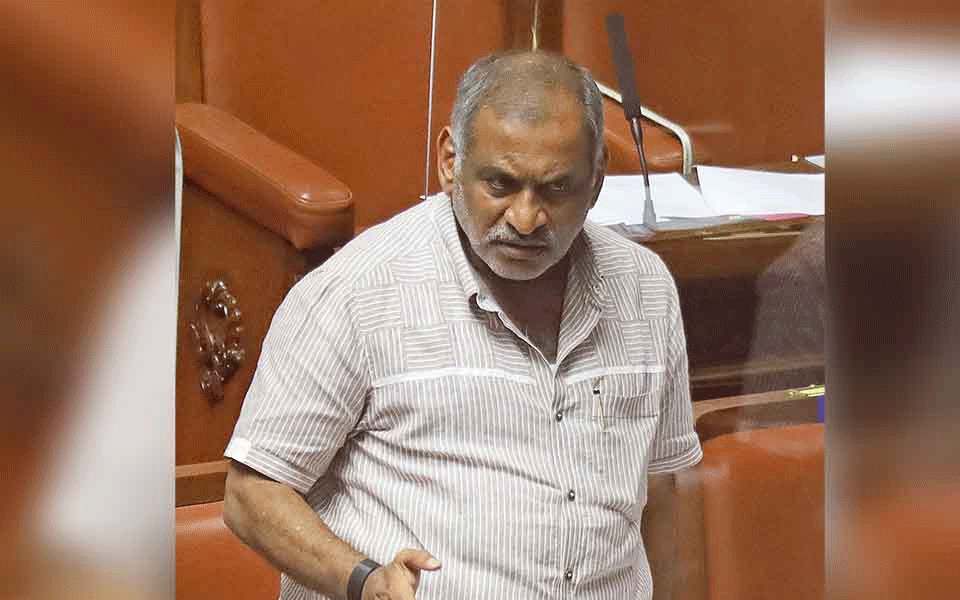
"To encourage sportspersons who win medals in international sports, government jobs are for the taking. A committee will be formed through which jobs will be given to the sportspersons from Group-A to Group-C and Group-D," Karnataka Law and Parliamentary Affairs Minister J C Madhuswamy told reporters after the Cabinet meeting.
He said those who win medals in Olympics or Paralympics and Common Wealth Games possessing a bachelor's degree would get a job in the Group-A category whereas medalists with a bachelor's degree in Asian would get Group-B post.
The medalists possessing lower than a bachelor's degree would get any of the Group-C or Group-D post, Madhuswamy said.
"We are not compromising with educational qualification. We are giving an age relaxation of 10 years," the Minister explained.
He added that those sportspersons getting Group-A job would get the Assistant Commissioner's post while the Group-B post would be equivalent to Tahsildar's.
The Cabinet gave administrative approval to the revised estimated cost Rs 23,251.66 crore of the Yattinahole Drinking Water Scheme, Madhuswamy said adding that when the scheme was started, its estimated cost was Rs 12,000 crore. As the time lapsed, it has now escalated Rs 23,251.66 crore.
"The cost escalation happened due to land acquisition and increase in construction material cost," the Minister said.
The government also decided to give 20 sheep and a ram to 20,000 shepherds across the State under the Amrit Swabhimani Kuri (sheep) Yojana' worth Rs 354.5 crore.
Administrative approval was also granted today to purchase 921 electric buses for the Bangalore Metropolitan Transport Corporation (BMTC) with the financial assistance of Centre under its FAME 2 scheme from Convergence Energy Services Limited (CESL), Madhuswamy said.
He added that the Centre gives Rs 39.08 lakh for each bus. The Cabinet also gave its nod to reserve Rs 100 crore to meet the difference of cost.
Madhuswamy said the Cabinet gave its nod to the Karnataka Electricity Corporation Limited to get loan from banks or any financial institution to get loan up to Rs 3,000 crore for the year 2022-23.
Further, it decided to provide a grant of Rs 8,064 crore and adjustment to improve the financial health of the electricity supply companies and to minimise their losses, the Minister said.
"We could not provide them (ESCOMs) adequate funds since 2002 to till now. Due to which their arrears grew. So, we decided to reduce it. There were arrears of Rs 15,219 crore as on March 31, 2022. To enable the ESCOMs for further fund-raising, we are giving government guarantee to take loans," he said.
The Cabinet gave nod for the public-private partnership to invest Rs 4,000 crore in the 1,000 Mega Watt grid based pump hydro storage electricity scheme through the Power Company of Karnataka Limited.
Under the scheme, solar and wind power would be utilised and water would be stored. The water would be lifted and circulated on the turbine to generate hydro-electric power. This is aimed at meeting power requirement, the Minister explained.
"For this scheme, we are calling tenders to the tune of Rs 4,000 crore," Madhuswamy said.
The Channagiri Taluk hospital capacity would be increased from 100 beds to 250 beds in Davangere district for which Rs 26.5 crore would be spent, the Minister said.
The Cabinet also sanctioned the Bengaluru North University at Amaravati village in Jangamkote Hobli of Shidlaghatta Taluk to build administrative and academic block on their campus utilising their own funds of Rs 88 crore, Madhuswamy told reporters.
Under the Azadi Ka Amrit Mahotsav', the government decided to release 42 eligible prisoners on January 26, 2023, he added.
An amendment to the Karnataka State Civil Services Rules was also approved where the government servants would now be permitted to file their investment details by the end of financial year instead of December, the Minister said.
The Cabinet also gave nod to various road and drinking water projects.
Let the Truth be known. If you read VB and like VB, please be a VB Supporter and Help us deliver the Truth to one and all.
UP court rejects plea seeking Rahul Gandhi's voice sample in defamation case
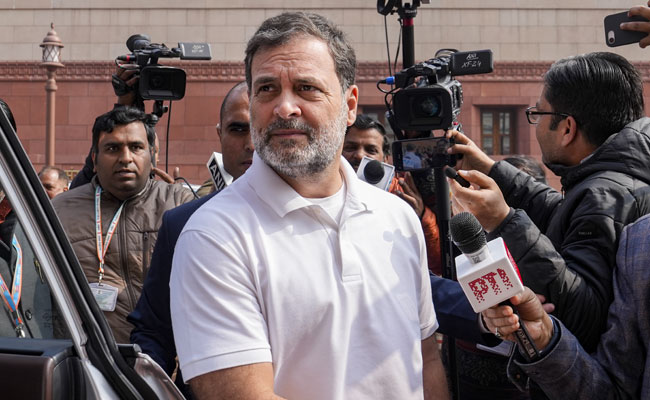
Sultanpur (UP) (PTI): A local MP/MLA court on Saturday rejected a plea seeking a voice sample of Rae Bareli MP Rahul Gandhi in a defamation case filed by a BJP functionary against the Congress leader, and posted the matter for next hearing on May 11.
The plea, filed by BJP leader Vijay Mishra through his counsel Santosh Kumar Pandey, had sought Gandhi's voice sample for a forensic test to compare it with an audio clip.
After the petition was dismissed, Pandey said they would file a revision plea before the sessions court against the order.
The court rejected the plea after hearing the arguments of both sides, including Gandhi's counsel Kashi Prasad Shukla.
The matter dates back to 2018 when Mishra, a local BJP leader, filed a defamation suit over Gandhi’s alleged objectionable remarks targeting Amit Shah while campaigning for the Karnataka Assembly elections.
After five years of legal proceedings, the court issued a warrant against Gandhi in December 2023.
The Rae Bareli MP surrendered before the court in February 2024, and was granted bail on two sureties of Rs 25,000 each by a special magistrate.
On July 26 last year, the Congress leader recorded his statement before the court, claiming innocence and calling the case a political conspiracy.
Earlier this year, multiple hearings were postponed due to a strike by lawyers and the ill-health of Gandhi’s counsel.