Karnataka CM Siddaramaiah invites KCR to his state to see Congress guarantees being implemented
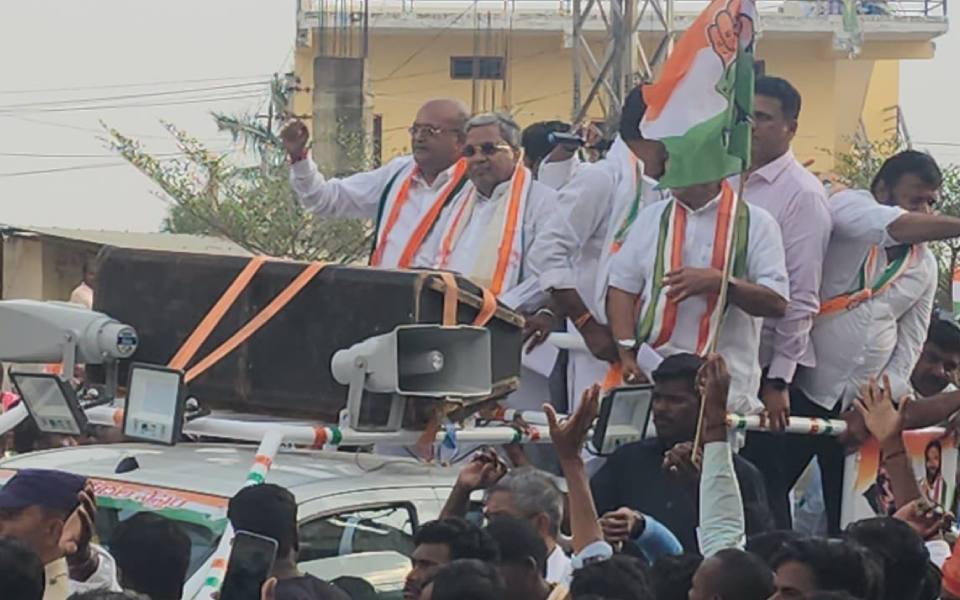
Hyderabad, Nov 26: Karnataka Chief Minister Siddaramaiah on Sunday invited his Telangana counterpart K Chandrasekhar Rao to visit his state to see how the five guarantee schemes of the Congress government have been implemented -- dismissing Rao's allegations that the party did not fulfil its poll promises.
Expressing confidence that the Congress would form the next government in Telangana and implement the six poll guarantees given to the state's people, he said KCR (K Chandrasekhar Rao) is going to lose power in the assembly elections.
Siddaramaiah said he saw media reports about the allegations made by Chandrasekhar Rao, his son K T Rama Rao and some BJP leaders that the Congress government in Karnataka has not implemented the five guarantees it gave to the people ahead of the May assembly polls that it won there.
He said these allegations are being made in view of the elections by the rival parties.
"The allegations made by opposition parties, these are all false allegations. The BRS party is lying and Chandrasekhar Rao is lying. Because he knows that he is going to lose the power (in the assembly elections)," Siddaramaiah told reporters here.
"When I came here earlier (as part of campaigning), I gave an open invitation to Chandrasekhar Rao to come to Karnataka and discuss with us and verify the documents. But, he did not come. Even today I will ask Chandrasekhar Rao: Please come to Karnataka and don't make such allegations unnecessarily for election purposes," Siddaramaiah said.
"You can verify...I don't know why they are telling lies. I can understand if Chandrasekhar Rao makes statement that the guarantees are not being implemented because he is facing the elections -- and for the purpose of elections he is saying lies and his son is also telling lie. I don't know why others are telling lies," he said.
Siddaramaiah said he was sure that the Congress will win the Telangana assembly elections.
"Congress will, 100 per cent, come to power in Telangana and all the six guarantees that have been promised will be implemented. Nobody should doubt it," he said.
On the Congress's five guarantees in Karnataka, he said the first guarantee 'Shakthi' scheme, providing free bus travel for women, wasimplemented in June and it has logged over 100 crore rides recently.
On the 'Anna Bhagya' scheme which was to provide 10 kg rice for free, Siddaramaiah said the Food Corporation of India refused to supply the additional five kg rice under "pressure" from the Centre and hence his government was paying cash instead of the five kg rice promised to each beneficiary through Direct Benefit Transfer (DBT) since July.
Siddaramaiah further said the 'Gruha Jyothi' scheme, which promises 200 units of free electricity to households, started in July.
Regarding 'Gruha Lakshmi' scheme, which provides Rs 2,000 per month to the women head of the families, he said the scheme started in August and 1.14 crore beneficiaries have been covered so far and registration is continuing.
Siddaramaiah said the fifth guarantee 'Yuva Nidhi' scheme, (Rs 3,000 every month for unemployed graduate youth and Rs 1,500 for diploma holders) offering unemployment allowances, will commence in January 2024.
These schemes require about Rs 38,000 crore for this year and already budget allocation has been made, he said.
There is no question of cheating the people at all, he said adding that the Congress party never cheated the people. "Whatever promises Congress party made in its manifesto and also the five guarantees, we are implementing and we are going to implement," he said.
He said all the developmental works are also going on and there is no dearth of funds to carry them out.
Dismissing the charge that Karnataka would become bankrupt due to the guarantee schemes, Siddaramaiah said, "The economy of Karnataka is very good and sound and we are implementing all the promises made to the people of Karnataka".
When asked about senior BJP leader and former Karnataka CM B S Yediyurappa's accusation that Congress was deceiving the people by not implementing its five pre-poll guarantees after coming to power, Siddaramaiah said he (Yediyurappa) is "frustrated and making false statements".
Reacting to a comment on reports that Karnataka farmers were staging protests in Telangana, he said, "They are not Karnataka farmers, I know that. No farmer from Karnataka came to Telangana; why will they come and protest here?".
Responding to another query, he said "We have fulfilled five guarantees in the first phase and also 76 promises. A manifesto is always for five years and at once (in one go) we cannot implement all the promises".
Let the Truth be known. If you read VB and like VB, please be a VB Supporter and Help us deliver the Truth to one and all.
CM Siddaramaiah alleges ‘criminal conspiracy’ in Sringeri recount, vows legal action
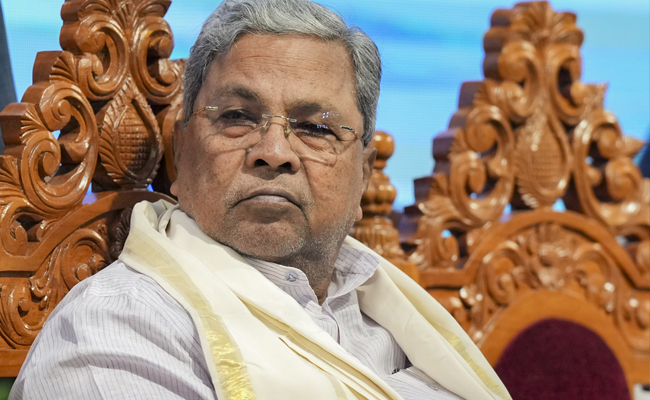
Bengaluru (PTI): Alleging a “criminal conspiracy” by BJP candidate D N Jeevaraj in the Sringeri Assembly poll recounting, Karnataka CM Siddaramaiah on Tuesday said the outcome was manipulated after valid postal ballot votes in favour of Congress leader T D Raje Gowda were tampered with during the recounting process.
Following a Karnataka High Court order on an election petition filed by Jeevaraj, challenging Raje Gowda’s election, the reverification and recounting were conducted on Saturday.
After the reverification and recount of postal ballots for the Sringeri Assembly constituency, votes polled in favour of Raje Gowda were reduced by 255, the returning officer said.
A report on the matter has been submitted to the Election Commission of India for further action, the officer added.
Congress leader Raje Gowda had won the 2023 Assembly polls from Sringeri by 201 votes, defeating his nearest rival Jeevaraj.
Addressing a press conference in Bengaluru, Siddaramaiah said the High Court had directed the recounting of postal ballots and that irregularities were noticed during the exercise conducted on May 2.
“This is a clear case of criminal conspiracy,” Siddaramaiah said, alleging that valid votes cast in favour of Raje Gowda were altered after being accepted by counting agents of all parties, including Congress, BJP, and JD(S).
He claimed that during the recounting of postal ballots, 255 votes were initially accepted as valid by all agents but were later tampered with by subordinate officials.
“There is a second mark on the votes polled in favour of Raje Gowda. They had accepted these as valid votes. Subsequently, another mark was made by officials. This is a clear case of criminal conspiracy,” he said.
When asked who was behind the alleged conspiracy, the CM replied, “It was hatched by Jeevaraj and others. It is planned.”
Siddaramaiah further alleged that the returning officer acted improperly by declaring the result despite the presence of an Election Commission observer during the recounting.
“Immediately after the counting, the returning officer announced the result. He should not have done so; this is against the law,” he said.
He pointed out that Raje Gowda had originally won by 201 votes, but after the recounting, the BJP candidate was declared the winner by 52 votes.
“The BJP has committed a criminal act of conspiracy. This is not vote chori but vote dacoity,” he alleged.
The CM said a police complaint had already been filed by Raje Gowda’s election agent, Sudhir Kumar, and emphasised the need for electoral integrity.
“We want transparency and free and fair elections. That is what our Constitution mandates,” he added.
Stating that the government would pursue legal remedies, Siddaramaiah said, “We are preparing an appeal challenging the returning officer’s announcement in a court of law.”
Responding to a separate query on elections in other states, the CM said there appeared to be an anti-incumbency factor in West Bengal, while results in Tamil Nadu were “surprising,” adding that Vijay’s party was emerging as the largest there.
Following the victory of party candidates in Bagalkote and Davanagere South, Siddaramaiah expressed confidence about future electoral prospects in Karnataka.
“Even in 2028, we will win the Assembly elections. We will come back,” the CM said.
Siddaramaiah added that he would order a forensic examination into the alleged tampering of postal ballots.