Karnataka govt approves purchase of new cars for 33 ministers for 10 crores; BJP reacts
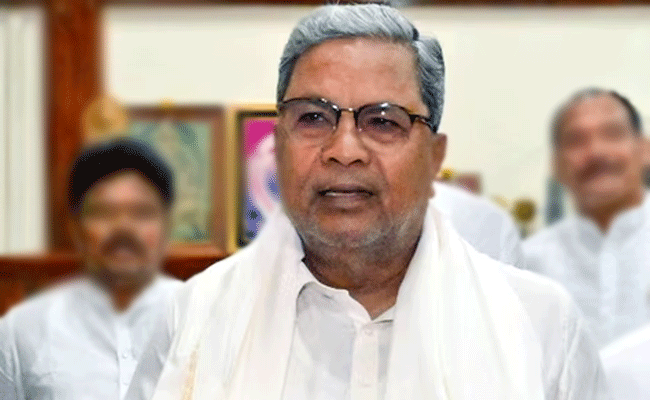
Bengaluru: In a move that has drawn criticism, the Karnataka government has decided to purchase 33 hybrid vehicles of the Toyota Innova Hycross model for its ministers. Each of these multi-purpose vehicles (MPVs) costs approximately Rs 30 lakh, resulting in an expenditure of around Rs 10 crore for the exchequer.
Chief Minister Siddaramaiah approved the purchase of these hybrid vehicles, which are claimed to be the world's first fully ethanol-powered cars equipped with flex-fuel engines. The government placed the order shortly after the model's launch on August 29.
This decision has come under scrutiny from the Bharatiya Janata Party (BJP), which has accused the Congress-led government of prioritizing the acquisition of high-end vehicles for ministers while the state grapples with severe drought conditions.
Notably, Chief Minister Siddaramaiah had already been allotted a Toyota Fortuner about two months ago. To procure the new cars for ministers, the government has invoked the 4G exemption clause, as per an order issued on August 17.
The order states: "Toyota Kirloskar motor company, Bengaluru, will be approached directly with exemption under section 4G of the Karnataka Transparency in Public Procurement (KTPP) Act of 1999 through the department of personnel and administrative reforms (DPAR). For good quality services under acceptable rates, DPAR is vested with the powers to procure them."
According to the KTPP Act, the 4G exemption can be sought by the government whenever there is a "natural calamity or emergency declared by the government...in respect of specific procurements, as may be notified by the government from time to time."
Government sources have indicated that the decision to purchase new vehicles is based on a norm stipulating that the vehicle should either have covered 1 lakh kilometers or completed three years on the road. "Since three years, no vehicle has been purchased for ministers. The last one was bought in 2020 during the tenure of former CM BS Yediyurappa," explained government officials.
Officials from the Department of Personnel and Administrative Reforms (DPAR) noted that procuring new vehicles is a "convention" when a new government assumes power. "When we have new ministers, it is a convention that the CM authorizes the purchase of new vehicles for comfortable travel of ministers across the state," said a DPAR official.
BJP MLA CN Ashwath Narayan criticized the move, stating, "The government is facing problems related to funds and should be more responsible when it comes to such expenses. The government has completed 100 days but is still struggling to arrange funds to take up development works," he alleged.
Let the Truth be known. If you read VB and like VB, please be a VB Supporter and Help us deliver the Truth to one and all.
Women BJP MLAs protest against opposition in UP assembly premises
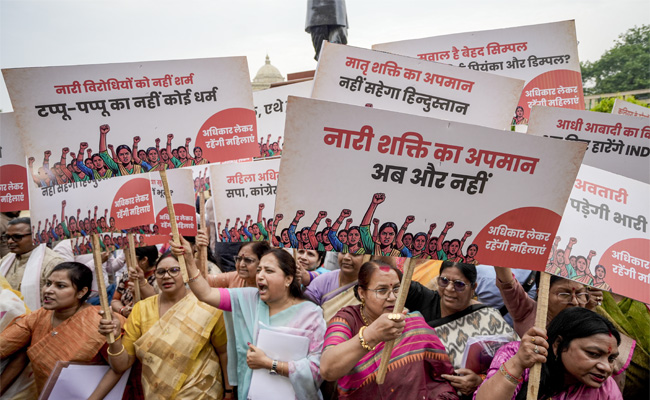
Lucknow (PTI): Women BJP MLAs held a protest in the Vidhan Bhawan complex before the one-day special session of Uttar Pradesh assembly, slamming the opposition for defeating the passage of a bill, which would have led to implementation of the Women's Reservation Law, in the Lok Sabha.
This followed another demonstration by Samajwadi Party MLAs, who alleged that the BJP was misleading public in the name of women's reservation.
The women BJP legislators assembled in front of Chaudhary Charan Singh's statue in the assembly premises, holding banners inscribed with the slogan "Insult to Matrushakti (women's power), India will not tolerate it". The protesting members entered the main hall of Vidhan Bhawan carrying the banners.
Participating in the protest, the state Minister for Women Welfare and Child Development, Baby Rani Maurya, told reporters that all opposition parties, including the Samajwadi Party and the Congress, had opposed the women's reservation, a stance for which they would have to pay a heavy political price.
"On this issue, all of us women stand united. We will ensure that we secure our reservation," she said.
BJP MLA Ketki Singh remarked that their protest represents the collective outrage of millions of women across the state.
Singh asserted that the opposition has betrayed women by creating hurdles in the path of women's reservation. The current demonstration is merely the beginning, and very soon, women from every street, intersection and household will join the protest movement, she said.
Minister Vijaylakshmi Gautam said, "We strongly condemn the despicable act committed by the Samajwadi Party and the Congress in an attempt to hold back 'half the population' (women). Their action was directed against the very bill that Prime Minister Narendra Modi had introduced to empower and strengthen Nari Shakti (women's power), and which he strived to pass expeditiously."
Uttar Pradesh assembly is holding a one-day special session on Thursday. During the session, the government is set to move a censure motion against the opposition parties over their failure to pass the Constitution Amendment Bill, which would have led to implementation of the Women's Reservation Act, in the Lok Sabha.