Karnataka waiting to oust BJP government: Surjewala after Cong's victory in local body polls
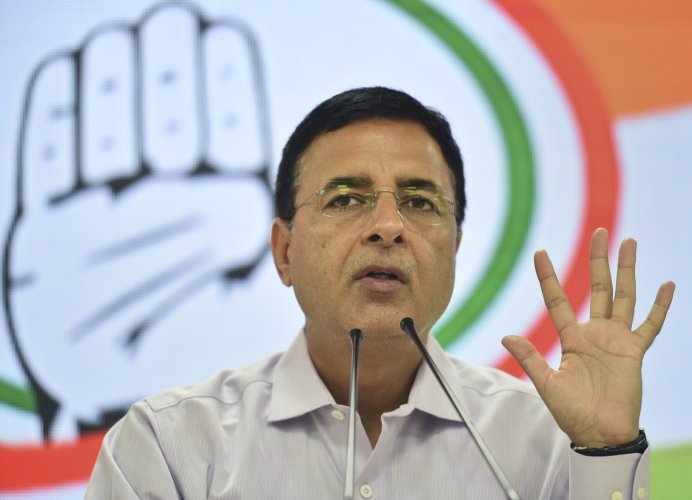
New Delhi, Dec 30: The Congress on Thursday said its victory in the Karnataka local body polls is a clear indication that issues such as anti-conversion laws do not strike a chord with the people of the southern state, who are "waiting to throw out the BJP government".
"It is evident from recent by-election results that people are waiting to throw out the illegitimate and corrupt BJP government that has eclipsed progress and paralysed governance," Congress general secretary Randeep Singh Surjewala said in a statement here.
He said the vote share in the Karnataka local body polls also indicates a huge slide in the Bharatiya Janata Party's (BJP) popularity in the state.
"The vote share of Congress came up to 42.06 per cent, where as for BJP and JD(S), it stood at 36.9 per cent and 3.8 per cent respectively," Surjewala, who is the in-charge of Congress affairs in Karnataka, said.
He said successive election results of late have clearly established that the voters care the most about price rise, falling incomes, jobs, rampant corruption and the BJP government's apathy towards public welfare.
"Manufactured issues like anti-conversion laws and management of temples are not what people are going to be taken in with.
"Progressive Kannadigas realise that such issues are meant to serve no one but divisive forces. Every second that the spurious and corrupt Bommai government continues, it is an anathema to development and progress," Surjewala said.
In the elections to 58 urban local bodies, Surjewala said Congress emerged victorious in 500 wards, against the 435 won by the ruling BJP. The JD(S) bagged only 45 wards.
Surjewala congratulated Karnataka Congress chief D K Shivakumar, CLP leader Siddaramaiah, the MLAs and all senior leaders of the party on the electoral outcome.
"Their continued hard work and unity in action will bring the Congress back to power in the state and usher in a new era of putting Karnataka as the number one state in development," he said.
Let the Truth be known. If you read VB and like VB, please be a VB Supporter and Help us deliver the Truth to one and all.
Ordinance issued to increase number of Supreme Court judges from 34 to 38
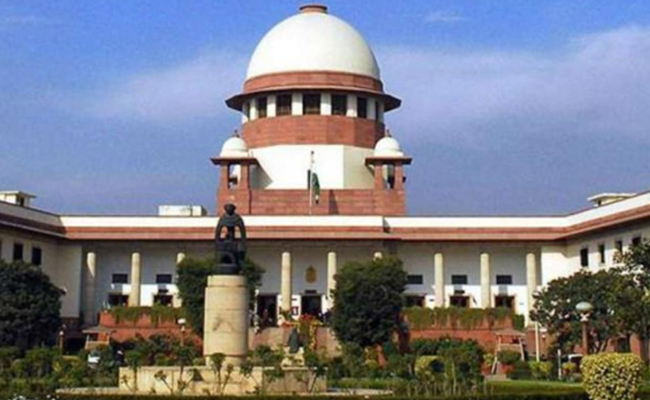
New Delhi (PTI): The government has promulgated an ordinance to increase the strength of the Supreme Court from the present 34 judges to 38, including the Chief Justice of India.
The law ministry notified the ordinance on Saturday, which amended the Supreme Court (Number of Judges) Act, 1956, to increase the sanctioned strength of the top court.
So far, the sanctioned strength of the top court was 34, including the Chief Justice of India (CJI). Now, the number of judges has been increased by four, taking the sanctioned strength to 38.
The top court will now have 37 judges, other than the CJI.
With the apex court having two vacancies at present, and the ordinance coming into force immediately, the Supreme Court Collegium will now have to recommend six names for appointment as judges in the top court.
A bill will be brought in the Monsoon Session of Parliament to convert the ordinance – an executive order – into a law passed by Parliament.
The Union Cabinet had cleared a draft bill on May 5 to increase the number of apex court judges.
The strength of the Supreme Court was last increased from 30 to 33 (excluding the CJI) in 2019.
The Supreme Court (Number of Judges) Act, as originally enacted in 1956, put the maximum number of judges (excluding the CJI) at 10.
This number was increased to 13 by the Supreme Court (Number of Judges), Amendment Act, 1960, and to 17 by another amendment to the law.
The Supreme Court (Number of Judges) Amendment Act, 1986, augmented the strength of judges from 17 to 25, excluding the CJI.
A fresh amendment in 2009 further increased the strength from 25 to 30.
Article 124(3) of the Constitution lists the qualifications required to become a Supreme Court judge.
An Indian citizen who has either served as a high court judge for at least five years, or as an advocate for 10 years, or is a distinguished jurist, can be appointed to the top court.
The strength of the Supreme Court is increased based on the recommendations of the CJI, who writes to the Union law minister. After consulting the finance ministry, the Department of Justice under the law ministry moves the Cabinet with a draft bill.