Mysuru woman’s parents, sister die by suicide after she elopes with boyfriend

Mysuru: In a tragic incident, a couple and their younger daughter allegedly died by suicide in Mysuru after their elder daughter eloped with her boyfriend.
The deceased have been identified as Mahadeva Swamy (55), his wife Manjula (45), and their daughter Harshitha (20), residents of Budanur village in HD Kote taluk, as reported by The Indian Express on Monday.
Swamy's elder daughter had confided in her family about her relationship with a youth. After facing objections from her parents, she fled with her boyfriend on Friday and later called to inform them of her intention to marry him. The news of the elopement quickly spread through the village, TIE quoted officers as saying.
Devastated by the turn of events, Swamy and his family made their way to the Hebbal reservoir around 4:00 a.m. on Saturday, leaving behind a four-page suicide note. In the note, Swamy stated that the family property should not be shared with his estranged daughter.
“We do not want her to attend the funeral. We are responsible for our death. All the property must be transferred to my brother,” the note reportedly read.
When Swamy and his family were found to be missing, relatives and villagers began a search. During their efforts, locals spotted a two-wheeler parked near the reservoir. Further investigation revealed three pairs of slippers on the banks, raising concerns about their whereabouts.
Police were notified, and they, in turn, alerted fire services to assist in the search. After a search operation, the bodies of all three family members were recovered from the reservoir, the report added.
(Assistance for overcoming suicidal thoughts is available on the state’s health helpline 104, Tele-MANAS 14416.)
Let the Truth be known. If you read VB and like VB, please be a VB Supporter and Help us deliver the Truth to one and all.
Ordinance issued to increase number of Supreme Court judges from 34 to 38
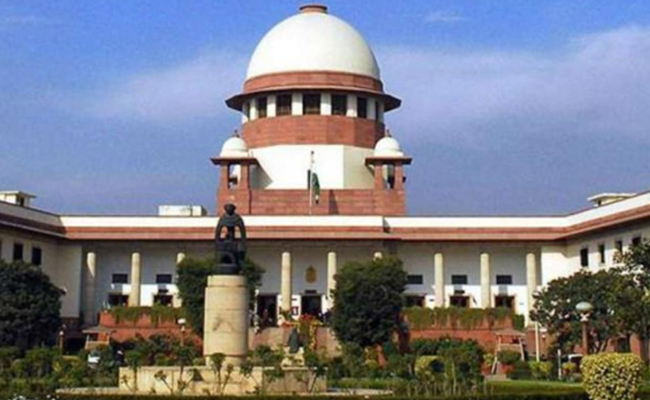
New Delhi (PTI): The government has promulgated an ordinance to increase the strength of the Supreme Court from the present 34 judges to 38, including the Chief Justice of India.
The law ministry notified the ordinance on Saturday, which amended the Supreme Court (Number of Judges) Act, 1956, to increase the sanctioned strength of the top court.
So far, the sanctioned strength of the top court was 34, including the Chief Justice of India (CJI). Now, the number of judges has been increased by four, taking the sanctioned strength to 38.
The top court will now have 37 judges, other than the CJI.
With the apex court having two vacancies at present, and the ordinance coming into force immediately, the Supreme Court Collegium will now have to recommend six names for appointment as judges in the top court.
A bill will be brought in the Monsoon Session of Parliament to convert the ordinance – an executive order – into a law passed by Parliament.
The Union Cabinet had cleared a draft bill on May 5 to increase the number of apex court judges.
The strength of the Supreme Court was last increased from 30 to 33 (excluding the CJI) in 2019.
The Supreme Court (Number of Judges) Act, as originally enacted in 1956, put the maximum number of judges (excluding the CJI) at 10.
This number was increased to 13 by the Supreme Court (Number of Judges), Amendment Act, 1960, and to 17 by another amendment to the law.
The Supreme Court (Number of Judges) Amendment Act, 1986, augmented the strength of judges from 17 to 25, excluding the CJI.
A fresh amendment in 2009 further increased the strength from 25 to 30.
Article 124(3) of the Constitution lists the qualifications required to become a Supreme Court judge.
An Indian citizen who has either served as a high court judge for at least five years, or as an advocate for 10 years, or is a distinguished jurist, can be appointed to the top court.
The strength of the Supreme Court is increased based on the recommendations of the CJI, who writes to the Union law minister. After consulting the finance ministry, the Department of Justice under the law ministry moves the Cabinet with a draft bill.