K'taka: Cong warns of action against leaders airing remarks on cabinet reshuffle, leadership change
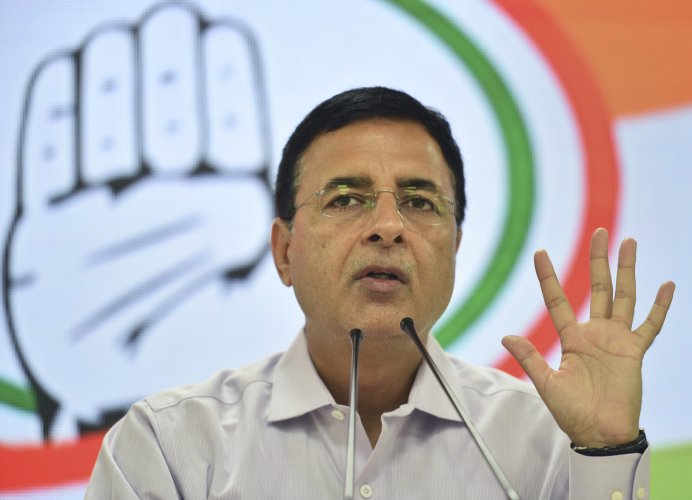
Bengaluru, Nov 1: Cracking the whip on party legislators, leaders and Ministers against making open remarks on issues such as cabinet reshuffle and leadership change, Congress General Secretary in-charge of Karnataka Randeep Singh Surjewala on Wednesday warned of action against those violating party discipline.
He spoke to reporters after a meeting with AICC General Secretary (Organisation) K C Venugopal, state Congress (KPCC) President D K Shivakumar, and Chief Minister Siddaramaiah, regarding issues related to the party, and the government in the state and preparations for 2024 Lok Sabha polls.
"We have briefly discussed the issue of various statements that were made by some of our Ministers and MLAs and I have told KPCC President -- anybody falling out of party line, we have warned and I again warn very clearly and categorically -- no Minister, no MLA, no party leader should be violating the party discipline," Surjewala said.
After a two-and-half hour long meeting at the state Congress headquarters here, he said anybody who does so, is doing a huge disservice to the party, and if anybody does not fall in line, then the party would have to think of taking appropriate action.
"We want the entire state cadre, be it block Congress President, district President, frontal organisation, MLA, MLA candidates who could not make it, Ministers and other functionaries in the government, to always look at adhering to party discipline and ensure that the party's agenda is implemented," he said, adding that this has been conveyed in no uncertain terms and "if necessary we will have to crack the whip."
Certain recent developments in the state Congress indicate that all is not well within the ruling party that swept to power by ousting BJP with a thumping majority in 2023 Assembly polls held in May.
Suggesting any one with difference of opinion are welcome to discuss with him and express, the AICC General Secretary said, they can also go to party General Secretary - Organisation, Congress national President or the Chief Minister and convey their opinion."But we will accept no public statements on that account."
Responding to a specific question on statements by certain MLAs bout cabinet reshuffle, he said, no party MLA is authorised to say such things, and what the party will do is within the party forum.
"There is a government in place and we are running that government efficiently and MLAs should be looking at development of their constituency and restrict themselves to look at the agenda of progress and development that the Congress party is setting out to do," he said, adding that having aspiration is always good and it is the duty of the party to ensure that everybody's aspirations are addressed and they get a role to play in the progress of the state.
Regarding remarks about CM or leadership change, Surjewala said they are completely out of line and that legislators and Ministers have been warned against it, saying it is not their duty or job.
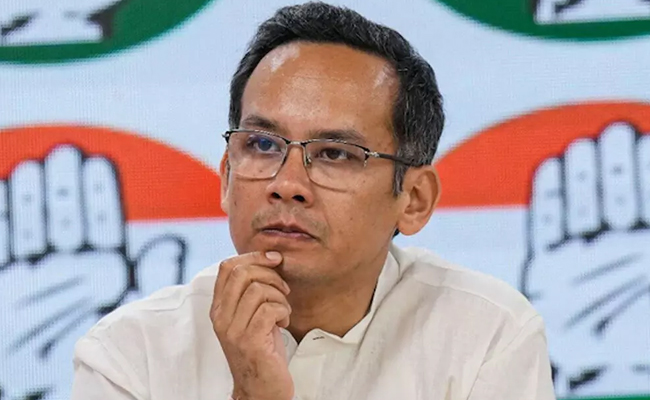
Congress' Mandya MLA Ravikumar Gowda's (Ravi Ganiga) recent claim that Deputy Chief Minister D K Shivakumar will become the CM after two-and-half years of the government's tenure, had created a buzz within the ruling party circles, with some Ministers asserting that incumbent Siddaramaiah will complete full term, and a few others saying it is for the high command to decide.
Debate about the possibility of cabinet reshuffle had come to fore, with government's Chief Whip in the Legislative Assembly Ashok Pattan recently claiming that Surjewala and Venugopal have assured him that there will be a Cabinet reshuffle after two-and-a-half years, in which senior leaders like him will be accommodated.
Also, recent developments such as Siddaramaiah's dinner meeting at Home Minister G Parameshwara's residence along with a couple of Ministers and PWD Minister Satish Jarkiholi -- who is said to be miffed -- reportedly planning a trip to Dubai along with 50 former and current legislators, and pitch for three more Deputy Chief Ministers -- have added to lot of speculations within the ruling Congress in the state.
Noting that issues of formation of various boards and corporations were discussed at today's meeting, Surejewala said two ot three more rounds of discussions are likely to be held in this regard, and the party is looking at appointing both party carders as well as legislators (both MLAs and MLCs) as heads of these bodies.
"The discussions will continue. I'm incharge of poll bound Madhya Pradesh currently. Elections will be over on November 17 there, and immediately I will be back here to carry forward the discussion on appointments to boards and corporations," he said.
Appointments to boards and corporations is said to be among the issues on which both Siddaramaiah and Shivakumar have certain differences of opinion, according to party sources.
Sharing details of the discussions regarding preparations for the ensuing Parliamentary elections, Surjewala said Karnataka is at the centre point of Congress party's strategy for LS polls, and both the Chief Minister and KPCC President have assured that the party will win more than 20 seats (out of total 28 LS seats in the state).
"We in fact hope to completely sweep the polls and raise the number to about 25 plus seats," he said.
The process of identifying the LS poll candidates must begin without any delay, and he will kickstart his tour of different constituencies after the five state polls conclude by the end of this month.
Averring that the party hopes that its guarantees which have been implemented will ensure party's victory in the Lok Sabha polls, he said, the KPCC President and the CM have been requested to identify the set of candidates, by calling meeting of -- legislators from each parliamentary constituency, district or block Congress committees, leaders of frontal organisations and other leaders -- to discuss possible candidates.
Reorganisation of the Pradesh Congress Committee was also deliberated at the meeting, the General Secretary said adding a proposal will soon be presented to Congress' national President Mallikarjun Kharge. After discussion with him, there will be a rejig, as many office bearers are MLAs or Ministers, and new younger talent should be given organisational responsibility by replacing them.
The meeting also briefly reviewed the Congress government's guarantee programme and how they are getting implemented on the ground, Surjewala said. It was pointed out that regular audit is going on and wherever there is a deficiency the concerned Minister and Ministry are addressing those issues, to ensure maximum beneficiaries are covered.
Let the Truth be known. If you read VB and like VB, please be a VB Supporter and Help us deliver the Truth to one and all.
Thunderstorm hits Lucknow, IMD issues red alert across multiple UP districts
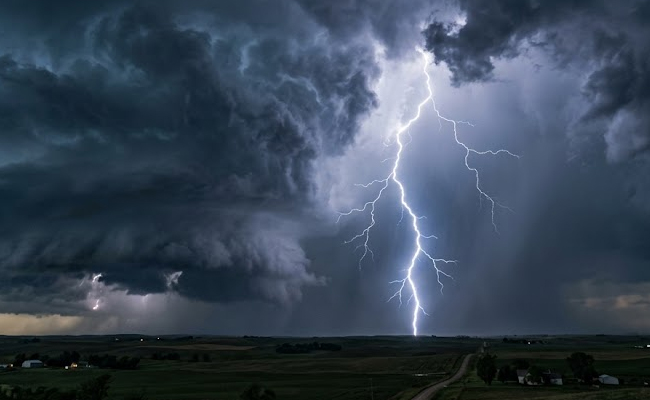
Lucknow: Shortly after the India Meteorological Department issued a red alert warning of severe weather conditions in the region, a sudden thunderstorm hit Lucknow and adjoining districts on Monday morning.
The Indian Express reported that the skies turned dark around 8:45 am as strong winds lashed parts of the city. Incidents of tree falls were reported from several locations, disrupting traffic and normal movement.
The weather department said thunderstorms accompanied by lightning, hail and gusty winds of 40 to 60 kmph are likely to continue over the next three hours across several districts.
A red alert has been issued for districts including Unnao, Barabanki, Hardoi, Sitapur, Bahraich, Gonda, Shravasti and Lakhimpur Kheri, where moderate thunderstorms with hail and strong winds may damage trees, power lines and temporary structures.
An orange alert is in place for Rae Bareli, Amethi, Kanpur Nagar, Ayodhya, Kanpur Dehat, Auraiya, Kannauj, Farrukhabad, Shahjahanpur and Balrampur, where thunderstorms with lightning and winds up to 60 kmph could lead to localised disruptions.
Major parts of the state remains under yellow alert, including districts such as Prayagraj, Agra, Bareilly, Aligarh and Moradabad, where light rain, lightning and winds of 30 to 40 kmph are expected.
Authorities have advised residents to remain indoors, avoid open areas and trees during lightning, and secure loose objects.