K'taka govt to implement 'e-RUPI' for cashless education scholarship fee payment

Bengaluru, Dec 28: The Karnataka government's e-Governance department has partnered with the National Payments Corporation of India (NPCI) and State Bank of India (SBI) for enabling and implementing 'e-RUPI', a cashless and contactless payment solution to students under its scholarship programme.
e-RUPI will be used to ensure a leak-proof delivery of education fees of eligible students by paying digitally to the college or institute by the Karnataka government.
The Karnataka government will get e-vouchers delivered to the mobiles of eligible students. The voucher code can be received on the feature phone also. The students will be able to redeem e-RUPI at the identified colleges or institutes for the intended purpose of fees payment, NCPI said in a release.
For redeeming e-RUPI, the identified institutes will scan the QR code or SMS string displayed by the students using an Application or POS machine, and this process will remove the requirement of any physical token delivery for the students to avail of the scholarship, it said.
"e-RUPI is indeed a very powerful tool for governments to use as it allows direct transfer of the benefits to the targeted beneficiary, with safety and security. The instrument ensures that the beneficiary gets the benefit as per the guidelines of the scheme. Under this initiative, each transaction is mapped with the beneficiary and the institution ensuring that the e-Voucher can be redeemed by the college where the student has enrolled," Additional Chief Secretary, DPAR (e-governance) Rajiv Chawla said.
The Karnataka government has on-boarded around 176 schemes of 35 departments of the state government on the Direct Benefit Transfer Platform.
Following the successful implementation of this pilot project, the state is examining the use of e-RUPI Voucher in other schemes such as seed distribution, fertiliser distribution, micro irrigation schemes, issue of laptops to students, and Imparting skilled training, the release said.
"We believe e-RUPI is a revolutionary initiative in the direction of ensuring a convenient and leak-proof delivery of schemes. This is a win-win for both students and colleges. While students receive the voucher, they can redeem it only for payment of fees to colleges/Institutes," NPCI Chief of Products Kunal Kalawatia said.
Let the Truth be known. If you read VB and like VB, please be a VB Supporter and Help us deliver the Truth to one and all.
Ordinance issued to increase number of Supreme Court judges from 34 to 38
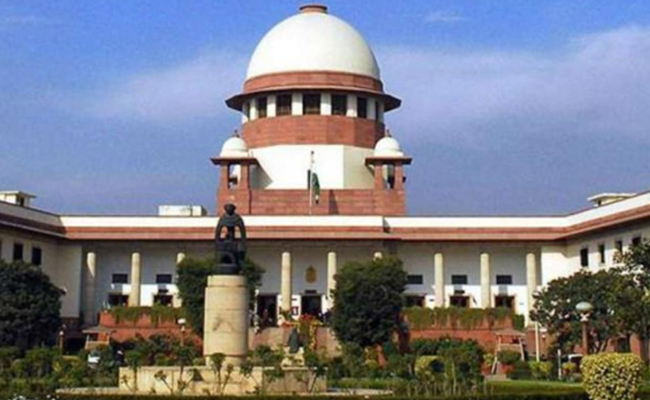
New Delhi (PTI): The government has promulgated an ordinance to increase the strength of the Supreme Court from the present 34 judges to 38, including the Chief Justice of India.
The law ministry notified the ordinance on Saturday, which amended the Supreme Court (Number of Judges) Act, 1956, to increase the sanctioned strength of the top court.
So far, the sanctioned strength of the top court was 34, including the Chief Justice of India (CJI). Now, the number of judges has been increased by four, taking the sanctioned strength to 38.
The top court will now have 37 judges, other than the CJI.
With the apex court having two vacancies at present, and the ordinance coming into force immediately, the Supreme Court Collegium will now have to recommend six names for appointment as judges in the top court.
A bill will be brought in the Monsoon Session of Parliament to convert the ordinance – an executive order – into a law passed by Parliament.
The Union Cabinet had cleared a draft bill on May 5 to increase the number of apex court judges.
The strength of the Supreme Court was last increased from 30 to 33 (excluding the CJI) in 2019.
The Supreme Court (Number of Judges) Act, as originally enacted in 1956, put the maximum number of judges (excluding the CJI) at 10.
This number was increased to 13 by the Supreme Court (Number of Judges), Amendment Act, 1960, and to 17 by another amendment to the law.
The Supreme Court (Number of Judges) Amendment Act, 1986, augmented the strength of judges from 17 to 25, excluding the CJI.
A fresh amendment in 2009 further increased the strength from 25 to 30.
Article 124(3) of the Constitution lists the qualifications required to become a Supreme Court judge.
An Indian citizen who has either served as a high court judge for at least five years, or as an advocate for 10 years, or is a distinguished jurist, can be appointed to the top court.
The strength of the Supreme Court is increased based on the recommendations of the CJI, who writes to the Union law minister. After consulting the finance ministry, the Department of Justice under the law ministry moves the Cabinet with a draft bill.