K'taka rights groups urge PM Modi to visit "sites of injustices" in Bengaluru, instead of roadshows
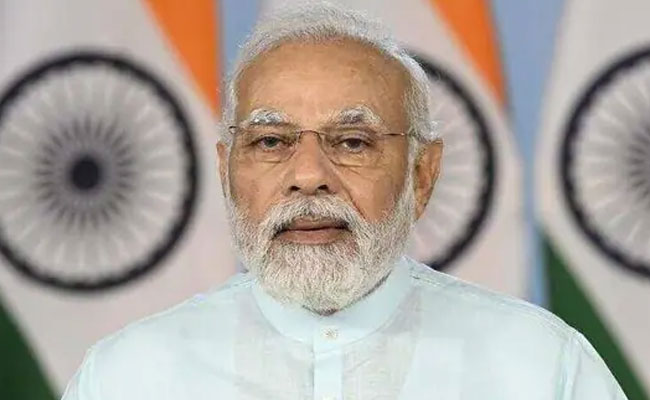
Bengaluru: As Prime Minister Narendra Modi gears up for a roadshow in Bengaluru as part of the BJP's election campaign, two rights groups in Karnataka have prepared an alternative route map known as the "citizens' route map." The groups, Bahutva Karnataka and Eddelu Karnataka, are urging the Prime Minister to avoid the roadshow and instead visit the "sites of injustices" in the city. According to the groups, the citizens' route map highlights the issues of marginalized communities and seeks to draw attention to the need for urgent action.
They have also called for Modi to conduct a 'Jan Ki Baat' press meet to engage with the public and address their concerns. The alternative route map comes in the wake of growing concerns about the BJP's election campaign and the party's approach to governance. Both Bahutva Karnataka and Eddelu Karnataka have been vocal in their criticism of the ruling party, accusing them of neglecting the welfare of marginalized communities and pursuing divisive policies.
Here is the full text of the route map:
Karnataka is having a state election. We will vote on what the current government has done and not done for the state. We do not know why your party is asking for votes in the name of the Prime Minister and not the Chief Minister. We do not know why you need to come do a road show here, for which lots of trees have had branches cut, street vendors prevented from doing business and roads blocked.
Given you are coming, we would like you to go to these spots.
Please follow the citizen’s route map and answer these questions.
Day 1 – Visit the sites of Injustice
Day 2- Stay in Freedom Park
Detailed Schedule
1) Shivaram Karanth layout – Ignoring the demands of farmers for fair compensation, Karnataka government destroyed standing crops. Gave notices to farmers preventing from protesting!
Q: How will you double the income of farmers when you won’t even let them farm?
2) ITI where workers were laid off for unionising, which is their right. This comes under your government and your minister turned a deaf ear.
Q: Why is the Contract Labour (abolition and regulation) Act 1970 not followed by your government?
3) Jayanagar BDA Complex – The BBMP violated the Street Vendors Act 2014 by evicting 300+ vendors without even giving notice? Not just that , the government has refused to conduct a survey of street vendors.
Q: Why does your government refuse to protect the rights of Street Vendors?
4) Ejipura EWS quarters where the Yeddyurappa government gave this land on a platter to BJP MLA Mr. Garudachar who has still failed to construct houses. The Lokayukta recommended to the BBMP to take back the land but the government has not done so.
Q: Why is your government helping builders at the cost of slum dwellers?
5) Electronic City – In the Electronic city police station limits, terrorist Puneeth Kerehalli used a stun gun on a citizen and broadcast it live. Yet no action was taken.
Q: Does your government not believe in rule of law? Can anyone use stun guns publicly?
Lunchbreak : You can have lunch at the closest Indira canteen you get and answer why the state government has cut funds for this pro-poor canteen
6) Majestic bus stand. Please ask bus commuters about the troubles they face. In 2018 your party manifesto promised doubling of bus fleet. Instead out of the 6500 buses, only 5600 are on road as your government has stopped hiring of drivers.
Q: Does your government want to weaken or strengthen BMTC?
7) Cottonpet police station – A dalit youth was killed in police custody here. Atrocities against Dalits are at an all time high and convictions at an all time low.
Q: Does your government not care for the welfare of Dalits?
8) Mahadevapura where Powrakarmikas stay in tents and had their houses flooded and damaged due to rain. Powrakarmikas are struggling as your government promised to regularize powrakarmikas but back-tracked and cheated them.
Q: Does the labout of Dalit- Bahujan women not count?
9) Visit any of the new Namma Clinics set up by your government or PHCs.
Q: Why do the public health facilities not have enough medicines or staff?
10) Devanahalli, where farmers who are protesting land acquisition had cases filed against them because the protest was not at Freedom Park.
Q: Why does your government stifle every protesting voice? Do farmers not have freedom of speech and expression under your government ?
Day 2
Please stay only in Freedom park. When citizens are restricted to Freedom Park for protests, when our rallies are not allowed, why should politicians be able to roam around everywhere ?
Please conduct a press meet there and also listen to Jan ki Baat.
Please allow any and all citizens to come and ask you questions.
Let the Truth be known. If you read VB and like VB, please be a VB Supporter and Help us deliver the Truth to one and all.
RR beat RCB by six wickets in IPL
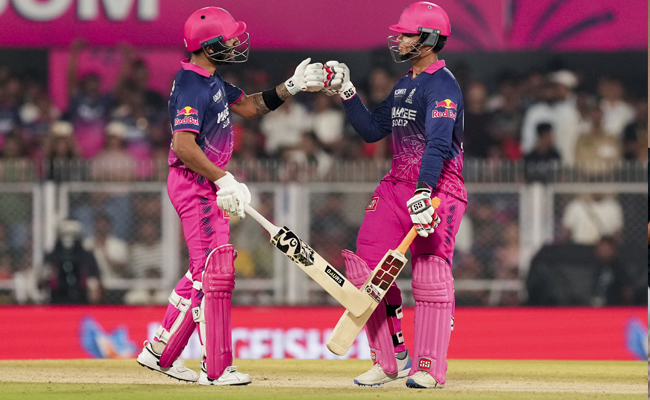
Guwahati (PTI): Blistering fifties by Vaibhav Sooryavanshi and Dhruv Jurel powered Rajasthan Royals to a six-wicket win over Royal Challengers Bengaluru in their IPL match here on Friday.
Sent in to bat, RCB rode on a fighting half-century by skipper Rajat Patidar (63) to post 201 for 8.
Virat Kohli (32), Romario Shepherd (22) and Venkatesh Iyer (29) also chipped in with useful contributions.
In reply, Sooryavanshi (78 off 26 balls) and Dhruv Jurel (81 not out off 43 balls) shared a 37-ball 108-run partnership for the second wicket to set the platform. Krunal Pandya (2/30) tried to bring them back with back-to-back wickets.
But Jurel, in the company of Ravindra Jadeja (24), completed the task with another 68-run stand, with two overs to spare.
For RR, Jofra Archer (2/33), Ravi Bishnoi (2/32) and Brijesh Sharma (2/37) took two wickets.
Brief scores:
Royal Challengers Bengaluru: 201 for 8 in 20 overs (Rajat Patidar 63; Jofra Archer 2/33, Ravi Bishnoi 2/32, Brijesh Sharma 2/37).
Rajasthan Royals: 202 for 4 in 18 overs (Vaibhav Sooryavanshi 78, Dhruv Jurel 80 not out; Krunal Pandya 2/30, Josh Hazlewood 2/44).