Large-scale damage to power infrastructure in Bengaluru due to rain
BESCOM records Rs 65.3 crore loss this FY
_vb_09.jpeg)
Bengaluru: Along with causing waterlogging and danger of inundation of houses, the heavy showers in Bengaluru have hit its power infrastructure on a large scale, with 1,465 electricity poles and 190 transformers being damaged this month.
Bangalore Electricity Supply Company (BESCOM) officials have estimated that an additional 600 to 700 poles might be damaged in the next 10 days. The areas under the limits of BESCOM recorded damage of 1,880 electricity poles and 151 transformers in April this year, due to rain. So far, BESCOM’s loss due to rain in the Financial Year 2025-26 is recorded to be Rs 65.3 crore, reports The Hindu.
In April this year, the city witnessed a threefold hike in damage to power poles, as against the damage in April 2024, when 558 poles were affected. While nine transformers were damaged in April 2024, the number increased drastically this year.
The increased intensity of wind and rain has caused the damage in April 2025, according to BESCOM officials. A senior officer added that intensive rainfall started in mid-April this year while in 2024 it was in the last week of the month. Additionally, the number of days when the city received heavy showers accompanied by forceful winds was also much higher this year, as compared to last year, he added, clarifying that, as a result, it would be difficult to compare the level of damage.
The officer also said that loosening of soil due to the civil works going on in Bengaluru has also led to the uprooting of trees. He explained that more than one power pole along a power line would be affected when one tree fell.
BESCOM has said that the problem during such weather had no permanent solution. The officer, however, said that they had contacted the Bruhat Bengaluru Mahanagara Palike (BBMP) and the Forest Department for pre-monsoon maintenance, as it would help alleviate the problem. He explained that the BBMP and Forest Department would take up the maintenance work in mid-January, with BESCOM providing manpower as well as financial and material assistance.
Experts, however, have stressed that a scientific approach towards maintenance and a successful implementation of both aerial and underground cables would be needed to prevent such damage.
Let the Truth be known. If you read VB and like VB, please be a VB Supporter and Help us deliver the Truth to one and all.
Ordinance issued to increase number of Supreme Court judges from 34 to 38
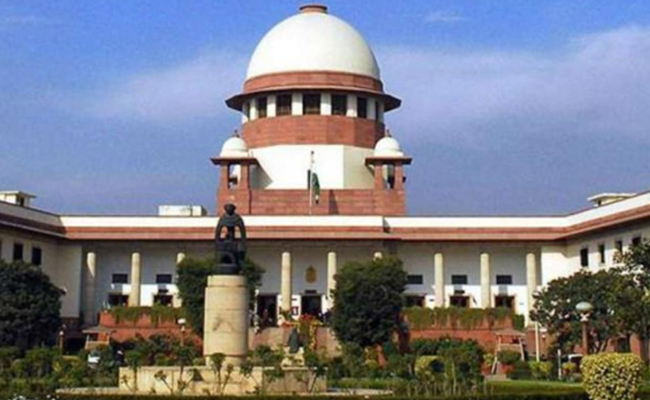
New Delhi (PTI): The government has promulgated an ordinance to increase the strength of the Supreme Court from the present 34 judges to 38, including the Chief Justice of India.
The law ministry notified the ordinance on Saturday, which amended the Supreme Court (Number of Judges) Act, 1956, to increase the sanctioned strength of the top court.
So far, the sanctioned strength of the top court was 34, including the Chief Justice of India (CJI). Now, the number of judges has been increased by four, taking the sanctioned strength to 38.
The top court will now have 37 judges, other than the CJI.
With the apex court having two vacancies at present, and the ordinance coming into force immediately, the Supreme Court Collegium will now have to recommend six names for appointment as judges in the top court.
A bill will be brought in the Monsoon Session of Parliament to convert the ordinance – an executive order – into a law passed by Parliament.
The Union Cabinet had cleared a draft bill on May 5 to increase the number of apex court judges.
The strength of the Supreme Court was last increased from 30 to 33 (excluding the CJI) in 2019.
The Supreme Court (Number of Judges) Act, as originally enacted in 1956, put the maximum number of judges (excluding the CJI) at 10.
This number was increased to 13 by the Supreme Court (Number of Judges), Amendment Act, 1960, and to 17 by another amendment to the law.
The Supreme Court (Number of Judges) Amendment Act, 1986, augmented the strength of judges from 17 to 25, excluding the CJI.
A fresh amendment in 2009 further increased the strength from 25 to 30.
Article 124(3) of the Constitution lists the qualifications required to become a Supreme Court judge.
An Indian citizen who has either served as a high court judge for at least five years, or as an advocate for 10 years, or is a distinguished jurist, can be appointed to the top court.
The strength of the Supreme Court is increased based on the recommendations of the CJI, who writes to the Union law minister. After consulting the finance ministry, the Department of Justice under the law ministry moves the Cabinet with a draft bill.