Madikeri: Editor, reporter of newspaper sent to jail, fined for publishing minor rape victim's photo
Madikeri: In a recent judgment, the Second Additional District and Sessions Court in Virajpet sentenced the editor and a reporter of the 'Cauvery Times,' a daily newspaper in Kodagu district, to one year of imprisonment and imposed a fine of Rs 25,000 on each of them. This decision came in response to their violation of the law by publishing the photograph of a minor who was raped and murdered in 2019.
The case dates back to 2019 when a minor was raped and murdered, leading to the registration of a case at the Siddapur Police Station. Subsequently, the accused in the case were arrested and sentenced to life imprisonment. During the coverage of the case, reporter Vasanth Kumar from the 'Cauvery Times' included a photograph of the victim, a clear violation of the law that prohibits the publication of the identity or photograph of sexual offence victims.
In July 2019, the victim's brother filed a complaint with the Gonikoppa Police, stating that the publication of his sister's photograph in the 'Cauvery Times' had caused significant distress to his family. Sub-Inspector BS Sridhar, who had been the investigating officer in the case, initiated an investigation against both reporter Vasanth Kumar and the editor of the daily, Nanjappa. He submitted the chargesheet to the Second Additional District and Sessions Court in Virajpet.
The court heard the case on August 28, 2023, and subsequently sentenced the journalists to one year of imprisonment while also imposing a fine of Rs 25,000 on each of them. Additionally, Judge Sujatha ruled that if they failed to pay the fine, an additional three months of imprisonment would be imposed. The Virajpet court granted Nanjappa and Vasanth Kumar conditional bail in light of this judgment.
It is worth noting that reporter Vasanth Kumar had previously been fined Rs 1 lakh by the Junior Civil Court in Virajpet for publishing false news in the newspaper. Moreover, a separate case had been registered against him for utilizing a fake Registrar of Newspapers for India (RNI) number to publish the daily newspaper.
Let the Truth be known. If you read VB and like VB, please be a VB Supporter and Help us deliver the Truth to one and all.
Women BJP MLAs protest against opposition in UP assembly premises
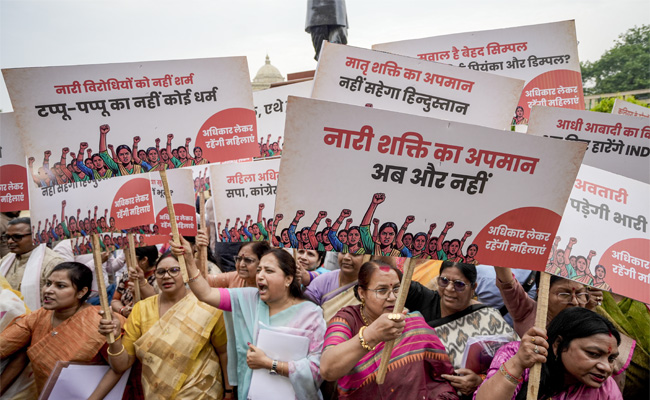
Lucknow (PTI): Women BJP MLAs held a protest in the Vidhan Bhawan complex before the one-day special session of Uttar Pradesh assembly, slamming the opposition for defeating the passage of a bill, which would have led to implementation of the Women's Reservation Law, in the Lok Sabha.
This followed another demonstration by Samajwadi Party MLAs, who alleged that the BJP was misleading public in the name of women's reservation.
The women BJP legislators assembled in front of Chaudhary Charan Singh's statue in the assembly premises, holding banners inscribed with the slogan "Insult to Matrushakti (women's power), India will not tolerate it". The protesting members entered the main hall of Vidhan Bhawan carrying the banners.
Participating in the protest, the state Minister for Women Welfare and Child Development, Baby Rani Maurya, told reporters that all opposition parties, including the Samajwadi Party and the Congress, had opposed the women's reservation, a stance for which they would have to pay a heavy political price.
"On this issue, all of us women stand united. We will ensure that we secure our reservation," she said.
BJP MLA Ketki Singh remarked that their protest represents the collective outrage of millions of women across the state.
Singh asserted that the opposition has betrayed women by creating hurdles in the path of women's reservation. The current demonstration is merely the beginning, and very soon, women from every street, intersection and household will join the protest movement, she said.
Minister Vijaylakshmi Gautam said, "We strongly condemn the despicable act committed by the Samajwadi Party and the Congress in an attempt to hold back 'half the population' (women). Their action was directed against the very bill that Prime Minister Narendra Modi had introduced to empower and strengthen Nari Shakti (women's power), and which he strived to pass expeditiously."
Uttar Pradesh assembly is holding a one-day special session on Thursday. During the session, the government is set to move a censure motion against the opposition parties over their failure to pass the Constitution Amendment Bill, which would have led to implementation of the Women's Reservation Act, in the Lok Sabha.