Man in Bengaluru held for sexually harassing television actor by sending her lewd messages

Bengaluru: Annapoorneshwari Nagar Police on Monday arrested a man who is accused of sexually harassing a television actor by sending obscene messages and video clips to her Facebook account.
As per a report in Deccan Herald, the actor has worked in Kannada and Telugu serials. The arrested man, Naveen K, who called himself ‘Naveenz’ on Facebook, had been harassing the actor for three months, a senior officer has said.
The actor ignored a friend request sent by Naveen, after which, the man started sending her lewd messages on Facebook. The actor then warned him not to do so, but the warning was ignored and the victim continued receiving the obscene messages as well as video clips, of his private parts too.
The man created multiple fake profiles as the victim blocked his account, and continued the harassment.
As a last resort, the actor met Naveen near a hotel in Nagarbhavi on Saturday, November 1, and warned him not to trouble her on social media, but he again sidelined her warning and continued to harass her.
The actor then filed a complaint with Annapoorneshwari Nagar Police, who registered a case. Based on the details provided by her, Naveen was arrested. He has been sent to judicial custody.
Let the Truth be known. If you read VB and like VB, please be a VB Supporter and Help us deliver the Truth to one and all.
14 India-bound ships in Strait of Hormuz stopped by Iran; 1 hit by bullets, 1 crosses: Sources
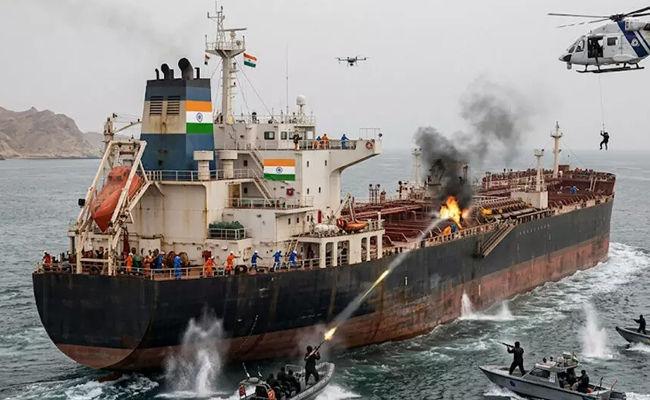
New Delhi (PTI): A convoy of 14 India-bound ships carrying crude oil and gas were stopped by the Iranian Revolutionary Guard Corps (IRGC) by firing at two of them while they were transiting the Strait of Hormuz, leading to 13 of the vessels returning to different locations in the Persian Gulf, official sources privy to the development said.
An Indian-flag carrying ship, which was hit by bullets fired by the IRGC while crossing the Strait of Hormuz, was carrying crude oil and a window pane was broken, forcing it to stop the journey and return. The extent of damage to the second vessel was not immediately known but it also had returned.
However, another ship, which was Indian flagged and loaded with crude oil for the Hindustan Petroleum Corporation Limited, sailed through the Strait and is now heading towards India, the sources said.
Two Iranian gunboats approached the targeted tanker and fired at it without warning. Gunboats approached the vessel 37 kilometres northeast of Oman, causing other vessels to return without completing the crossing, the sources said.
The incident was reported in waters between the Qeshm and Larak islands, they said.
Out of the 14 India-bound vessels, seven are carrying the Indian flag, four have the Liberia flag, two are of the Marshall Islands and one of Vietnam.
Six of them are loaded with crude oil, three have LPG and four are loaded with fertilisers. Among the ships, five are bulk carriers. All 14 vessels were sailing in a row.
Thirteen of them were stopped by the Iranian Navy and were instructed to wait. Out of the 13 stranded vessels, seven vessels are drifting south of Larak Island, waiting for clearance from the Iranian Navy, the sources said.
The Indian government is understood to have been coordinating with the Iranian authorities for the safe voyage of the stranded India-bound ships, they said.
The standoff over the Strait of Hormuz reportedly escalated again on Saturday as Iran reversed its reopening of the crucial waterway and fired on ships attempting to pass. This came as the United States pressed ahead with its blockade of Iranian ports.
Confusion over the Strait, through which roughly one-fifth of the world's oil passes, threatened to deepen the energy crisis.
The ceasefire between Iran and the US is due to run out by mid-next week.
Iran's joint military command said Saturday that "control of the Strait of Hormuz has returned to its previous state ... under strict management and control of the armed forces."
It warned that it would continue to block transit through the strait as long as the US blockade of Iranian ports remained in effect.