Mekedatu project will benefit Tamil Nadu more than Karnataka: D.K. Shivakumar
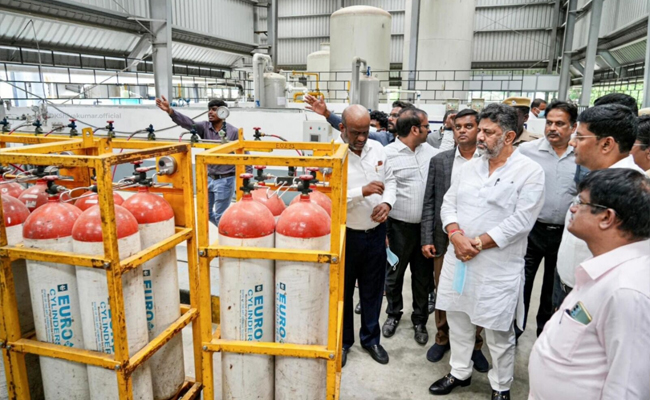
Chennai: Deputy Chief Minister D.K. Shivakumar today said that the Mekedatu project, if implemented, would benefit the people of Tamil Nadu more than those in Karnataka. He made this statement during his visit to the Srinivasa Solid Waste Management Unit in Chennai on Tuesday. Responding to questions from the media about Tamil Nadu's opposition to the Mekedatu Dam, he said, “Varuna Deva has been kind to us this year. If the Mekedatu scheme is implemented, it will be more beneficial for Tamil Nadu than for Karnataka. However, we will not discuss this much now.”
Shivakumar, who was in Chennai to study the city’s solid waste management model, was accompanied by 15 officials. “I came here to learn about gas generation from garbage and solid waste management. We’ve gained valuable insights from the waste management practices here. I had been planning to visit for the past year and finally had the opportunity. We will implement some of the good practices in our state as well,” he said.
He also pointed out that while power generation from solid waste has not been successful in many places, Tamil Nadu has made significant progress. “We have been permitted to generate electricity from waste in 10 locations. Earlier, I visited Hyderabad, and here in Chennai, they have efficiently set up a CNG manufacturing plant in the middle of the city. We have also achieved some good results, but their work here is commendable,” he added.
When questioned about the alleged irregularities in Karnataka Industrial Area Development Board (KIADB) CA land allotment by BJP Rajya Sabha member Lehar Singh, Shivakumar asserted that the allotment had been done legally. “There is nothing illegal about this. We have not allotted the site to an individual but to a charitable trust,” he clarified.
Let the Truth be known. If you read VB and like VB, please be a VB Supporter and Help us deliver the Truth to one and all.
11k litres of milk poured into Narmada river after religious event; environmentalists see red
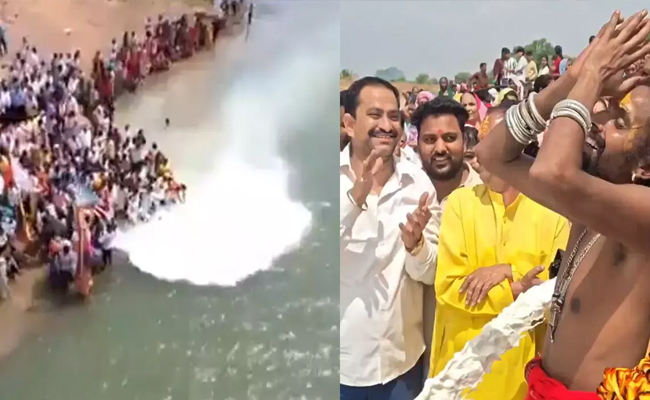
Sehore (PTI): Around 11,000 litres of milk were poured into Narmada river, often called the lifeline of Madhya Pradesh, in Sehore district on the culmination of a 21-day religious event as part of a sanctification ritual, prompting environmentalists to flag its negative impact on the ecosystem.
The event concluded at Satdev village in Bherunda area, located about 90 km from the district headquarters, with a 'mahayagna' on Wednesday.
The milk was offered to the river as part of rituals and prayers for the purity of the waters, the well-being of pilgrims and prosperity, organisers said.
The milk was brought in tankers to the riverbank and later poured into the flowing water amid chanting of mantras in the presence of a crowd of devotees.
However, environmentalists raised concerns over the practice, warning of its potential ecological impact.
"Such large quantities of organic matter can deplete dissolved oxygen in water, adversely affecting the river ecosystem. These impact local communities dependent on the river for drinking water and threaten aquatic life as well as domestic animals," noted environmentalist and wildlife activist Ajay Dube said.
Religious offerings should be symbolic and mindful, he asserted.
Renowned environmentalist Subhash Pandey said 11,000 litres of milk acts as a significant organic pollutant.
"It is highly oxygen-demanding and can lead to oxygen depletion, aquatic mortality, eutrophication (process of plants growing on river surface) and loss of potability. These effects are predictable from dairy-effluent chemistry and have been documented in similar incidents worldwide," Pandey pointed out.
Narmada originates at Amarkantak in the state and traverses 1,312 km westward to Maharashtra and Gujarat, emptying into the Arabian Sea via the Gulf of Cambay.
It is the largest west-flowing river in the peninsula, passing through a rift valley, and acts as a crucial water source for irrigation in MP, Gujarat and Maharashtra.