Mother-son duo in Bengaluru assault BBMP sanitation workers over garbage dispute

Bengaluru: Five women sanitation workers, known as pourakarmikas, employed by the Bruhat Bengaluru Mahanagara Palike (BBMP), were assaulted by a mother and her son in Byadarahalli on Wednesday, September 11. The incident occurred after a dispute over garbage collection outside the duo's residence, and the assault was captured in a video that has since gone viral on social media.
The Byadarahalli Police have registered an FIR against the accused under the SC and ST (Prevention of Atrocity) Amendment Ordinance-2014, along with various sections of the Indian Penal Code (IPC) related to causing injury, criminal intimidation, and intentional insult. The complaint was lodged by Lakshmi C, one of the injured workers.
According to the complaint, the accused, identified as Chandru and his mother, residents of 14th Cross at Bharathnagar in Byadarahalli, approached the sanitation workers while they were cleaning the street. Chandru's mother demanded that the workers clear a pile of garbage outside their house. The workers explained that the waste was too much for them to manage and asked her to wait for the auto tipper that regularly collects large amounts of waste.
However, the situation quickly escalated. Lakshmi reported that Chandru’s mother verbally abused the workers, stating that they were paid with the tax money from their family and called her son to "teach them a lesson," using derogatory remarks about their caste. When Lakshmi attempted to record Chandru's abusive comments, he allegedly snatched her phone, threw it to the ground, and physically assaulted her by pulling her hair, slapping her, and tearing her uniform.
The situation worsened when Lakshmi's colleagues tried to intervene. Chandru, with help from his mother, allegedly assaulted the other workers as well, including hitting Ramakka on the hand and kicking Asha, Munirathna, and Anniyamma. Chandru also issued death threats during the altercation, according to Lakshmi's complaint.
Fearing for their jobs, the sanitation workers refrained from retaliating and instead reported the incident to their superior. Despite this, the verbal and physical abuse continued in the presence of the superior. Eventually, the workers approached the police, leading to Chandru’s detention.
As a result of the attack, Lakshmi's phone, worth Rs 30,000, was damaged, and Ramakka’s bangles were broken. Lakshmi sustained injuries to her back, head, and stomach, while her colleagues suffered minor injuries.
Nirmala M, president of the BBMP Pourakarmika Sangha, condemned the assault, stating, "We are not slaves. We are respected people, and we're just doing our job. Using abusive language and violence against us is unacceptable. We urge the police to take swift action and arrest the accused immediately."
Let the Truth be known. If you read VB and like VB, please be a VB Supporter and Help us deliver the Truth to one and all.
Put petty politics aside; it's not about one party, but India: Rahul on TMC's loss in polls
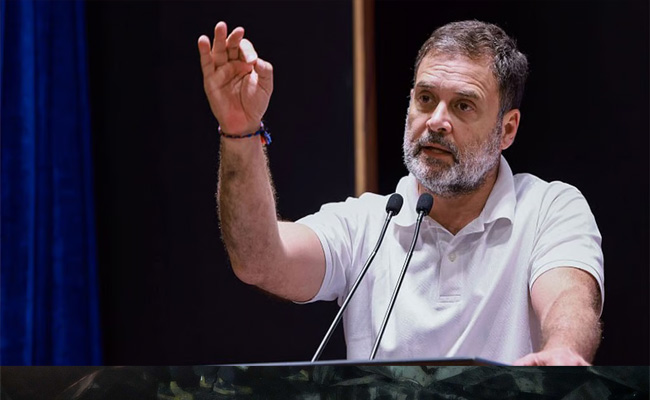
New Delhi (PTI): Congress leader Rahul Gandhi on Tuesday termed the BJP's victory in Bengal and Assam assembly polls a "theft" of the mandate, and a big step forward in the saffron party's mission to "destroy" Indian democracy.
Gandhi also came out in support of the TMC, which has been trounced by the BJP in the polls, and urged those gloating over the loss of Mamata Banerjee's party to put petty politics aside.
"Some in the Congress, and others, are gloating about TMC's loss.They need to understand this clearly - the theft of Assam and Bengal's mandate is a big step forward by the BJP in its mission to destroy Indian democracy," Gandhi said in a post on X.
"Put petty politics aside. This is not about one party or another. This is about India," he said in his post.
The BJP ousted Trinamool Congress from power in Bengal and captured power for the third time in a row in Assam in results of assembly polls declared on Monday.