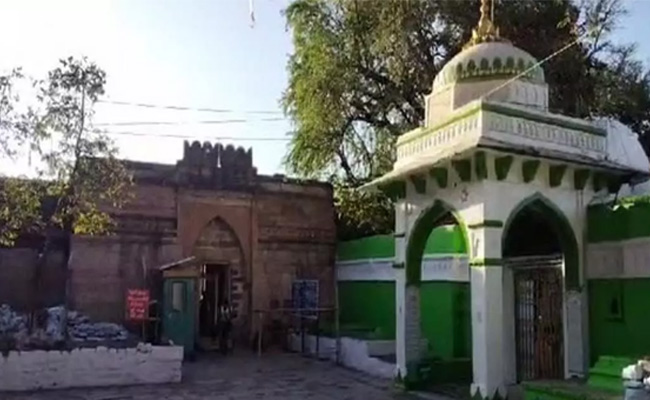
Mutalik warns to lay siege Belagavi Mini Vidhana Soudha if Datta Peetha is not handed over to Hindus
Dattamala Abhiyana
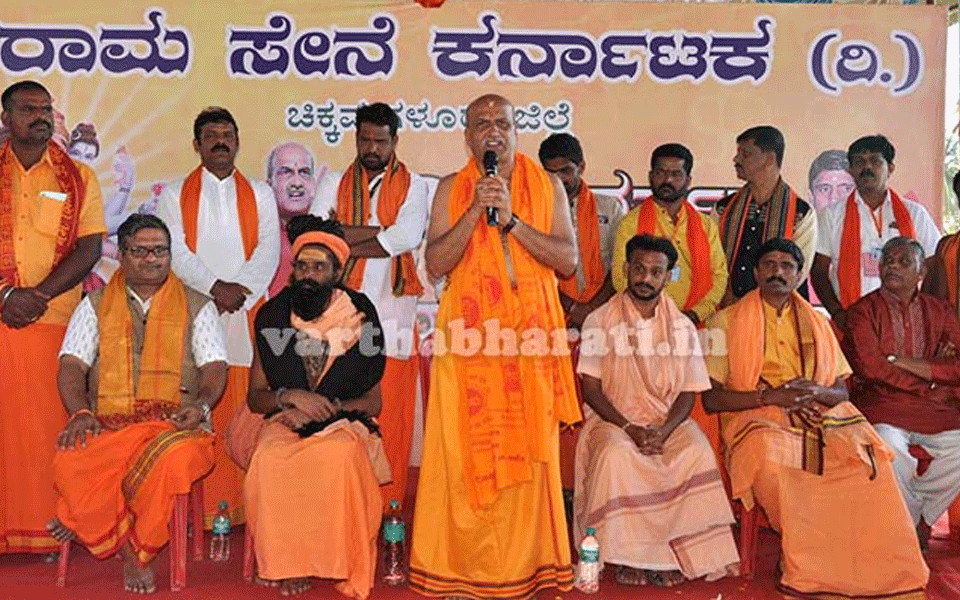
Chikmagaluru, October 28: Sri Rama Sene national president Pramod Mutalik warned of lay sieging the Belagavi Mini Vidhana Soudha during the Belagavi Session if the Datta Peetha was not handed over to Hindus within the Winter Session to be held in Belagavi.
Addressing a religious convention after the Shobha Yatra organized as part of the Dattamala Abhiyan at Bola Rameshwara Temple here on Sunday, Mutalik said that in the name of communal harmony, the Hindu ideology was being targeted without giving scope for Hindu ideology in the Hindu nation. Rama Mandir was the adorable god for hundred crore Hindus in the country. But both the central government and the Supreme Court were not in a position to listen the voice of hundred crore people of the country, he said.
Court interference not necessary
The Supreme Court has allowed the entry of women into 800-year-old Ayyappa Swamy temple in Kerala much against to the tradition and custom being followed since centuries. The courts should not interfere in the religious issues. The Supreme Court should reconsider its verdict on Sabarimala temple. There was atheist government in Kerala where Hindus were being converted. The Central Government should dismiss the Communist government in Kerala and impose the President’s rule. The Kerala government had backed three women who tried to enter the temple, he alleged.
The BJP has gained the Datta Peetha benefit. They were happy if the justice was ensured when BJP was in power. Previous government had allowed a Maulvi to offer pooja at Datta Peetha, for which the BJP was responsible, he alleged.
When BJP was in power, it did not go to the court and appoint right advocate. As a result, Maulvi was offering pooja. As former prime minister H.D Deve Gowda had solved the Hubballi Idgah maidan issue amicably, Chief Minister H.D Kumaraswamy should solve Datta Peetha issue and handover it to Hindus and shift the tombs to Nagenahalli, he said.
Let the Truth be known. If you read VB and like VB, please be a VB Supporter and Help us deliver the Truth to one and all.
Punjab: Blast near army cantt area in Amritsar, hours after explosion in Jalandhar
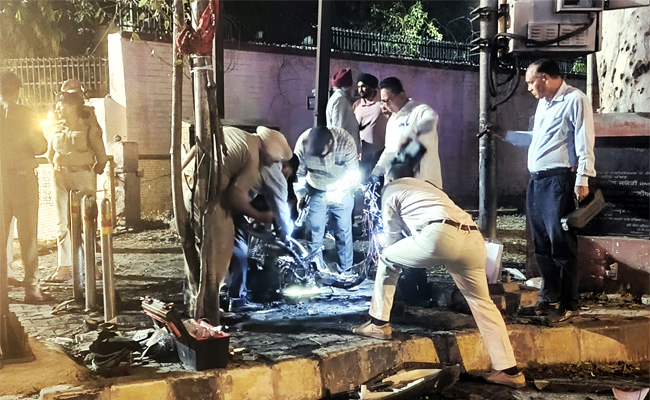
Chandigarh (PTI): An explosion occurred near the army cantonment area in Khasa late Tuesday night in Punjab's Amritsar, the second such incident which took place around three hours after a blast outside the headquarters of the Border Security Force's Punjab Frontier in Jalandhar.
According to the police, an investigation into both blast incidents is currently underway, and no injuries have been reported.
The first explosion happened around 8 pm in Jalandhar, while the second blast occurred at approximately 11 pm in Amritsar.
Amritsar (Rural) Senior Superintendent of Police Suhail Mir Qasim stated that police received reports of a loud sound at around 11 pm on a road in Khasa. "Our teams arrived on the scene immediately," he said.
Preliminary inspections indicated that someone had thrown an explosive device towards the boundary wall, leading to the explosion, according to the SSP.
ALSO READ: Trump pauses Project Freedom, claims great progress for final agreement with Iran
Police mentioned that a piece of a tin sheet covering the boundary wall had fallen as a result of the blast.
Following the explosion, a team of forensic and bomb disposal squad visited the site to collect samples.
Amritsar Rural Superintendent of Police Aditya S. Warrier, who also visited the scene, confirmed that further investigations are ongoing. Police added that a team of army officials also assessed the situation, after which the area was cordoned off.
CCTV footage from the vicinity shows the explosion occurring at night. A local villager reported that his family was awakened by the loud sound and came outside their home to see what had happened.
Before the Amritsar explosion, a blast took place outside the headquarters of the Border Security Force's Punjab Frontier in Jalandhar district around 8 pm on Tuesday, causing panic in the area.
CCTV footage captured the explosion, which resulted in a cloud of smoke. An unidentified man was seen running for cover following the blast.
The blast ripped apart a scooter, damaged a traffic signal pole and windowpanes of a nearby shop. Locals recounted that the scooter, which was parked outside the BSF headquarters, Punjab Frontier, caught fire shortly after a loud sound. It belonged to Gurpreet Singh, who regularly delivers parcels in the area.
Talking to reporters on Tuesday night, one of Gurpreet's relatives said that the scooter caught fire as he was approaching it. He immediately called his father and informed him about the incident.
Jalandhar Police Commissioner Dhanpreet Kaur confirmed to reporters late Tuesday that an Activa scooter parked near the gate caught fire suddenly. She stated that Gurpreet is fully cooperating with the investigation.
Witnesses nearby reported hearing a loud sound following the explosion.
On April 27, an explosion occurred at a freight corridor rail track in Shambhu in Patiala. Police had arrested four members of a pro-Khalistan terror module, backed by Pakistan's ISI, for the blast.
In light of these incidents, opposition parties have condemned the AAP government for its handling of the situation.
Shiromani Akali Dal (SAD) President Sukhbir Singh Badal criticised Chief Minister Bhagwant Mann, who also holds the home portfolio, over the recent blasts.
"Three blasts in 10 days, two in a single day, May 5: Jalandhar outside BSF headquarters and Sri Amritsar Sahib Army area, April 27: Rajpura rail track. Continued intelligence failures and the collapse of law and order are a matter of grave concern. Chief Minister @BhagwantMann, who is also the state Home Minister, is busy with mimicry and cheap politics. He has forfeited the right to remain in office," Badal said in a post on X.
Punjab Congress chief Amrinder Singh Raja Warring also slammed the Mann government over the two blasts.
"Back-to-back blasts have shaken Punjab. Yesterday in Jalandhar, and now near Khasa Camp in Amritsar, this is deeply alarming. Who is trying to destabilise our state? Why has the Punjab Government failed to prevent such incidents? What is the Government of India doing? Repeated lapses point to a serious breakdown of intelligence and security. Punjab's peace cannot be compromised. We demand accountability and immediate action," Warring said in a post on X.