Mysuru gears up for grand Vijayadashami procession, marking culmination of Dasara festivities
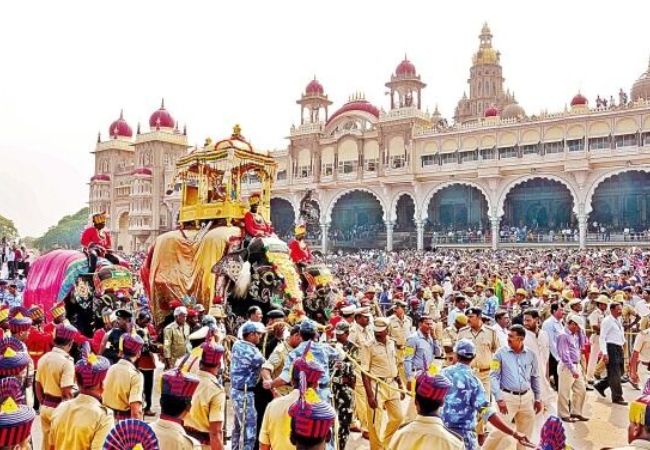
Mysuru (PTI): The city of palaces is set for a spectacular Vijayadashami procession on Thursday, marking the grand finale of the 11-day iconic ‘Mysuru Dasara’ celebrations.
Celebrated as ‘Nada Habba’ (state festival), the Dasara or ‘Sharana Navaratri’ festivities this year have been a grand affair, showcasing Karnataka’s rich culture and traditions in royal pomp and glory.
Thousands of people are expected to witness the ‘Jamboo Savari’—a march of a dozen caparisoned elephants led by ‘Abhimanyu’, carrying the idol of Goddess Chamundeshwari, the presiding deity of Mysuru, on a 750-kg golden howdah or 'Ambari'.
The grand procession will begin with Chief Minister Siddaramaiah offering pooja to the Nandi flag between 1 pm and 1.18 pm during the auspicious “Dhanur Lagna” at the Balarama Gate of the majestic Amba Vilas Palace.
The procession, comprising cultural groups and tableaux from various districts depicting Karnataka’s heritage, will cover about five kilometres before culminating at Bannimantapa. Tableaux from government departments showcasing schemes, programmes and social messages will also be there. Large crowds are expected along the route hours before it begins.
The chief minister and dignitaries, including scion of erstwhile Mysuru royals, Yaduveer Krishnadatta Chamaraja Wadiyar, will flag off the procession by showering flowers on the idol of Goddess Chamundeshwari during the auspicious 'Kumbha Lagna' between 4.42 pm and 5.06 pm.
Twenty-one cannon shots will mark the arrival of Abhimanyu, flanked by ‘Kumki’ elephants, and dignitaries will offer flowers from a specially set-up dais.
The Dasara procession on Vijayadashami symbolises the victory of good over evil. Historically, the king rode in the howdah, accompanied by his brother and nephew, with Sri Jayachamarajendra Wadiyar being the last royal king of Mysuru to do so. Today, the tradition continues with the idol of Goddess Chamundeshwari carried in the 750-kg howdah — a wooden core covered with 80 kg of gold.
Police have made elaborate security and crowd management arrangements for the event, officials said.
At the palace, keeping tradition alive, Yaduveer Krishnadatta Chamaraja Wadiyar, dressed in regal attire, will lead the ‘Vijaya Yatra’ from Amba Vilas Palace to the Bhuvaneshwari Devi temple within the premises, where he will perform a special pooja to the ‘Shami’ tree on Thursday.
On Wednesday, Wadiyar performed the 'Ayudha Pooja' a ritual honouring the erstwhile royal family’s weapons, vehicles, and animals, including elephants, horses, and cows.
As part of the celebrations, the ‘Vajramushti Kalaga’ — a duel between wrestlers (‘Jetties’) armed with a knuckle-duster (‘Vajramushti’) — will be held at the palace, with participants from across the state.
During the ten days of Dasara, the palace, major streets, circles, and buildings of Mysuru were adorned with lights and this celebration of lights is called 'Deepalankaara'. Cultural programmes were held at various venues, alongside events such as the food mela, flower show, farmers’ Dasara, women’s Dasara, Yuva Dasara, children’s Dasara, and poetry recitals.
The Dasara airshow on Wednesday drew large crowds, while the torchlight parade at Bannimantap grounds on Thursday evening will see Governor Thaawarchand Gehlot as the chief guest.
The Navaratri celebrations at the palace included daily rituals, with Wadiyar conducting the ‘Khasagi Durbar’ (private durbar) seated on the golden throne amid chanting of Vedic hymns.
Dasara, celebrated by the Vijayanagar rulers, was inherited by the Wadiyars of Mysuru. Initiated in Mysuru by Raja Wadiyar I in 1610, it became a private affair after the abolition of the privy purse in 1971. The tradition continued as a low-key event until the state government revived grand Dasara celebrations in 1975 when D Devaraj Urs was the chief minister.
Let the Truth be known. If you read VB and like VB, please be a VB Supporter and Help us deliver the Truth to one and all.
Vijay unable to prove majority, not invited for CM oath ceremony: Sources
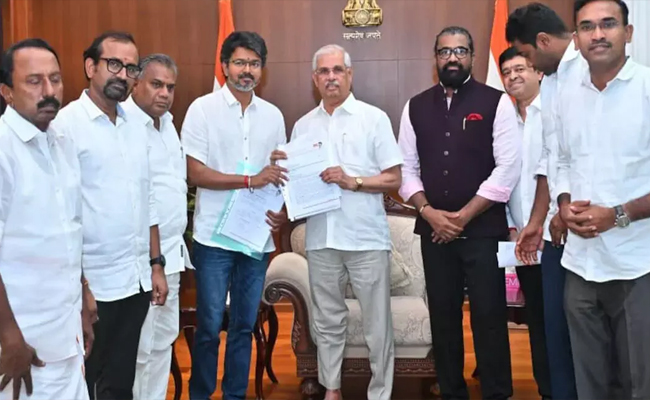
Chennai: Actor-politician Vijay has reportedly not been invited to take oath as Chief Minister of Tamil Nadu after failing to demonstrate support from the required number of MLAs, sources in Raj Bhavan said.
According to media reports that quoted sources in the office of R.N. Ravi Arlekar, Vijay could not prove the backing of 118 legislators, the majority mark in the 234-member Tamil Nadu Assembly.
Despite last-minute efforts to secure support from the Viduthalai Chiruthaigal Katchi (VCK), Amma Makkal Munnetra Kazagam (AMMK), and an IUML legislator, Vijay reportedly managed support from only 116 MLAs, falling short by two members.
Sources said Vijay failed to submit letters of support from the VCK and the Indian Union Muslim League (IUML).
Later, the IUML issued a statement clarifying that it was not part of the TVK-led alliance.
Meanwhile, AMMK leader T.T.V. Dhinakaran is also said to have informed the Governor that his party would support the All India Anna Dravida Munnetra Kazhagam (AIADMK) instead.
Earlier in the evening, Vijay had met Governor Arlekar and staked claim to form the government, stating that he enjoyed the support of 118 MLAs.