National conference on AI for empowering persons with disabilities held in Bengaluru
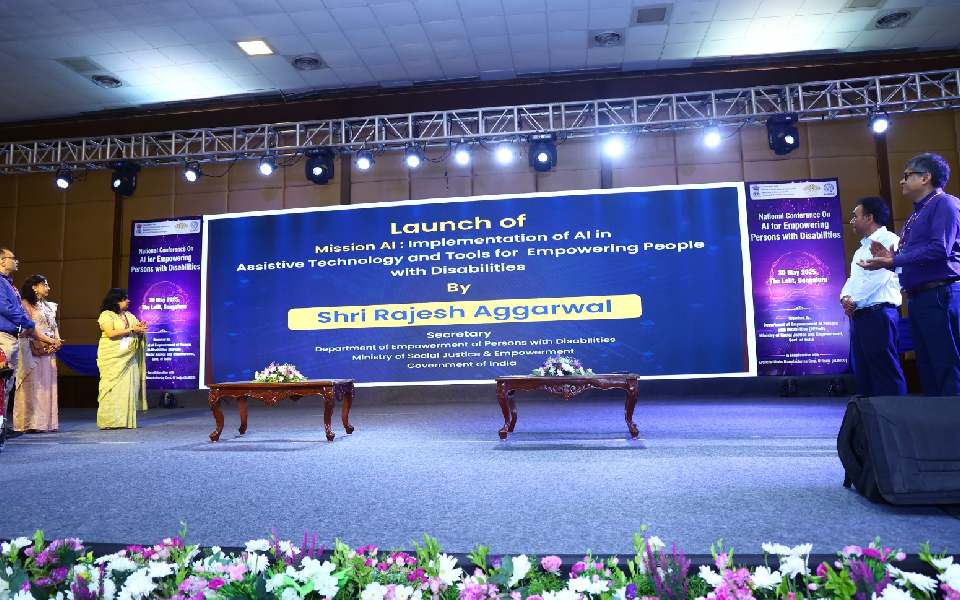
Bengaluru: Artificial Intelligence (AI) is rapidly reshaping the landscape of accessibility and inclusive development, a message that stood central at the National Conference on Artificial Intelligence for Empowering Persons with Disabilities, held today in Bengaluru, Karnataka.
The landmark event brought together an impressive array of government officials, academicians, technologists, and accessibility advocates to explore how AI is enhancing the lives of persons with disabilities.
Delivering the special address at the conference, Rajesh Aggarwal, Secretary of the Department for Empowerment of Persons with Disabilities (DEPwD), Ministry of Social Justice and Empowerment, Government of India, described the emergence of AI as the dawn of "a new era of inclusion."
His keynote highlighted transformative advances in Deep Learning, Robotics, and Computer Vision, underlining their enormous potential to improve the quality of life for people with disabilities.
As part of his address, Aggarwal also launched four key initiatives aimed at integrating AI into the accessibility ecosystem:
-
Mission AI Accessibility
-
Mission AI: Implementation of AI in Assistive Technologies and Tools for Empowering People with Disabilities
-
National Disability Support AI Chatbot
-
United Benefits Interface (UBI)
These initiatives seek to establish inclusive digital infrastructures and offer scalable AI-driven solutions in assistive technologies, marking a significant step towards digital inclusion.
The conference was jointly organized by the Department for Empowerment of Persons with Disabilities (DEPwD) and the Artificial Limbs Manufacturing Corporation of India (ALIMCO), a Mini Ratna Central Public Sector Enterprise operating under the Ministry of Social Justice and Empowerment.
Praveen Kumar, Chairman and Managing Director of ALIMCO, reaffirmed the organization's commitment to advancing innovation in assistive technology and promoting inclusive design practices.
He emphasized that AI can serve as a force multiplier in building a more accessible India and praised the multi-sector collaboration the event fostered.
The event drew participation from several leading voices across academia, industry, and government, including:
-
Venu Govindaraju, Distinguished Professor, Department of Computer Science, University at Buffalo, USA (via video conference)
-
P.V.M. Rao and Rohan Paul, Professors at IIT Delhi
-
Buddha Chandrashekhar, CEO, Anuvadhini
-
Pragya Misra, Partnerships Lead, OpenAI – India
-
Aalekh Sharan, Head, Enterprise AI & Strategy, Sarvam AI
-
Manu Chopra, CEO, Karya Inc.
-
Sandeep Alur, CTO, Microsoft Innovation Hub, India
-
Chandrika Jain, Director of Marketing, Lenovo
-
Shekhar Naik, Padma Shri awardee and Inclusion Advocate, IIM Bangalore
-
Arshad Sayyad, Co-Founder and Chief Business Officer, StackGen
-
Ananthalakshmi Venkitaraman, CEO, EquiBeing Foundation
-
Prateek Madhav, Co-Founder and CEO, AssisTech Foundation (ATF)
-
Amit Prakash, Professor and Head, Department of Human-Centered Computing, IIIT Bengaluru
-
Amrita Kamat, Representative, Google India
-
Ekroop Caur, Secretary, Department of Electronics, IT, BT, and S&T, Government of Karnataka
-
Abhishek Singh, Additional Secretary, Ministry of Electronics and Information Technology (MeitY) and Director General, National Informatics Centre (NIC), New Delhi
The conference spotlighted how cross-disciplinary collaboration can harness AI to empower millions of persons with disabilities.
A National Conference on Artificial Intelligence For Empowering Persons with Disabilities was held today at Hotel The Lalit, Bengaluru. The conference was jointly organized by the Department for Empowerment of Persons with Disabilities (DEPwD),
— PIB in Karnataka (@PIBBengaluru) May 30, 2025
1/3 pic.twitter.com/TIsfwGlvla
Let the Truth be known. If you read VB and like VB, please be a VB Supporter and Help us deliver the Truth to one and all.
Commission agent's licence suspended in Meerut for storing veggies in toilet

Meerut (UP) (PTI): The market administration in Meerut has suspended the licence of a commission agent or ‘arhtiya’ for storing vegetables inside a defunct toilet at the Mawana Naveen Sabzi Mandi in the city, officials said on Sunday.
The action followed after a video went viral showing vegetables, including tomato, ladyfinger, green chilli, coriander, mint and bottle gourd – packed in polythene bags inside an unused toilet on the market premises.
The secretary of the Mandi committee, Arjun Singh, told PTI that the toilet had been out of use for a long time due to being clogged.
“Abhay Kumar, the proprietor of Pradhan Trading Company, stored leftover vegetables there without permission. Within two hours of receiving information on May 15, a team from the Mandi committee reached the spot, seized about one quintal of vegetables, and buried them in a pit,” Singh said.
A notice was issued to Abhay Kumar, but since no satisfactory response was received, his licence has been suspended, he added.
According to officials, toilets in the market complex meant for use by farmers, commission agents and customers were allegedly being used as storerooms.
Following the incident, SDM Santosh Kumar Singh has sought an explanation from the Mandi committee secretary.
Strict action would be taken against those found guilty after an inquiry report is received, the SDM said.