National Film Awards: Nathicharami (Kannada) wins best lyrics award; KGF gets Best Action Direction
Ayushman Khurrana, Vicky Kaushal gets best actor awards
The 66th National Film awards were announced by Rahul Rawail, head of the Jury for feature films, on Friday.
Awards given in 31 categories in feature film category. An Award for film friendly state has been instituted this year. Uttarakhand is the most film-friendly State this year.
Dada Saheb Phalke Award:
Best non feature film: Son Rise by Vibha Bakshi and The Secret Life of Frogs by Ajay and Vijay Bedi
Best Director: Uri - Adhitya Dhar
Best Feature Film: Ellaru
Best Actor: Ayushmann Khuranna for Andhadhun and Vicky Kaushal for Uri
Best Actress: Keerthy Suresh for Mahanati
Best Supporting Actor - Swanand Kirkire for Cumbhak
Best supporting actress - Surekha Sikri for Badhaai Ho
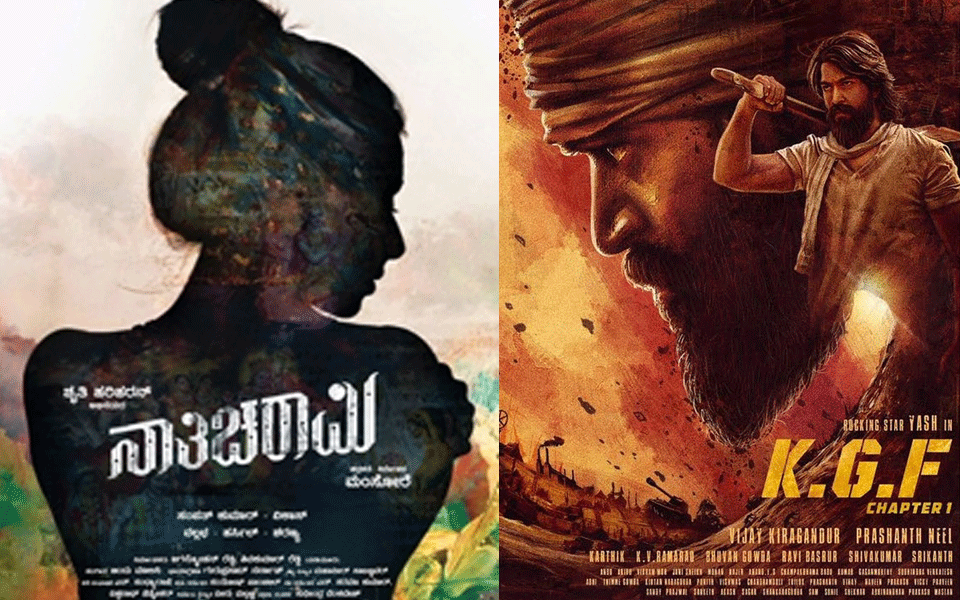
Best Action Direction: KGF Chapter I
Best Choreography: Padmaavat for Ghumar
Best Film for National Integration -
Best Cinematography - Ullu (Malayalam)
Best Popular Film: Badhaai Ho
Best film on Environment issues - Paani
Best Debut Film of a Director: Naan
Best film on Social Issues: Padman
Best Child artist:
Best Children's Film: Sarkari Area Prathamika Shaale Kasaragod
Best Cinematography:
Best Special Effects: KGF
Special Jury Award: Award shared by Sruthi Hariharan, Joju George for Joseph, Savithri for Sudani From Nigeria, Chandrachood Rai
Best Film Critic:
Best Film on Environment Conservation/Preservation: Paani
Best Regional films
Rajasthani - Turtle
Panchenga - In the Land of Poisonous Women
Marati - Bhonga
Hindi - Andhadhun
Urdu - Hamid
Telugu - Mahanati
Assamese - Bulbul Can Sing
Punjabi - Arjedha
Music
Best Lyrics: Nathichirami (Kannada)
Best Music Direction (Songs): Sanjay Leela Bhansali for Padmaavat
Best Music Direction (Background score): Uri
Best Sound Design: Uri
Best Female playback Singer: Bindu for Mayavi Manave (Kannada)
Best Male Playback Singer: Arijit Singh for Bhinte Dhil
Let the Truth be known. If you read VB and like VB, please be a VB Supporter and Help us deliver the Truth to one and all.
RSS chief raises concern over illegal immigration, reiterates push for three-child policy
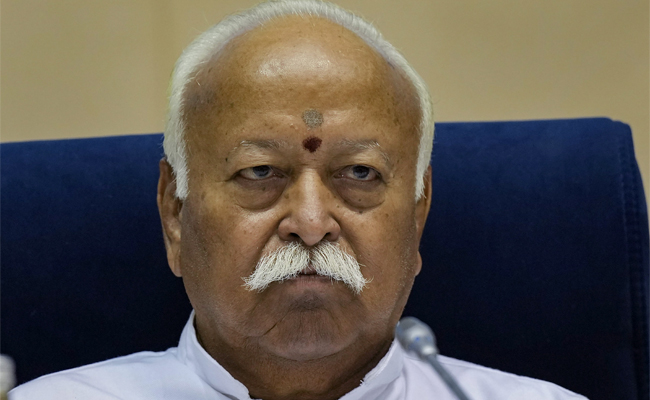
Mathura (UP) (PTI): RSS chief Mohan Bhagwant on Tuesday raised concerns over illegal immigration in India, asking people to keep a close watch to identify intruders and report them to authorities.
He also reiterated his push for a three-child policy, stressing the need for higher birth rates, while also discouraging "forced" religious conversions.
Speaking after inaugurating an ashram here, Bhagwat highlighted the issue of illegal immigration and said, "People need to keep a closer watch to identify foreigners and ensure that they do not receive employment here."
He, however, said that there should be no discrimination against Indian citizens.
Bhagwat's remarks on intruders come at a time when assembly elections are due in multiple states -- including Assam and West Bengal, where the issue of illegal immigrants has garnered a lot of traction of late. The BJP has also been talking about it frequently.
ALSO READ: CM Rekha Gupta presents Delhi govt's Rs 1,03,700 crore budget for 2026-27
On family health and population, the Rashtriya Swayamsevak Sangh (RSS) chief said doctors recommend three children for sound family health, as childhood interactions help individuals develop social skills and the ability to adjust within a group.
He said population studies warn that a fertility rate below three poses long-term risks.
"Countries with low birth rates have actively sought to increase their population above three," he said.
Bhagwat urged reconsideration of India's population policy, stressing that while legal measures can be applied, public understanding is crucial first.
A humanitarian approach requires families to aim for three children rather than two, he said, asserting that this is essential for the welfare of society.
Bhagwat also called for an end to forced religious conversions.
"The government may legislate, but society must stop this on its own. Many who converted to other religions are descendants of Hindus and may wish to return. Those willing should be welcomed back," he said.
The RSS chief also cited the "aggressive" nature of countries like the US and China, and hailed India as more accommodating of others' viewpoints.
"The US may come around and say that our economic model is the best, and everyone should follow it. China may say our model is best suited for everyone. However, India's approach is not about imposing on others; it believes everyone's viewpoint is correct. It is about living according to dharma, truth and cultural pride. The world may be aggressive, but our model emphasises ethical conduct, which the global community can learn from," he said.
Bhagwat said he had come to inaugurate the ashram out of "affection", as ashrams play a crucial role in shaping life perspective, promoting pride in one's religion and culture while discouraging aggression.
They are necessary in today's times, he said, pointing out that the term "ashram" is unique to Indian culture, without an equivalent translation in any other language.
"An ashram is first a school where life knowledge is taught. Those who stay disciplined and study here can serve society effectively for decades while nurturing their own character," he said.
Bhagwat highlighted that the ultimate human pursuit is moksha, or liberation. He explained the four types of human endeavours, with the fourth being dharma, which is imparted through ashram education and holds immense importance.
He also compared traditional Indian education with global systems, noting that even Finland's acclaimed education model mirrors the Gurukul-ashram approach.
"Here, real knowledge is gained, not just the ability to fill one's stomach," he said, adding that the ashram system instils perseverance and makes life more meaningful through education.
He asserted that India's ancient cultural values and Sanatan Dharma have relevance in today's "turbulent world", and ashrams will remain central in preparing society to uphold these values.
Madhya Pradesh Chief Minister Mohan Yadav, Uttar Pradesh Deputy Chief Minister Brajesh Pathak and several seers were among those present at the event.