No meaning in allegations, complain to Lokayukta with evidence: CM Bommai to contractors association
CM Bommai dismisses 40% commission charges by contractors’ association
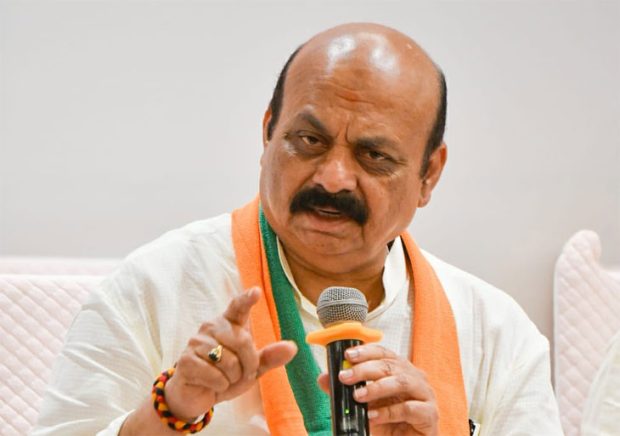
Bengaluru, Aug 24: Trying to question the credibility of the "40 per cent commission" charge against his government by the state contractors association as it was made after meeting the Leader of Opposition, Karnataka Chief Minister Basavaraj Bommai on Wednesday said there is no meaning to such claims.
Any baseless statement will be nothing but motivated, Bommai said, adding that he would advise the association to give a complaint to the Lokayukta if there is anything specific with evidence.
"First of all, the association headed by D Kempanna is not the only association of contractors. It is one among several other such associations. Secondly, there is no meaning in his allegations. It should be noted that he has spoken after meeting (Leader of Opposition) Siddaramaiah," Bommai said in response to a question regarding the allegations.
Speaking to reporters here, he said, following the concerns raised by the association last time, the government had made certain orders, and even going a step ahead as it constituted a tender scrutiny committee headed by a retired judge, which no other state has done.
"If they have any specific complaint, they can go before the Lokayukta and give a complaint. The Lokayukta has full freedom, it will investigate and we will take strict action against the guilty if any," he added.
An association delegation led by its President D Kempanna on Wednesday met Congress leader Siddaramaiah, after which the former alleged that the whole system was corrupt and accused ministers and MLAs of demanding a percentage in commission.
Kempanna said the association would be writing another letter to the Prime Minister in this regard and that it will continue its fight demanding an independent judicial probe.
The association president even specifically charged the Kolar district in-charge Minister (Munirathna), without taking his name, accusing him of threatening officials to collect and get the money.
Responding to a question on Kempanna specifically pointing at the Kolar district in-charge Minister (Munirathna), the Chief Minister said, "Whoever it is, with specific case and incident along with evidence, let them give a complaint, and it will be investigated."
Regarding the association stating that they will write a letter to the Prime Minister, Bommai said everyone has the right to write a letter to the Prime Minister, but other than that there is a system in place to investigate corruption.
"After the recent court order (High Court), Lokayukta is fully independent, there are judicial officers there. Let them give a complaint, it will be investigated," he added.
The association had earlier written a letter to the Prime Minister in this regard in July last year.
In their letter to Modi, the association had claimed "harassment" by ministers, elected representatives and others, accusing them of demanding up to 30 per cent of the tender amount for approving a contract, and 5-6 per cent towards release of 'Letter of Credit' against pending bills.
Let the Truth be known. If you read VB and like VB, please be a VB Supporter and Help us deliver the Truth to one and all.
TVK chief should be given opportunity to prove majority in TN Assembly: Omar
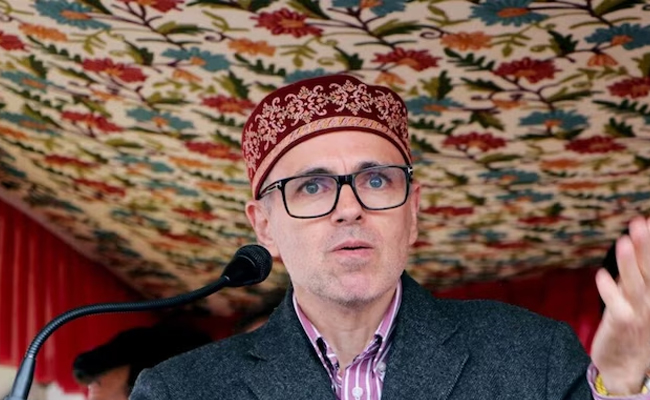
Srinagar (PTI): Jammu and Kashmir Chief Minister Omar Abdullah on Friday said there was no justification for the Tamil Nadu governor to stop TVK leader Vijay from forming the government, and he should be provided an opportunity to prove majority in the assembly.
Tamil Nadu Governor Rajendra Vishwanath Arlekar on Thursday rejected TVK chief Vijay's claim to form the government, stating that his party lacks the requisite numbers.
The Tamilaga Vettri Kazhagam (TVK) has fallen short of meeting a simple majority to form the government in Tamil Nadu. Though the Congress with five MLAs has offered support to TVK, Vijay's party falls short of a simple majority of 118 in the 234-member Tamil Nadu Assembly.
Abdullah said there was no justification for President's rule in Tamil Nadu in view of numerous Supreme Court judgements emphasising on inviting the single largest party to form the government and then prove its majority on the floor of the house.
"If we see the Supreme Court judgement, then there should be no President's rule. There are so many cases in which the SC has clearly stated that after the elections, the single largest party should be invited (for government formation) and they should be allowed to prove their majority in the assembly," Abdullah told reporters here when asked about the political situation in Tamil Nadu.
"It happened when (former prime minister) (A B) Vajpayee formed the government for 13 days, the President of India did not wait for him to show his numbers. The President of India invited him, the government was there for 13 days, but when Vajpayee did not have the numbers, he resigned," he said.
So, if we take the SC judgement, the J-K CM added, then the Tamil Nadu Lok Bhavan "has no justification to stop this process".
"Vijay should be allowed to form the government, and then he should be provided an opportunity to prove his majority and if he proves, he will remain, but if not, then he will have to resign," Abdullah said.
To a question on whether there would be impact of the Special Intensive Revision (SIR) in Jammu and Kashmir, the CM said its impact remains to be seen in the rest of the country first as the assembly elections in the Union territory were not due till 2029.
"As of now it (SIR) has happened in Bengal only. Why are you worried about J-K? The elections are not to take place here till 2029. Let us first see its impact in the rest of the country. What we had to suffer (in J-K), we have. We suffered their delimitation, which was done to benefit the BJP and its friends. Let's see what happens in the future," he said.
On the reported remarks of Leader of Opposition in the J-K assembly, Sunil Sharma, that if the chief minister goes for cabinet expansion, then his party, the National Conference (NC), would suffer like the Shiv Sena in Maharashtra and someone like Eknath Shinde would emerge here as well, Abdullah said all his MLAs stand firmly with the party.
"This tells about the intentions of the BJP. 'Aaya Ram Gaya Ram' (turncoats). Eknath Shinde left because the BJP helped him to leave. It is obvious that the LoP is impatient to hold the chair of the chief minister of J-K. I will only tell him that there is no Eknath Shinde in the National Conference. NC's MLAs stand firmly with the party," he said.
Abdullah said the cabinet expansion is on hold because statehood has not been restored to J-K.
"Cabinet expansion is not on hold because of any fear and that is why I regularly say that the LoP proves through statements like this that till the BJP does not get power, they will not allow us to work smoothly and will not make J-K a state again," he said.
Hitting out at the LoP and the BJP, the J-K CM said the people of J-K, especially those who voted for the BJP in the last elections, should remember that the LoP and his party "indulge in the politics of blackmail and the people here are intimidated in the name of statehood".