"No post is permanent', says CM Bommai triggering rumours of his exit
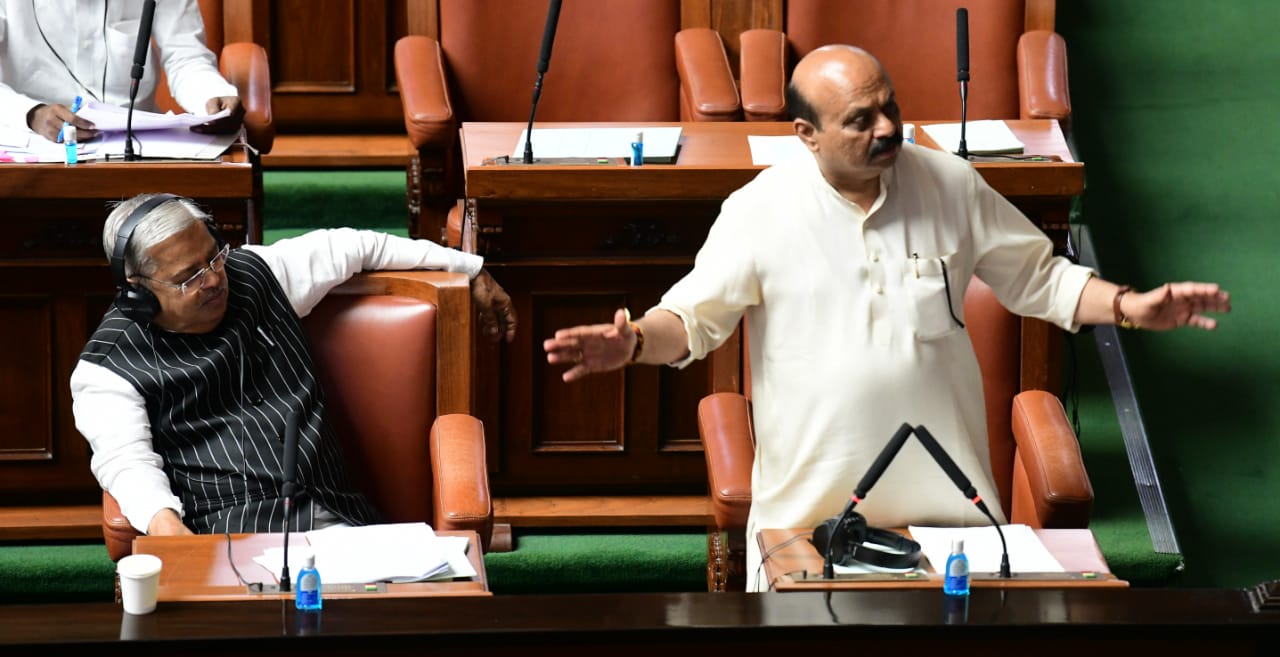
Haveri, Dec 19: Karnataka Chief Minister Basavaraj Bommai in an emotional address to the people of his constituency Shiggaon in this district said nothing is permanent in this world including posts and positions, fuelling speculation in some quarters about his possible exit.
"Nothing is eternal in this world. This life itself is not forever. We don't know how long we will be here in such a situation, these posts and positions are also not forever. I am aware of this fact every moment," he said.
In an expression of gratitude to the people of his constituency, Bommai said he is only 'Basavaraj' for them and not the Chief Minister.
The CM was addressing people after inaugurating the statue of Kittur Rani Chennamma, the 19th Century queen of Kittur in Belagavi district, who fought against the British.
"I have always been saying that outside this place (Shiggaon) I was Home Minister and Irrigation Minister in the past, but once I was in, I remained just 'Basavaraj' for you all.
Today as a Chief Minister I am saying that once I come to Shiggaon, I may be Chief Minister outside but amongst you, I will remain as the same Basavaraj Bommai because the name Basavaraj is permanent and not the posts", he said.
There have been rumours in some quarters that Bommai is likely to be replaced.
The CM is reportedly suffering from knee related problem, and may undergo treatment abroad but there was no official word on this.
The Chief Minister who turned emotional twice recalled how affectionately he was fed 'Rotti' (Jowar Roti) and 'Navane' (foxtail millet) rice every time he came to his constituency as Basavaraj.
"I don't have great things to say. If I could live up to your expectations, that's enough for me. I believe that no power is bigger than your love and trust.
I try my best not to talk to you in an emotional way but sentiments overwhelm me after seeing you all," Bommai said in a choking manner.
Noting that there was a huge responsibility on his shoulders to plan a comprehensive development of the state and to respond to the demands and requests of every community.
The Chief Minister said, "he always kept his conscience awake every moment and in his every deed".
Bommai took over as Chief Minister on July 28 after B S Yediyurappa resigned on the day he completed two years in office.
ಮುಖ್ಯಮಂತ್ರಿ @BSBommai ರವರು ಇಂದು ಶಿಗ್ಗಾಂವ್ ತಾಲೂಕ್ ನಲ್ಲಿ ಕಿತ್ತೂರು ರಾಣಿ ಚೆನ್ನಮ್ಮನವರ ಪುತ್ಥಳಿಗೆ ಹೂಮಾಲೆ ಹಾಕುವುದರ ಮೂಲಕ ಲೋಕಾರ್ಪಣೆ ಮಾಡಿದರು. ನಂತರ ಪಂಚಮಸಾಲಿ ಸಮಾಜದ ಸಮುದಾಯ ಭವನಕ್ಕೆ ಗುದ್ದಲಿ ಪೂಜೆ ಕಾರ್ಯಕ್ರಮವನ್ನು ದೀಪ ಬೇಳಗುವುದರ ಮೂಲಕ ಉದ್ಘಾಟಿಸಿದರು. (1/2) pic.twitter.com/FlnBbGkqgi
— CM of Karnataka (@CMofKarnataka) December 19, 2021
Let the Truth be known. If you read VB and like VB, please be a VB Supporter and Help us deliver the Truth to one and all.
Road crash in UP leaves 10 dead
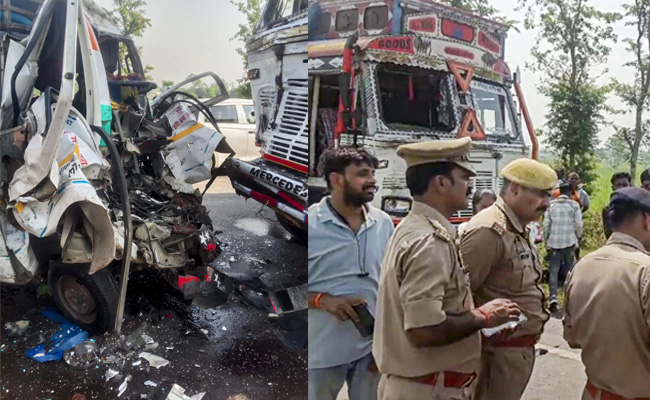
Lakhimpur Kheri (UP) (PTI): Ten people were killed when a van collided head-on with a truck on the Sisaiya-Lakhimpur national highway on Monday, police said.
The van was going to Sisaiya from Lakhimpur when the accident took place between Unchgaon and Bharehta villages.
Circle Officer of Dhaurahra, Shamsher Bahadur Singh, said all nine passengers travelling in the van and the driver were killed.
District Magistrate of Lakhimpur Kheri Anjani Kumar Singh told reporters that the van collided with a truck coming from the opposite direction, leading to nine casualties on the spot, while one succumbed to injuries at the district hospital.
Circle Officer, Dhaurahra, Shamsher Bahadur Singh told PTI, "Efforts are on to establish the identity of other deceased persons."
The seven of the deceased have been identified as Jaideep Singh (25), Pawan (23), Sohan (21), Ram Goyal (42), Sahajram (35), Pappu (18), all residents of Bahraich district and Adnan Khan (15), a resident of Lakhimpur Kheri district, police said.
Condoling the loss of lives in the accident, Uttar Pradesh Chief Minister Yogi Adityanath in a post on X, said, "The loss of life in the unfortunate road accident in Lakhimpur Kheri district is deeply distressing and heart-wrenching. My condolences are with the bereaved families."
"I have directed the local administration to provide prompt and adequate assistance to the injured and the victims. I pray to Lord Shri Ram to grant the departed souls a place at His divine feet and to bestow a speedy recovery upon the injured," Adityanath said on X.
Deputy Chief Minister Keshav Prasad Maurya and Brajesh Pathak too condoled the loss of lives in the accident.
"The loss of lives resulting from the road accident in Lakhimpur Kheri district is deeply tragic and heart-wrenching. My deepest condolences go out to the bereaved families," Maurya said.