No question of banning Bajrang Dal if it plays by rule-book: Congress leader Veerappa Moily
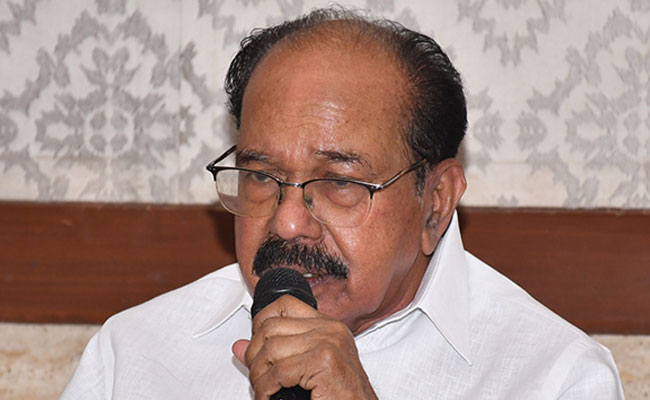
Bengaluru(PTI): There is no question of banning the Bajrang Dal if it plays by the rule-book and behaves itself, senior Congress leader M Veerappa Moily said on Friday, as his party's manifesto proposing to outlaw the outfit continues to come under fire from the BJP.
Speaking to PTI, Moily said the reference should be viewed as the Congress issuing some kind of a notice and warning to Bajrang Dal, and not as if the party is going to ban it if it's voted to power in the May 10 Assembly elections in Karnataka.
On this issue, the former Chief Minister indicated that the Congress would adopt the approach of the then Home Minister Vallabhbhai Patel who, he said, lifted the ban on RSS after receiving an undertaking from the organisation that it would not indulge in "illegal activities".
The Congress in its manifesto for the Assembly polls released earlier this week said it was committed to take firm and decisive action against individuals and organisations spreading hatred amongst communities on grounds of caste and religion.
The party said: "We believe that law and Constitution are sacrosanct and cannot be violated by individuals and organisations like Bajrang Dal, PFI or others promoting enmity or hatred, whether among majority or minority communities. We will take decisive action as per law including imposing a ban on such organisations."
Moily said the "well-drafted" manifesto says organisations and individuals indulging in hate-crimes and illegal and anti-national activities would be severely dealt with and in that context PFI and Bajrang Dal were mentioned, and that the party would go to the extent of imposing a ban. "That does not mean we have done it, we are going to do it (ban)."
The former Union Minister said the Congress party has got its "own culture".
When Mahatma Gandhi was assassinated, Patel banned the RSS, and an order to outlaw the organisation was issued, Moily said. But the then Prime Minister Jawaharlal Nehru took the view that "we will not take that kind of decision, because everybody belonging to RSS is not bad, only a few people may indulge in that. Don't have them (ban) like that and that's how he wanted the Home Minister to lift the ban."
"Before lifting the ban, Patel got an undertaking from the RSS that they will not indulge in politics or any such illegal activity. That undertaking was given (by the RSS). On that condition, the ban was removed. That is how graciously the Congress has dealt with the situation. In future, we will also do the same thing (in case of Bajrang Dal).
"If Bajrang Dal doesn't involve themselves in hate crimes, anti-national or anti-Constitutional issues, or they don't involve themselves in crimes, there is no question of ban, let them behave themselves, that's all, this (manifesto) is some sort of a notice given to them," Moily said.
He said the proposal of the Congress to ban Bajrang Dal would have no adverse impact on the party's electoral prospects in next week's elections.
"People of Karnataka are vigilant, and they are understanding, they realise the importance of it. It's only a warning to those bodies (such as Bajrang Dal) and individuals to behave themselves and work as per Constitution and also go by the rule of law of the country," Moily added.
Let the Truth be known. If you read VB and like VB, please be a VB Supporter and Help us deliver the Truth to one and all.
RR beat RCB by six wickets in IPL
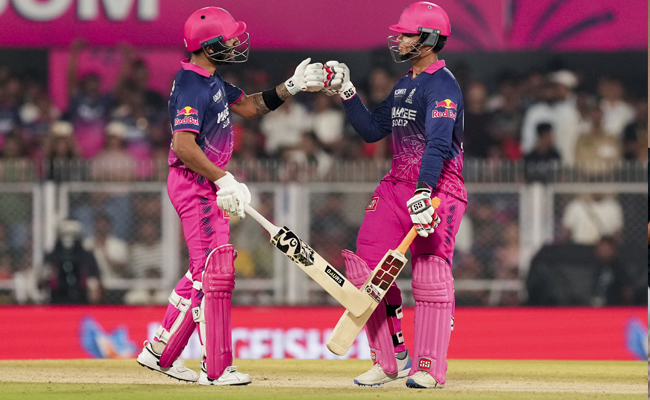
Guwahati (PTI): Blistering fifties by Vaibhav Sooryavanshi and Dhruv Jurel powered Rajasthan Royals to a six-wicket win over Royal Challengers Bengaluru in their IPL match here on Friday.
Sent in to bat, RCB rode on a fighting half-century by skipper Rajat Patidar (63) to post 201 for 8.
Virat Kohli (32), Romario Shepherd (22) and Venkatesh Iyer (29) also chipped in with useful contributions.
In reply, Sooryavanshi (78 off 26 balls) and Dhruv Jurel (81 not out off 43 balls) shared a 37-ball 108-run partnership for the second wicket to set the platform. Krunal Pandya (2/30) tried to bring them back with back-to-back wickets.
But Jurel, in the company of Ravindra Jadeja (24), completed the task with another 68-run stand, with two overs to spare.
For RR, Jofra Archer (2/33), Ravi Bishnoi (2/32) and Brijesh Sharma (2/37) took two wickets.
Brief scores:
Royal Challengers Bengaluru: 201 for 8 in 20 overs (Rajat Patidar 63; Jofra Archer 2/33, Ravi Bishnoi 2/32, Brijesh Sharma 2/37).
Rajasthan Royals: 202 for 4 in 18 overs (Vaibhav Sooryavanshi 78, Dhruv Jurel 80 not out; Krunal Pandya 2/30, Josh Hazlewood 2/44).