Not aware of the case for which I got ED summons, says Karnataka Congress chief DK Shivakumar
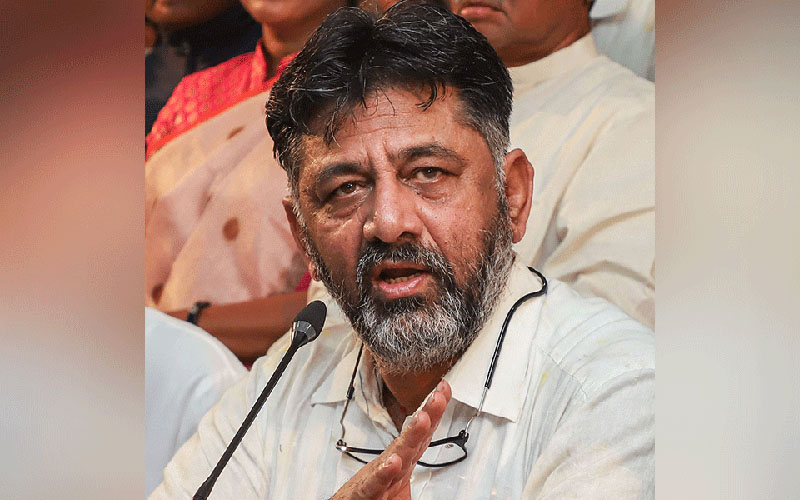
Bengaluru, Sep 16: Congress president in Karnataka, D K Shivakumar, who has been summoned by the Enforcement Directorate (ED), on Friday said he was not aware of the case for which he has been asked to appear before the central agency.
Alleging that those who have business transactions with him are being questioned, Shivakumar said he is unable to understand what illegal acts he has committed.
The ED had earlier arrested Shivakumar on September 3, 2019 in a money-laundering case and the Delhi High Court granted him bail in October that year.
The agency had, in May this year filed the charge sheet against him and others in the case which it had registered as a corollary to a complaint filed by the Income Tax (I-T) department.
The I-T department, during the initial probe, had allegedly found "unaccounted and misreported" wealth linked to the Congress leader.
Shivakumar had rejected the charges against him as "baseless" and "politically motivated."
Addressing reporters today, he said: "Everyday people around me, those who have business transactions with me are being called by ED and CBI and are being questioned. I have asked in the High Court about its origins. I do not know about the case registered by ED, only CBI had filed FIR. What FIR has ED filed and why, I don't know."
The former Minister said there was one case in which a charge sheet was filed by the ED, and that he had appeared before the court in connection with that case.
"With regard to the second case, some people are being investigated about me, I don't know why they are doing it. I will try to know about it. They have called me on Monday, I'm discussing with my advocates. The assembly session is on and there is also 'Bharat Jodo march', I have my own responsibilities too."
Calling the action of the ED as "harassment", both Shivakumar and Congress party have questioned the timing of the summons when the Congress' 'Bharat Jodo Yatra' was on and when the State Assembly session was underway.
They have accused the Narendra Modi-headed government at the Centre of having brought the ED - "the Election Dept of BJP"- to target him.
He said he doesn't know what case the ED has summoned him for. In CBI, there is a disproportionate assets case for which the then government led by B S Yediyurappa had given permission (for prosecution), and an FIR has been booked in that case.
Asked whether he will appear before ED, he said, "let's see....but I will cooperate. Our workers are a bit upset looking at the harassment; all those who were with me are being harassed. I'm unable to understand what illegal things I have committed."
Let the Truth be known. If you read VB and like VB, please be a VB Supporter and Help us deliver the Truth to one and all.
UP man gets life term for electrocuting mentally challenged wife to death in Bareilly
Bareilly (UP) (PTI): A local court here has sentenced a man to life imprisonment for murdering his mentally challenged wife by repeatedly electrocuting her while she was tied to a cot, lawyers said on Thursday.
Additional district government counsel Harendra Singh Rathore said Additional Sessions Judge Avinash Kumar Singh on Wednesday convicted Vinod Kumar (45) for killing his wife, Satyavati, in Chaina village of Bareilly district and imposed a fine of Rs 15,000 on him.
According to the prosecution, he was allegedly frustrated with his wife Satyavati's mental illness and often assaulted her.
Rathore said the prosecution examined nine witnesses to establish the charges against him.
As per court records, on the night of May 1-2, 2022, when Satyavati was asleep, Vinod tied her hands and legs to a cot using ropes and then connected an aluminium cable to an electric board to repeatedly administer electric shocks to her.
"She writhed in pain, but the accused continued to electrocute her until she died," the prosecution said.
The court observed that the murder was carried out in an inhuman manner.
After committing the crime, the accused threw the rope and cable on the roof and left for work at a brick kiln around 2 am to create a false alibi.
He later tried to mislead the police and the victim's family by claiming that Satyavati, whose mental condition was unstable, had accidentally died by suicide after grabbing a live electric wire.
However, the victim's brother, Sanjeev, a resident of Shahjahanpur district, suspected foul play and lodged an FIR under sections 498A (husband subjecting wife to cruelty) and 302 (murder) of the Indian Penal Code at Nawabganj police station.
During the trial, the prosecution relied on the post-mortem report prepared by Dr Faraz Anwar, who stated that multiple electrocution marks found on different parts of the victim's body could not have been self-inflicted.
The police also recovered the rope and electric wire used in the crime on the accused's identification, officials said.