Not in violation of any rules: Karnataka govt says on EC letter on ads in Telangana newspapers
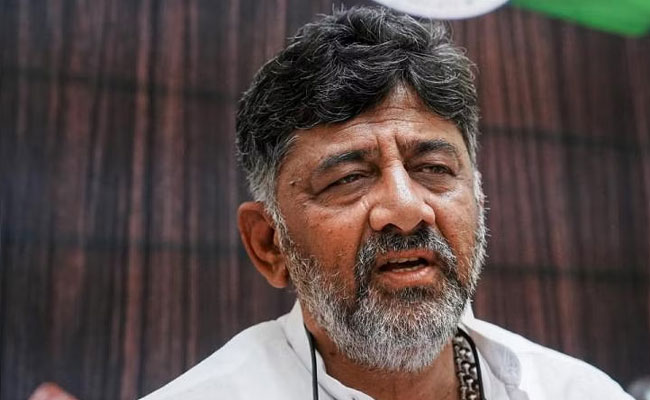
Bengaluru (PTI): Karnataka Deputy Chief Minister D K Shivakumar on Tuesday said that the state government's advertisements about its work in newspapers in poll-bound Telangana do not violate any rules, as they did not ask for votes.
He said the government would respond to the Election Commission's letter on this.
The BJP on Monday had lodged a complaint with the EC in the matter, alleging that the Congress violated the Representation of the People Act and the Model Code of Conduct with its government in Karnataka publishing advertisements in Telangana media with an eye on the November 30 assembly polls there.
The Election Commission on the same day asked the Congress government in Karnataka to stop publishing advertisements about its work in newspapers Telangana, and sought an explanation from it for not seeking prior approval as mandated under the Model Code of Conduct (MCC).
Speaking to reporters here, Shivakumar said that the advertisements were only aimed at projecting the work done by the Karnataka government amid claims by opposition parties that it did not implement any of its 'guarantee schemes'.
"We have not committed any violation; the Karnataka government has not asked anyone for votes... What violation have we committed?," he asked in response to a question about the EC's directions.
"Whatever work we have done, we have just presented them to various states -- to newspaper readers whether in Karnataka, Tamil Nadu, or Telangana... There is no problem," he insisted.
The ads were a counter to the opposition's claims about the Karnataka government, and did not canvass for votes, he reiterated. "They (opposition parties) were trying to propagate that we have not implemented (guarantee schemes) -- we have just said it (about implementation of guarantees in the ads), we have not asked for any votes.
"If we have asked any votes, then (it is) okay (to question), but we have not asked for votes from anyone; we have not said vote for Congress or X or Y."
He sought to compare the ads with those given by other governments in newspapers. "There will be so many magazines or publications covering lots of issues. They (other governments) also will give a lot of other advertisements. We are projecting ourselves (Karnataka govt), we are not projecting the Congress party -- we will definitely reply (to EC)," he said.
Telangana's ruling Bharat Rashtra Samithi (BRS) too had approached the poll panel on the issue.
In a letter to the Karnataka Chief Secretary, the panel said the state government did not obtain prior approval from it for publishing the advertisements, and that its action was violative of the poll code instructions issued to the central and state governments years ago.
It also instructed the Government of Karnataka to stop publishing any such advertisements in Telangana, with immediate effect, until it obtains the necessary approvals.
The EC has sought an explanation by 5 pm on Tuesday on the circumstances that led to the violation of the MCC.
In its letter, the commission also asked why disciplinary action should not be taken against the secretary-in-charge of the Department of Information and Public Relations for violations of procedure, as mentioned under MCC instructions.
In the past, the panel had observed that certain advertisements highlighting welfare schemes and achievements of the central and state governments were being published by some non-poll going states in newspapers in poll-bound states. It had considered this to be a violation of the spirit of the Model Code of Conduct.
In 2013, it had directed that, in future, all such advertisements issued by non-poll going states during the period in which the MCC is in force would be forwarded to the panel for clearance before they are sent for publication in newspapers having editions or circulation in poll-bound states.
The Telangana assembly polls will be held on November 30. Votes will be counted and results declared on December 3.
Let the Truth be known. If you read VB and like VB, please be a VB Supporter and Help us deliver the Truth to one and all.
Jharkhand: 3 arrested for 'raping' 2 women in Gumla

Gumla (PTI): Three persons were arrested on Monday for allegedly raping two women at a village in Jharkhand’s Gumla district, police said.
All the three accused have been remanded to judicial custody, Gumla Sadar Police Station officer-in-charge, Mahendra Karmali, told PTI.
According to police, one of the women had been called to Gumla Sadar by her boyfriend on Sunday for an outing.
“She arrived at the spot accompanied by a female. The woman’s boyfriend then called a friend, and they took the two women to a secluded place in Sisai police station area in the evening, forcibly made them consume alcohol before raping them,” the officer said.
The accused later called another man to the spot, who also allegedly raped the women, he said.
“The women later reached the Sadar Police Station and lodged a complaint on Sunday night. Police conducted raids and nabbed the three accused on Monday,” he added.
Further investigation is underway.