NWKRTC bus seized by Court for failing to pay ₹34 Lakh compensation to accident victim's family
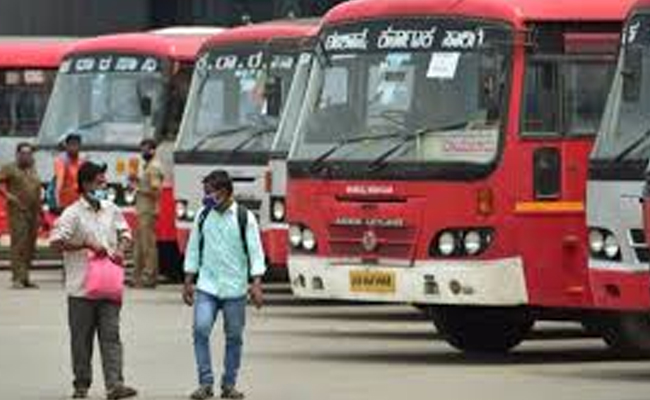
Kalaburagi: A bus belonging to the North-Western Karnataka Road Transport Corporation (NWKRTC) was seized by a local court in Kalaburagi for failing to pay ₹34 lakh in compensation to the family of a road accident victim. The seizure follows a court order from the Afzalpur JMFC court, which had directed NWKRTC to compensate the family of Sharanabasu Vadangeri, who lost his life in a bus accident.
In 2021, Vadangeri, a 34-year-old resident of Chowdapur village, was fatally struck by an NWKRTC bus while it was leaving the Chikodi bus station. The court found that the bus driver's negligent and reckless driving was the primary cause of the accident and held NWKRTC responsible for Vadangeri's death.
Despite the court's ruling, NWKRTC challenged the verdict, arguing that Vadangeri was at fault. However, the court rejected this claim and reaffirmed its decision, ordering NWKRTC to pay ₹34 lakh in compensation to Vadangeri's family, along with 8% annual interest. The court gave NWKRTC a 60-day window to comply with the ruling.
NWKRTC's failure to comply with the court's order led to further legal action. On Saturday, court officials executed the court's directive by seizing a bus from the Afzalpur bus terminal, estimated to be worth ₹40 lakh. The seized bus was subsequently parked on the court premises.
The court is expected to auction the bus, with the proceeds likely to be given to Vadangeri's family as compensation for their loss.
Let the Truth be known. If you read VB and like VB, please be a VB Supporter and Help us deliver the Truth to one and all.
11k litres of milk poured into Narmada river after religious event; environmentalists see red
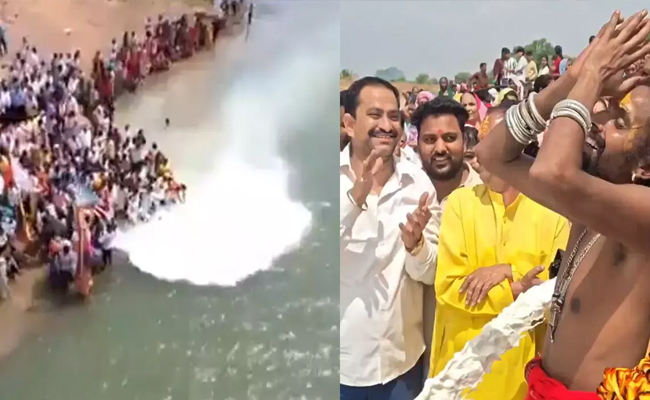
Sehore (PTI): Around 11,000 litres of milk were poured into Narmada river, often called the lifeline of Madhya Pradesh, in Sehore district on the culmination of a 21-day religious event as part of a sanctification ritual, prompting environmentalists to flag its negative impact on the ecosystem.
The event concluded at Satdev village in Bherunda area, located about 90 km from the district headquarters, with a 'mahayagna' on Wednesday.
The milk was offered to the river as part of rituals and prayers for the purity of the waters, the well-being of pilgrims and prosperity, organisers said.
The milk was brought in tankers to the riverbank and later poured into the flowing water amid chanting of mantras in the presence of a crowd of devotees.
However, environmentalists raised concerns over the practice, warning of its potential ecological impact.
"Such large quantities of organic matter can deplete dissolved oxygen in water, adversely affecting the river ecosystem. These impact local communities dependent on the river for drinking water and threaten aquatic life as well as domestic animals," noted environmentalist and wildlife activist Ajay Dube said.
Religious offerings should be symbolic and mindful, he asserted.
Renowned environmentalist Subhash Pandey said 11,000 litres of milk acts as a significant organic pollutant.
"It is highly oxygen-demanding and can lead to oxygen depletion, aquatic mortality, eutrophication (process of plants growing on river surface) and loss of potability. These effects are predictable from dairy-effluent chemistry and have been documented in similar incidents worldwide," Pandey pointed out.
Narmada originates at Amarkantak in the state and traverses 1,312 km westward to Maharashtra and Gujarat, emptying into the Arabian Sea via the Gulf of Cambay.
It is the largest west-flowing river in the peninsula, passing through a rift valley, and acts as a crucial water source for irrigation in MP, Gujarat and Maharashtra.