"Out of bounds": Curious case of 2 "banned-entry" candidates in K'taka Assembly polls
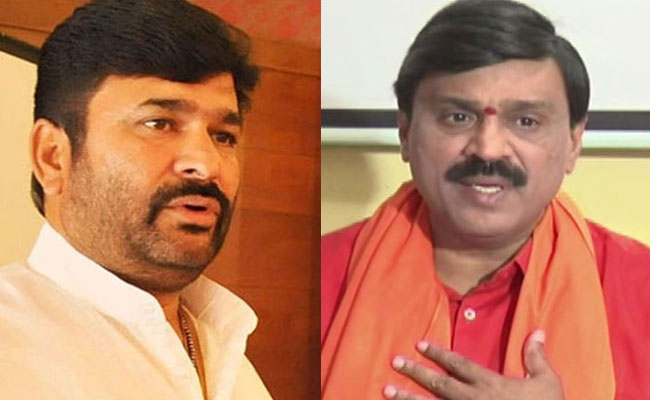
Bengaluru (PTI): Two "banned-entry" candidates Vinay Kulkarni and G Janardhana Reddy present a picture of a peculiar case in the run-up to the May 10 Karnataka Assembly elections.
While the Congress candidate Kulkarni can't go to Dharwad, the constituency he is contesting from, following a court-imposed ban, Reddy fielded his wife in Ballari city as he is barred from entry there.
Kulkarni's wife Shivaleela filed the nomination on his behalf.
"Our supporters are backing us with a firm belief that 'Saheb' will come here. In his absence I am seeking the blessings of the voters asking them treat me as 'Saheb'," she told reporters.
Since video and phone calls are the only means to reach out to his voters, Kulkarni in a video message said, "I will immerse myself for you and my constituency. You are my strength who backed me today."
Former Minister Kulkarni was arrested and remanded to judicial custody in November 2020 in connection with the murder of BJP leader and Zilla Panchayat member Yogeshgouda Goudar in June 2016.
He was granted bail by the Supreme Court on the condition that he would not be allowed to enter Dharwad, the district known as cultural capital of Karnataka as it produced acclaimed literatteurs and music maestros, without the permission of the jurisdictional court.
The jurisdictional Special Court in Bengaluru had rejected his request requesting entry, after which he had approached the High Court where his petition was dismissed by Justice K Natarajan on Friday.
Kulkarni's advocate had argued that he needs to be in the constituency to campaign.
The HC observed that the party, which gave him ticket to contest, should have known that he was forbidden by the court from entering Dharwad.
The case of former mining baron Janardhana Reddy of the famed 'Reddy brothers of Ballari' is not much different compared to Kulkarni.
A former BJP minister, Reddy has been barred by the apex court from entering Ballari in Karnataka and Anantapur and YSR Kadapa districts in Andhra Pradesh in connection with illegal mining case.
Reddy had severed ties with the BJP and floated a new party Kalyana Rajya Pragathi Paksha (KRPP). His brothers G Karunakara Reddy and G Somashekhara Reddy are with the BJP and are contesting from Ballari City and Harapanahalli, respectively, on the party ticket.
Since he is not allowed to enter Ballari, Reddy chose to contest from neighbouring Gangavathi in Koppal district.
The KRPP leader has fielded his wife Lakshmi Aruna G from Ballari City constituency against his brother Somashekhara Reddy.
Lakshmi Aruna was in tears on the day of filing her nomination papers as she missed her husband, who could not accompany with her.
She sought the blessings of voters to complete the projects such as ring road, airport, superspecialty hospital and drinking water, which Janardhana Reddy had started but "halted midway."
Janardhana Reddy said: "I am concentrating only in those constituencies wherever I have the scope of winning the election. My target is to win 20 to 28 seats. I am building party at the booth level with the available strength," he had told reporters.
Barred entry, Reddy cannot canvass for his wife or any other candidates that the party has fielded in Ballari district it considers as its stronghold.
Let the Truth be known. If you read VB and like VB, please be a VB Supporter and Help us deliver the Truth to one and all.
Two held in UP's Bijnor for contact with Pakistan linked Dubai handler
_vb_24.jpeg)
Bijnor (PTI): Two men were arrested in this Uttar Pradesh district on Friday for allegedly being in touch with a Pakistan-linked handler based in Dubai, police said.
Circle Officer, Najibabad, Anjani Kumar Chaturvedi said Uvaid Malik and Jalal Haider were arrested following inputs on their alleged links with Aqib, a resident of Meerut currently staying in Dubai.
According to police, Aqib had earlier come into the spotlight after a video surfaced on Instagram purportedly showing him displaying an AK-47 rifle and explosives.
During interrogation, the arrested men allegedly told police that Aqib used to incite youngsters against Hindus and encourage anti-national activities, the officer said, adding that detailed questioning of the accused is underway.
On April 6, Superintendent of Police (SP) Abhishek Jha said the video first surfaced in November last year. Aqib, a native of Sathla village in the Mawana area of Meerut, was allegedly seen in the video brandishing weapons.
Following the viral clip, a case was registered at the Nangal police station by sub-inspector Vinod Kumar. However, the then station house officer and investigating officer Satyendra Singh had recorded Aqib's statement and filed a final report, stating that the weapons seen in the video were toys, effectively giving him a clean chit.
Police said fresh developments have now revealed Aqib's suspicious links and the probe has been handed over to the Anti-Terrorist Squad (ATS).
The SP said action has been taken against the officials concerned, with the then SHO and investigating officer suspended and Circle Officer Nitesh Pratap Singh removed from his post.