Over 150 people lose Rs 1 crore in Karnataka via fake ‘Trump app’ scam: Report

Haveri: More than 150 individuals across Karnataka have reportedly fallen victim to a scam involving a mobile application falsely associated with U.S. President Donald Trump.
The total loss incurred by victims exceeds Rs 1 crore, with cases emerging in cities including Bengaluru, Tumakuru, Mangaluru, and Haveri, as reported by Deccan Herald on Sunday.
The scam involved the use of a fraudulent mobile application, named after Trump, and an AI-generated video impersonating him, which was circulated widely across social media platforms. The doctored video, which appeared to promote a financial opportunity, misled people into believing it was part of a legitimate campaign.
Victims were reportedly encouraged to call a number displayed alongside the video. Once contact was made, scammers convinced them to invest money with the promise of quick and high returns.
“Victims who fell into the fraudsters’ trap were promised rich rewards for their investment, besides opportunities to work from home. In Haveri alone, more than 15 such people have been swindled,” DH quoted Haveri Cybercrime Economics and Narcotics (CEN) inspector Shivashankar R. Ganachari as saying.
One of the fake apps created by the fraudsters was called ‘Trump Hotel Rental’, and it was promoted with promises that users could double their investments by simply installing the app and completing assigned tasks.
Users were required to pay an initial fee to activate their accounts and begin earning.
“We were asked to pay Rs 1,500 to set up our accounts, and asked to write profiles of companies," DH quoted one of the victims as saying. "Completion of each such task was accompanied by an increase in the money we had supposedly earned on our dashboard. In reality, I lost more than Rs 1 lakh,” rued the victim.
Let the Truth be known. If you read VB and like VB, please be a VB Supporter and Help us deliver the Truth to one and all.
Ordinance issued to increase number of Supreme Court judges from 34 to 38
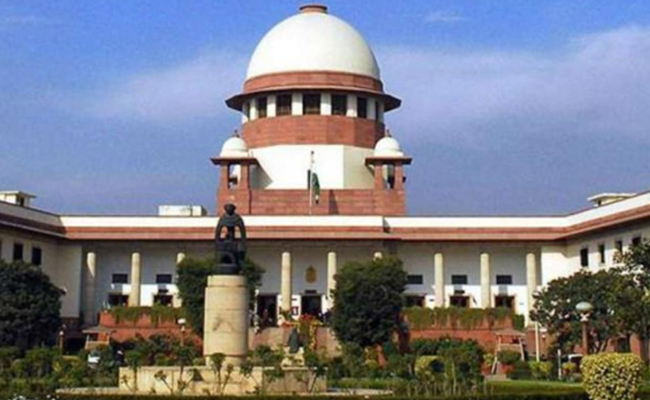
New Delhi (PTI): The government has promulgated an ordinance to increase the strength of the Supreme Court from the present 34 judges to 38, including the Chief Justice of India.
The law ministry notified the ordinance on Saturday, which amended the Supreme Court (Number of Judges) Act, 1956, to increase the sanctioned strength of the top court.
So far, the sanctioned strength of the top court was 34, including the Chief Justice of India (CJI). Now, the number of judges has been increased by four, taking the sanctioned strength to 38.
The top court will now have 37 judges, other than the CJI.
With the apex court having two vacancies at present, and the ordinance coming into force immediately, the Supreme Court Collegium will now have to recommend six names for appointment as judges in the top court.
A bill will be brought in the Monsoon Session of Parliament to convert the ordinance – an executive order – into a law passed by Parliament.
The Union Cabinet had cleared a draft bill on May 5 to increase the number of apex court judges.
The strength of the Supreme Court was last increased from 30 to 33 (excluding the CJI) in 2019.
The Supreme Court (Number of Judges) Act, as originally enacted in 1956, put the maximum number of judges (excluding the CJI) at 10.
This number was increased to 13 by the Supreme Court (Number of Judges), Amendment Act, 1960, and to 17 by another amendment to the law.
The Supreme Court (Number of Judges) Amendment Act, 1986, augmented the strength of judges from 17 to 25, excluding the CJI.
A fresh amendment in 2009 further increased the strength from 25 to 30.
Article 124(3) of the Constitution lists the qualifications required to become a Supreme Court judge.
An Indian citizen who has either served as a high court judge for at least five years, or as an advocate for 10 years, or is a distinguished jurist, can be appointed to the top court.
The strength of the Supreme Court is increased based on the recommendations of the CJI, who writes to the Union law minister. After consulting the finance ministry, the Department of Justice under the law ministry moves the Cabinet with a draft bill.