Power tariff hike in Karnataka prompts protests by traders, small business owners
Price of rice and water too may go up
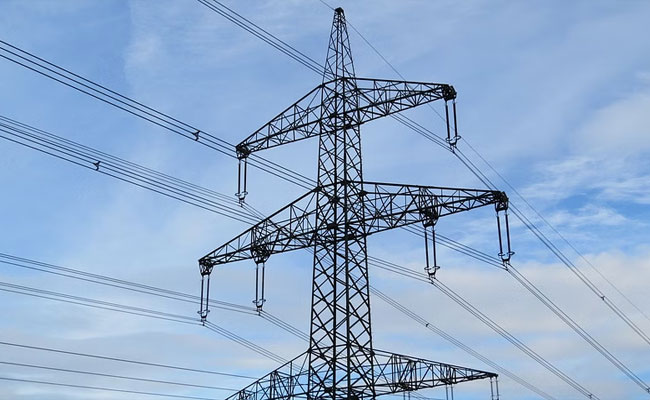
Bengaluru (PTI): Traders and small business owners held protest rallies in several parts of Karnataka and observed a one day strike on Thursday opposing the recent power tariff hike, even as the state's Medium and Large Scale Industries Minister M B Patil appealed to them to cooperate with the state government. He asserted that the power tariff was increased by the Karnataka Electricity Regulatory Commission (KERC) and not the state government.
Meanwhile, the Karnataka State Rice Millers' Association (KSRMA) has hinted that the rice prices may be increased in the state by about Rs three to Rs four per kg.
"It is not us who are increasing the price. The power tariff and paddy prices have gone up. The hike will be by Rs three to Rs four per kg across the fine rice varieties," KSRMA General Secretary S Shiva Kumar said.
Following a call for a 'bandh' given by Hubballi-based Karnatak Chamber of Commerce and Industry (KCCI), industrialists and small traders participated in a protest march in big numbers. Their protests came at a time when the state government started the registration process earlier this week for the 'Gruha Jyoti' scheme offering up to 200 units of free electricity for residential connections.
Carrying banners, posters and placards, the traders and industrialists held marches in the district headquarters of Hubballi-Dharwad, Shivamogga, Belagavi, Ballari, Vijayanagar, Davangere and Koppal, among others. They shouted slogans demanding that the government roll back the hike.
In Belagavi, a large number of traders and small-and-micro industry owners marched up to the office of the Deputy Commissioner with their banners and placards.
KCCI acting president Sandeep Bidasaria claimed that the hike in power tariff has gone up between 50 and 70 per cent, which has deeply impacted small businesses.
A protester in Belagavi, a city bordering Maharashtra, alleged that many industries were planning to move out to the neighbouring state due to the drastic increase in tariff.
Many shops were shut and production was stopped in small industries in several parts of the state in response to the bandh call. In the district headquarters town of Bidar, several shops were shut and the main market wore a deserted look following the Bandh.
In an attempt to make the protestors see reason, Minister Patil said, "First of all, the power tariff has not been hiked by us. Karnataka Electricity Regulatory Commission, an autonomous body, has increased the power tariff before our government came to power. So we have no connection with the power tariff hike".
According to him, Chief Minister Siddaramaiah too has given a statement that the power tariff hike cannot be rolled back.
However, Patil told reporters that he would discuss the matter with Siddaramaiah and Energy Minister K J George.
"I appeal to everyone, the industries and others, to please cooperate. KERC keeps revising prices from time to time. It follows a procedure. It is not done by the government. They revised the tariff now and will do it in future as well," the minister said.
Amid speculations that the Bangalore Water Supply and Sewerage Board was also planning to revise the water supply charges, an official said a BWSSB team apprised Deputy Chief Minister D K Shivakumar, who holds the Bengaluru Development portfolio, on the issues.
"We told the DCM that we have not revised the water supply charges for the past 10 years and it's about time to increase the rate given the increase in input costs. The decision has not been taken yet. The matter is under consideration," the official said.
Let the Truth be known. If you read VB and like VB, please be a VB Supporter and Help us deliver the Truth to one and all.
11k litres of milk poured into Narmada river after religious event; environmentalists see red
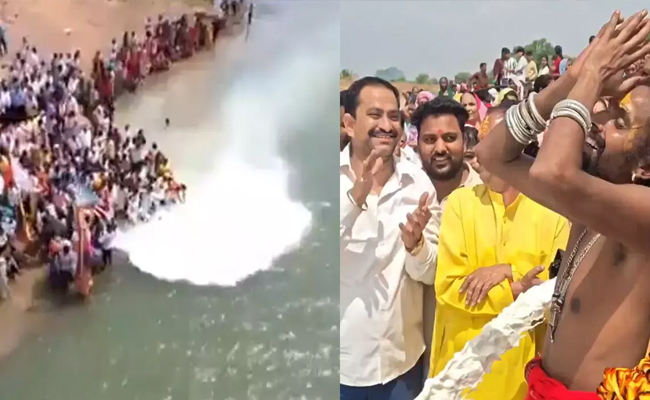
Sehore (PTI): Around 11,000 litres of milk were poured into Narmada river, often called the lifeline of Madhya Pradesh, in Sehore district on the culmination of a 21-day religious event as part of a sanctification ritual, prompting environmentalists to flag its negative impact on the ecosystem.
The event concluded at Satdev village in Bherunda area, located about 90 km from the district headquarters, with a 'mahayagna' on Wednesday.
The milk was offered to the river as part of rituals and prayers for the purity of the waters, the well-being of pilgrims and prosperity, organisers said.
The milk was brought in tankers to the riverbank and later poured into the flowing water amid chanting of mantras in the presence of a crowd of devotees.
However, environmentalists raised concerns over the practice, warning of its potential ecological impact.
"Such large quantities of organic matter can deplete dissolved oxygen in water, adversely affecting the river ecosystem. These impact local communities dependent on the river for drinking water and threaten aquatic life as well as domestic animals," noted environmentalist and wildlife activist Ajay Dube said.
Religious offerings should be symbolic and mindful, he asserted.
Renowned environmentalist Subhash Pandey said 11,000 litres of milk acts as a significant organic pollutant.
"It is highly oxygen-demanding and can lead to oxygen depletion, aquatic mortality, eutrophication (process of plants growing on river surface) and loss of potability. These effects are predictable from dairy-effluent chemistry and have been documented in similar incidents worldwide," Pandey pointed out.
Narmada originates at Amarkantak in the state and traverses 1,312 km westward to Maharashtra and Gujarat, emptying into the Arabian Sea via the Gulf of Cambay.
It is the largest west-flowing river in the peninsula, passing through a rift valley, and acts as a crucial water source for irrigation in MP, Gujarat and Maharashtra.