Pralhad Joshi seeks opposition cooperation in smooth conduct of LS session
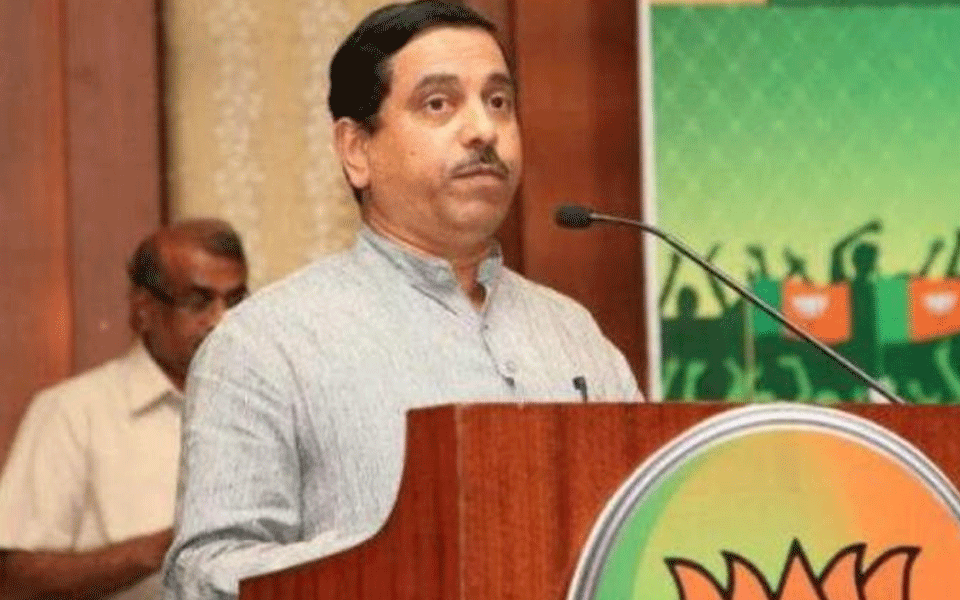
Bengaluru, Jun 1: Seeking opposition's cooperation in the smooth conduct of the upcoming Lok Sabha session, newly-appointed Parliamentary Affairs Minister Pralhad Joshi Saturday said the government was ready for discussion on any issue.
The first session of the 17th Lok Sabha will be held from June 17 to July 26, with the regular budget to be presented on July 5.
"I request all the opposition parties, people have given unprecedented mandate in favour of Narendra Modi and the BJP. For five years lets successfully conduct the sessions and discuss on issues.The government is ready for discussion on any issue," Joshi said.
Speaking to reporters on his visit to the city after taking over as minister, he said it is common belief that in the Lok Sabha there should be debates, discussions and not disruptions.
"So following the peoples mandate lets all work together- is our request to all the opposition parties. In the days to come we will call a meeting in this regard, so I seek their cooperation," Joshi said.
He pointed out that there are four ministers from Karnataka in the Modi cabinet and they would meet once in 15 days and discuss on Karnataka related issues and follow up.
"We want to protect the interest of Karnataka that's our decision," he said, adding that the big result to the BJP led by Modi was a huge responsibility, "as expectations of people are very high."
Karnataka Lok Sabha members-- Pralhad Joshi, D V Sadananda Gowda (Chemical and Fertilizer) and Suresh Angadi (MoS Railway) were inducted into the ministry Thursday, apart from Nirmala Sitharaman (Finance), who is a Rajya Sabha MP from the state.
Responding to a question on the Mahadayi river water issue, he said both the Karnataka and Goa governments have sought clarification and have appealed to the Supreme Court on the matter.
"... let Karnataka government call an all party meeting and legal experts, if they want notification, we will participate in it.
Legal experts, who had represented Karnataka, had earlier said since both states have filed an appeal, it cannot be done. But if experts say it is possible, lets try, we have no objection," he said.
Mahadayi river tribunal had delivered its verdict allocating 13.5 tmcft of water to Karnataka.
As all three riparian states (Karnataka, Goa, Maharashtra) have sought clarifications from the tribunal on its final judgment and as states have also gone to the Supreme Court against it, the Centre has refused to notify the tribunals verdict citing legalities.
When pointed out that a BJP government was in power in Goa, Joshi said parties in the states would take a stand for their state.
Earlier, too, Congress governments were there at the Centre, at Goa and here, he said.
"The Mahadayi issue did not crop up after Modi came or Pralhad Joshi," he said.
Asked if the prime minister would intervene and solve the issue at this stage, Joshi, without giving any direct response, blamed the Congress for taking the matter to the tribunal.
The minister, who also holds the coal department portfolio, said there would not be any shortage in supply of coal.
"...there is minimum stock of 15-16 days everywhere, whatever demand comes that will be supplied," he added.
On a query that a report was submitted by a Congress leader to the party leadership alleging that the BJP had distributed money to win the Tumkur Lok Sabha seat, Joshi said the Congress should stop levelling such "wild allegations", especially after the people have rejected them in the polls.
Former prime minister and JD(S) supremo H D Deve Gowda faced defeat from the seat.
"What have they done (distributed money) in Mandya, Hassan, Bengaluru Rural and Tumkur? The people of the state know very well. Let us not talk about it. The people have already given the mandate and the time is now to work," he said.
On the Karnataka government, Joshi said, "We have told many times, we don't need to do anything. They will collapse on their own."
Asked what were the options for the BJP if the JD(S)-Congress government falls, Joshi said "There are many options. The BJP is the single largest party in the state. We will explore all options when the time comes, including going for fresh elections."
On AIMIM chief and Hyderabad MP Asaduddin Owaisi's remarks that the BJP sees terrorists wherever there are Muslims, Joshi said it is inappropriate to link Hyderabad to Muslims.
"Why should Owaisi link Hyderabad to Muslims when our cabinet minister from Telangana, Kishan Reddy, referred to Hyderabad. He did not mention or target Muslims, but terrorists," he said.
Newly-appointed Union Minister of State for Home Reddy has reportedly alleged that whenever a terrorism-related incident takes place in the country, its roots are traced to Hyderabad. Owaisi criticised him for the remarks.
Let the Truth be known. If you read VB and like VB, please be a VB Supporter and Help us deliver the Truth to one and all.
Trump says EU has until July 4 to approve last year's trade deal or it will face higher tariffs
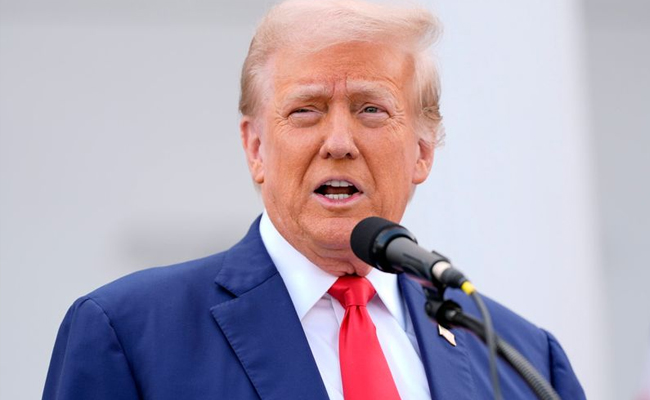
Washington (AP): President Donald Trump has said in a social media post that goods from the European Union would face higher tariff rates if the 27-member bloc fails to approve last year's trade framework by July 4.
The announcement on Thursday appeared to be a deadline extension after the president said last Friday that EU autos would face a higher 25 per cent tariff starting this week. Trump made the updated announcement after what he described as a "great call" with European Commission President Ursula von der Leyen.
Still, the US president was displeased that the European Parliament had yet to finalize the trade arrangement reached last year, which was further complicated in February by the US Supreme Court ruling that Trump lacked the legal authority to declare an economic emergency to impose the initial tariffs used to pressure the EU into talks.
"A promise was made that the EU would deliver their side of the Deal and, as per Agreement, cut their Tariffs to ZERO!" Trump posted. "I agreed to give her until our Country's 250th Birthday or, unfortunately, their Tariffs would immediately jump to much higher levels."
It was unclear from the post whether Trump was implying that the tariff rates would jump on all EU goods or the increase would only apply to autos.
His latest statement indicates he might be backing away from his earlier threat on EU autos by giving the European Parliament several more weeks to approve the agreement.
Under the original terms of the framework, the US would charge a 15 per cent tax on most goods imported from the EU.
But since the Supreme Court ruling, the administration has levied a 10 per cent tariff while investigating trade imbalances and national security issues, aiming to put in new tariffs to make up for lost revenues.