Religious conversions rampant in K'taka, says govt; anti-conversion Bill being mulled
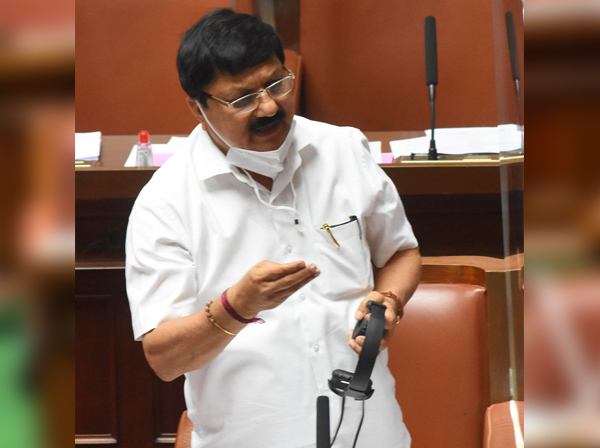
Bengaluru, Sep 15: The Karnataka Legislative Council on Thursday took up the "contentious" legislation against religious conversions for consideration and passage.
The 'Karnataka Protection of Right to Freedom of Religion Bill' was passed by the Legislative Assembly in December last.
As the Bill was pending for passage in the Legislative Council, where the ruling BJP was short of majority then, the government had subsequently promulgated an ordinance in May this year to give effect to the bill.
Home Minister Araga Jnanendra piloted the Bill for the consideration of the Upper House today.
Stating that in recent times religious conversions have become widespread, he said there have been mass conversions with allurements and through force, disturbing peace and leading to mistrust among people following different religions.
The Bill does not take away anyone's religious freedom and anyone can practise the religion of his or her choice, but not under pressure and allurements, Jnanendra said.
The Minister moved some amendments to substitute certain clauses in the Bill like: It (legislation) shall be deemed to have come into force with effect from the 17th day of May 2022;" also that "....the ordinance is hereby repealed".
Earlier, during the passage of the Bill in the Legislative Assembly, Jnanendra had said eight States have passed or were implementing such a law, and Karnataka would become the ninth.
The Bill provides for protection of right to freedom of religion and prohibition of unlawful conversion from one religion to another by misrepresentation, force, undue influence, coercion, allurement or by any fraudulent means.
It proposes an imprisonment from three to five years with a fine of Rs 25,000 while for violation of provisions with respect to minors, women, SC/ST, the offenders will face imprisonment from 3 to 10 years and a fine of not less than Rs 50,000.
The Bill makes provisions also for the accused to pay up to Rs five lakh as compensation to those who were made to convert, and with regard to cases of mass conversion there shall be a 3-10 year jail-term and a fine of up to Rs one lakh.
It also states that any marriage which has happened for the sole purpose of unlawful conversion or vice-versa by the man of one religion with the woman of another, either by converting himself before or after marriage or by converting the woman before or after marriage, shall be declared as null and void by the Family Court.
Wherever that court is not established, a court having jurisdiction can try such a case on a petition presented by either party thereto against the other party of the marriage.
The offence under this Bill is non-bailable and cognisable.
The Bill mandates that persons who wish to convert to another faith shall give a declaration in a prescribed format at least 30 days in advance to the District Magistrate or the Additional District Magistrate specially authorised by the District Magistrate in this regard of his residing district or place of birth within the State.
Also the religious converter who performs the conversion shall give 30 days advance notice in a format to the District Magistrate or the Additional District Magistrate.
The Minister further said the person who wishes to convert will lose the religion of his or her origin and facilities or benefits attached with it, including reservations; however, one is likely to receive the benefits entitled to in the religion he or she converts to.
Let the Truth be known. If you read VB and like VB, please be a VB Supporter and Help us deliver the Truth to one and all.
Man dragged into river by crocodile in Vadodara; search ops underway
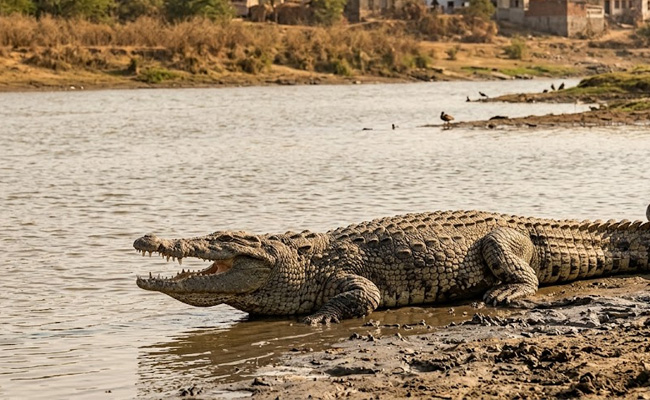
Vadodara (PTI): A 22-year-old man was dragged into a river by a crocodile in Gujarat's Vadodara district on Thursday and search operations are currently underway to locate him, a police official said.
The incident took place at 1:30pm when Mithun Vasava, a resident of Kagdipara village, had gone to take a dip in Dev river amid the stifling heat, the official told PTI.
"The crocodile suddenly attacked the man and dragged him into the river. Search operations are currently underway to locate Vasava," the official added.