Researchers find evidence of 4,000-year-old human settlement in Karnataka's Maski: Report
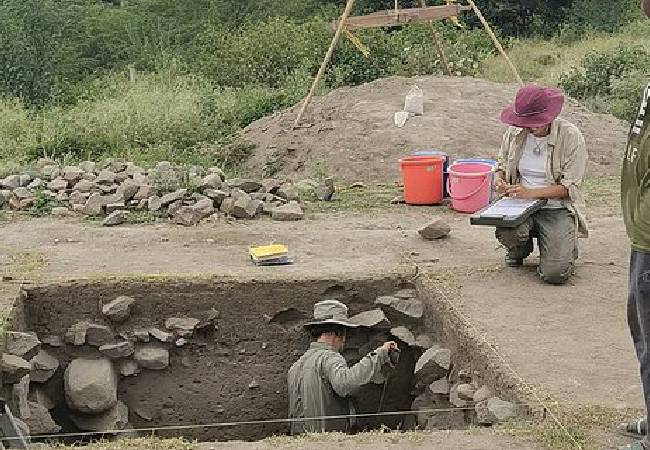
Maski: A collaborative team of international and Indian researchers has uncovered evidence of a 4,000-year-old human settlement in Maski, a town in Karnataka’s Raichur district, reported Deccan Herald on Thursday.
A group of over twenty researchers from the United States, Canada, and India has been excavating areas around Mallikarjun Hill and the Anjaneya Swamy temple in Maski for the past three months. During the dig, they unearthed various artefacts and tools dating back 4,000 years, suggesting the presence of a once-thriving human settlement.
The excavation team includes Professor Andreem M. Bower of Stanford University (USA), Peter G. Johansson of McGill University (Canada), and Hemanth Kadambi from Noida University (India).
The team started digging around in Maski after obtaining permission from the ASI. They identified 271 locations of archaeological interest and stumbled upon evidence confirming that the region around the Mallikarjun Hill and the temple were inhabited by people between the 11th and 14th centuries BCE, added the report.
“We have found evidence that indicates that there was a human settlement in Maski around 4,000 years ago,” DH quoted Kadambi as saying.
Among the artefacts unearthed are various domestic tools and cooking implements, including earthen pots and pans.
This new finding further enhances Maski’s historical significance, which gained prominence with the earlier discovery of an inscription dating back to the time of Mauryan emperor Ashoka.
Let the Truth be known. If you read VB and like VB, please be a VB Supporter and Help us deliver the Truth to one and all.
Two arrested in K'taka for assaulting minors, uploading CSAM content

Bengaluru (PTI): Two men were arrested for allegedly sexually assaulting two minor girls, recording the acts on mobile phones and uploading the videos online as child sexual abuse material, police said on Thursday.
The accused have been identified as Kiran Kumar (29), hailing from Chitradurga district, and Aditya M K (20), hailing from Shivamogga district, they said.
A probe was initiated after information was received from the NCRP portal regarding a suspected instance of creation of Child Sexual Abuse Material (CSAM) for online dissemination, police said.
Accordingly, a case was registered at Kaggalipura Police Station under relevant sections of the IT Act on May 10, they added.
Investigation revealed that two minor girl victims were exploited and videos were created and uploaded to the internet. The child victims have subsequently recorded their statements as per procedure and further necessary legal steps have been taken, Pronab Mohanty Director General of Police, Cyber Command, said in a statement.
Based on the statements of the victims, the accused persons, who allegedly assaulted the minors, recorded the acts on mobile phones and uploaded the videos online, were arrested, he said.
Following the probe, sections 65(2) (rape) and 70 (gangrape) of the Bharatiya Nyaya Sanhita, along with relevant sections of the POCSO Act, have been added to the FIR, police said.
Officials collected relevant information and on May 12, arrested the accused persons and seized three mobile phones belonging to them, in which the videos had allegedly been recorded, he said.
The accused were later produced before the court and taken into police custody for further investigation, he added.
According to him, in CSAM cases, police usually apprehend offenders who have downloaded such content or have kept them in their possession after obtaining them from elsewhere, usually the internet.
"The present case is one of the very few instances where content creators and uploaders have been apprehended," Mohanty added.