Revolt in Karnataka BJP as senior leader Eshwarappa to contest as independent
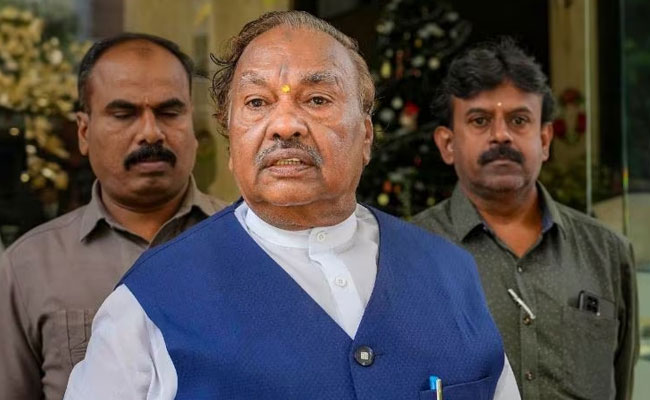
Shivamogga (Karnataka) (PTI): Senior BJP leader K S Eshwarappa on Friday announced that he will contest as an independent candidate from the Shimoga seat in the upcoming Lok Sabha polls, blaming party veteran and former Chief Minister B S Yediyurappa for his son K E Kantesh being denied a ticket for the Haveri constituency.
However, he claimed that this was a fight to save the party and its ideology and to make Narendra Modi Prime Minister once again.
"I will contest as your independent candidate from the Shimoga Lok Sabha constituency," Eshwarappa said, announcing his banner of revolt against BJP, at a meeting convened by his supporters.
"The party may issue notice to me or expel me. In case I win within two months, I'm confident that my supporters will join me at the feet of my mother -- the BJP," he added.
Yediyurappa's son and sitting MP B Y Raghavendra is the party candidate from Shimoga, where Congress has fielded former Chief Minister S Bangarappa's daughter Geetha Shivarajkumar, wife of Kannada film star Shivarajkumar and daughter-in-law of thespian late Dr Rajkumar.
The 75-year-old former Deputy Chief Minister reiterated his allegation that Yediyurappa, a member of the BJP Parliamentary Board and Central Election Committee, had assured a ticket for his son and promised to campaign for his victory, but had now "cheated" him.
Eshwarappa said that Yediyurappa had ensured a ticket for Bommai and Union Minister of State for Agriculture and Farmers Welfare Shobha Karandlaje, but "not for his son".
BJP has fielded former Chief Minister Basavaraj Bommai from the Haveri seat.
ALSO READ: Did not cheat Eshwarappa, obeyed high command orders: Basavaraj Bommai
Eshwarappa claimed that Kantesh had prepared himself to contest from Haveri after taking Yediyurappa's consent. "If Kantesh had contested Haveri he would have surely won," he said.
He alleged that BJP's state unit is in the clutches of the Yediyurappa family, with one son as MP and the other son B Y Vijayendra as MLA and state president. He questioned if the Congress' culture of dynastic politics had crept into the Karnataka BJP.
Eshwarappa, who is a former state BJP president, also accused Yediyurappa of sidelining those who espoused the cause of Hindutva like Nalin Kumar Kateel, Pratap Simha, C T Ravi and D V Sadananda Gowda. Incidentally, Kateel, Simha and Gowda--all sitting MPs-- have been denied tickets for the 2024 Lok Sabha polls.
Eshwarappa, Yediyurappa and the late HN Ananth Kumar are widely credited for building the BJP in Karnataka from the grassroots.
Pointing out that he has served the party for over 40 years, Eshwarappa said that he would never quit the party in his life, but was taking a decision to save the ideology and principles of the party.
However, Eshwarappa repeatedly stressed that he is not opposed to Prime Minister Narendra Modi.
"Even if my life goes, I will not go against Narendra Modi. If my heart is opened there will be Lord Rama on one side, and Modi on the other."
He called on his supporters to unite and work together to ensure his victory so that the issues in the party are noticed by the national leadership which would help "save the BJP from one family" and ensure that "justice is done to lakhs of workers and Hindutva activists".
Eshwarappa also said that he was taking this position not just because his son had been denied the ticket. "I want the organisation to survive, the party should not go into the clutches of one family," he said. He also claimed that Yediyurappa's recent assurance of making Kantesh an MLC was a lie.
Earlier in the day in Bengaluru, in response to these developments, Yediyurappa said, "We will convince Eshwarappa. He should be with us, he is our senior leader. I'm confident that everything will be fine."
Ahead of the Assembly polls last year, Eshwarappa opted out of the contest and requested the party's central leadership to not field him from any constituency as he wished to retire from electoral politics. Prime Minister Narendra Modi had then dialled Eshwarappa and spoken to him over a video call to express appreciation for his move to retire from politics as per the instructions of the party.
Let the Truth be known. If you read VB and like VB, please be a VB Supporter and Help us deliver the Truth to one and all.
KSRTC bus gutted in Haveri; all 17 passengers found to be safe
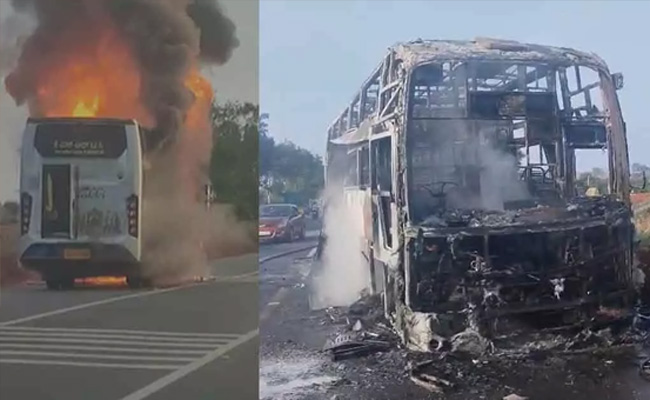
Haveri: A major fire reportedly broke out in a Karnataka State Road Transport Corporation (KSRTC) bus near Devaragudda in Ranebennur taluk of the district, causing the bus to get gutted in the flames.
The state transport bus was traveling from Bengaluru to Gadag when, at Devaragudda, the fire is said to have broken out unexpectedly. The timely action of the driver reportedly prevented a calamity. All 17 passengers are learned to be out of danger, although the bus was destroyed.
The local fire brigade arrived at the spot on being informed of the mishap and doused the fire.