SC seeks K'taka’s response on exemption granted to Kodavas,Jummas on having firearms without license
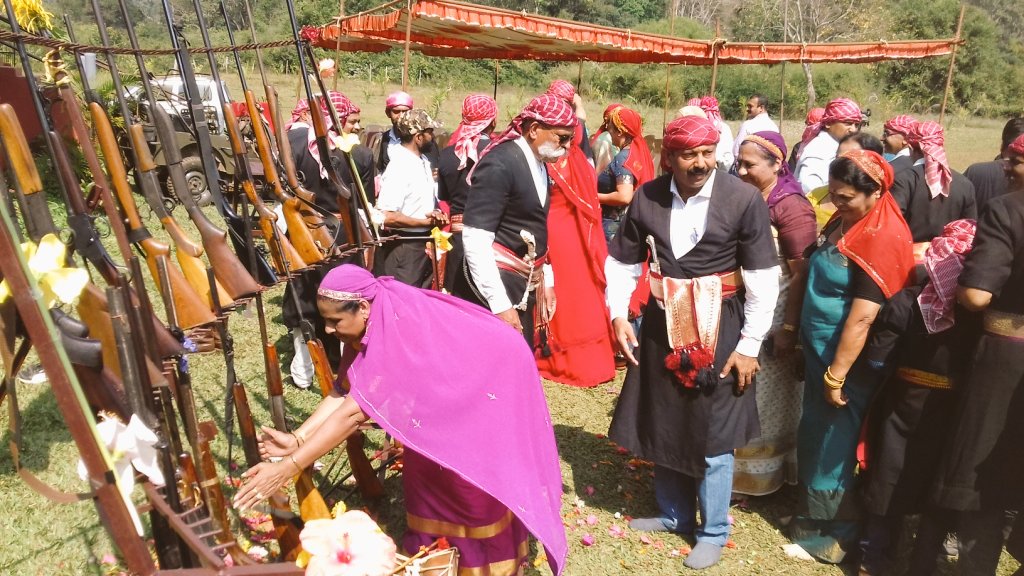
The Supreme Court bench headed by Justice NV Ramana on Tuesday referred the Karnataka High Court’s verdict on the exemption granted to the Kodava Community and Jumma tenure holders to carry and possess firearms without license.
According to a report published by Scroll.in, the Ministry of Home Affairs had exempted the Kodava community and Jumma tenure holders from some of the provisions of the Arms Act, 1995.
The Kodava community lives predominantly in the Coorg region of Karnataka while Jumma tenure holders are people belonging to agriculturist castes inheriting land tenure called jumma.
Taking into account the exemption granted to only one community, a retired Army officer Captain Chethan YK had filed a petition earlier in the Karnataka HC which was later moved to Supreme Court.
“The arms or ammunition carried or possessed by any person being Coorg by race and every Jumma tenure holder in Coorg and herein exempted whilst residing or travelling outside the district of Coorg shall not exceed one rifle with 100 rounds of ammunition for the same and one smooth bore breech or muzzle loading gun with 500 cartridges or the equivalent in leaden shot and gunpowder,” said the notification filed by Union Ministry of Home Affairs on 29 October 2019.
Earlier in September, the High Court bench comprising Justices Satish Chandra Sharma and SS Magadum had upheld the Union Ministry’s validation of the exemption.
However, challenging this, Chethan had argued that the government notification creates discrimination based on “caste/race and ancestral land tenure” in a plea to the Supreme Court.
He also pointed out that according to the Section 41 of Arms Act, exemption from getting an arms license can be granted only in “public interest”.
“However, no reasoning has been given in the notification on granting such exemption to the Kodava community,” the plea added.
A senior counsel appearing for the Kodava community argued that the exemption had been since the British ruled India.
The Supreme Court has now proceeded to seek Karnataka government’s response in this regard.
Let the Truth be known. If you read VB and like VB, please be a VB Supporter and Help us deliver the Truth to one and all.
Two arrested in K'taka for assaulting minors, uploading CSAM content

Bengaluru (PTI): Two men were arrested for allegedly sexually assaulting two minor girls, recording the acts on mobile phones and uploading the videos online as child sexual abuse material, police said on Thursday.
The accused have been identified as Kiran Kumar (29), hailing from Chitradurga district, and Aditya M K (20), hailing from Shivamogga district, they said.
A probe was initiated after information was received from the NCRP portal regarding a suspected instance of creation of Child Sexual Abuse Material (CSAM) for online dissemination, police said.
Accordingly, a case was registered at Kaggalipura Police Station under relevant sections of the IT Act on May 10, they added.
Investigation revealed that two minor girl victims were exploited and videos were created and uploaded to the internet. The child victims have subsequently recorded their statements as per procedure and further necessary legal steps have been taken, Pronab Mohanty Director General of Police, Cyber Command, said in a statement.
Based on the statements of the victims, the accused persons, who allegedly assaulted the minors, recorded the acts on mobile phones and uploaded the videos online, were arrested, he said.
Following the probe, sections 65(2) (rape) and 70 (gangrape) of the Bharatiya Nyaya Sanhita, along with relevant sections of the POCSO Act, have been added to the FIR, police said.
Officials collected relevant information and on May 12, arrested the accused persons and seized three mobile phones belonging to them, in which the videos had allegedly been recorded, he said.
The accused were later produced before the court and taken into police custody for further investigation, he added.
According to him, in CSAM cases, police usually apprehend offenders who have downloaded such content or have kept them in their possession after obtaining them from elsewhere, usually the internet.
"The present case is one of the very few instances where content creators and uploaders have been apprehended," Mohanty added.