Chennai: Siddaramaiah conferred with Ambedkar Sudar award by VCK
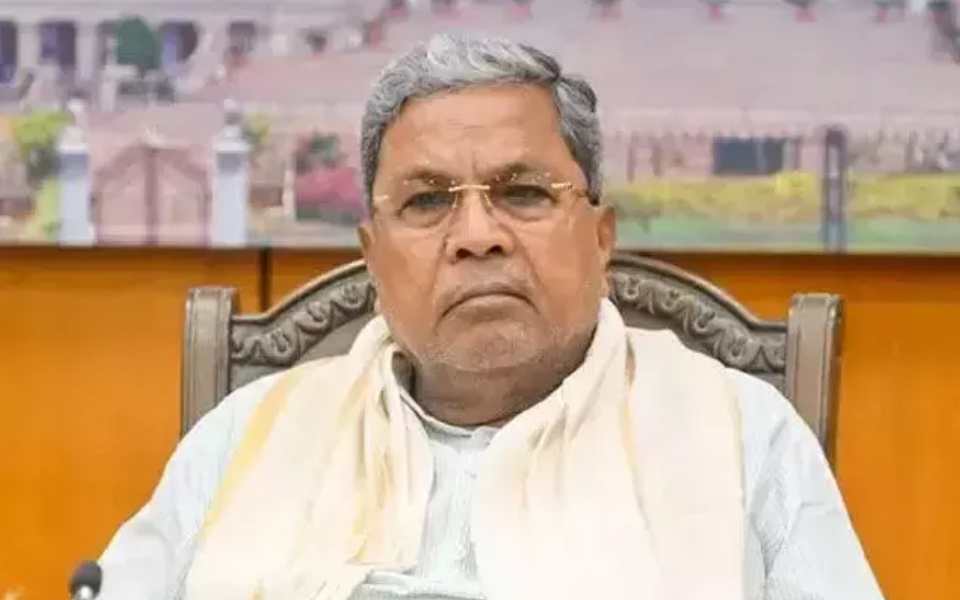
Chennai, Jul 30: Senior Congress leader Siddaramaiah, who received the Ambedkar Sudar award instituted by the Viduthalai Chiruthaigal Katchi (VCK), at a gala function here on Saturday evening accused the BJP government at the Centre of 'duplicity' in ensuring social justice.
Though he hailed Droupadi Murmu becoming the President of India, the Centre was not keen on implementing social justice, he claimed and referred to a statement by former Union Minister Anant Kumar Hegde, who had said his party came to power to change the constitution drafted by Ambedkar.
"The Minister in Narendra Modi's cabinet made a statement: 'We have come to power only to change the constitution written by Ambedkar.' He should have made the statement with the knowledge of the Prime Minister and Home Minister Amit Shah, otherwise he would have been sacked immediately," Siddaramaiah claimed.
"I welcome Droupadi Murmu becoming the President but wonder if the RSS has ever followed social justice in elevating its leaders," the leader of the opposition in Karnataka Assembly said.
The award was in recognition of his tireless service in opposing the 'Sanatana' and following the footsteps of "revolutionary social reformer" B R Ambedkar said Lok Sabha MP Thol Thirumavalavan, after presenting the award.
"Siddaramaiah's past 16 years of political journey has been with the Congress. He remains firm in opposing the principles of 'Sanatana' because of his own backward class background and his ideological commitment to activist Ram Manohar Lohia, Ambedkar and social reformer Basavanna," Thirumavalavan, also founder of the TN-based VCK said.
The former Karnataka CM remained committed to opposing the hate politics of the Sangh Parivar that engineers divisions within society and caste on religious lines," the VCK leader said and added that Siddaramaiah's ascension to the position of Chief Minister was a result of his relentless hard work and the politics of social justice taken forward by him.
S V Rajadurai, writer and human rights activist, V G Santhosam industrialist, Chellappan former IAS officer, Tehlan Baqavi, leader of Social Democratic Party of India, Prof K Rajan, archaeologist and R Jawahar (posthumous) writer and activist were presented the Periyar Oli, Kamarajar Kathir, Iyothee Thass Aadhavan, Quaid-E-Millat Pirai, Semmozhi Gnayiru and Marx Mamani awards, respectively.
"I am very very happy to receive this prestigious Ambedkar Sudar award given by VCK," Siddaramaiah said after receiving the award.
Advocating the abolition of the caste system in India, AAP Minister for Social Welfare, SC & ST, Rajendra Pal Gautam pointed out that world over caste system has been dispensed with and only in India it has been kept live.
"Why was the caste system not abolished in India? The Centre and BJP-ruled States want the caste system to be alive. They want the atrocity to continue. They are not willing to give us our share. So, we have to fight for justice and fulfill the dreams of Ambedkar," he said.


Let the Truth be known. If you read VB and like VB, please be a VB Supporter and Help us deliver the Truth to one and all.
Vijay unable to prove majority, not invited for CM oath ceremony: Sources
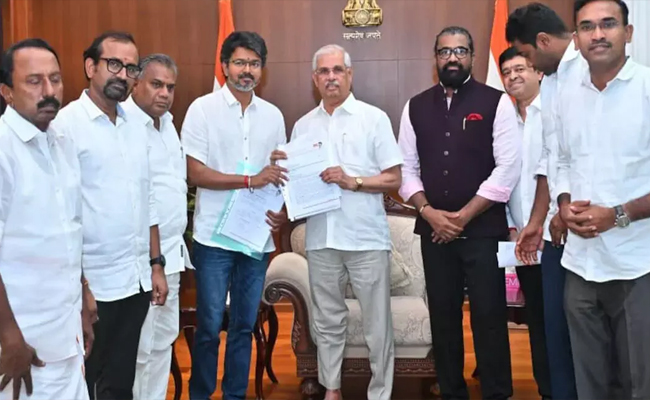
Chennai: Actor-politician Vijay has reportedly not been invited to take oath as Chief Minister of Tamil Nadu after failing to demonstrate support from the required number of MLAs, sources in Raj Bhavan said.
According to media reports that quoted sources in the office of R.N. Ravi Arlekar, Vijay could not prove the backing of 118 legislators, the majority mark in the 234-member Tamil Nadu Assembly.
Despite last-minute efforts to secure support from the Viduthalai Chiruthaigal Katchi (VCK), Amma Makkal Munnetra Kazagam (AMMK), and an IUML legislator, Vijay reportedly managed support from only 116 MLAs, falling short by two members.
Sources said Vijay failed to submit letters of support from the VCK and the Indian Union Muslim League (IUML).
Later, the IUML issued a statement clarifying that it was not part of the TVK-led alliance.
Meanwhile, AMMK leader T.T.V. Dhinakaran is also said to have informed the Governor that his party would support the All India Anna Dravida Munnetra Kazhagam (AIADMK) instead.
Earlier in the evening, Vijay had met Governor Arlekar and staked claim to form the government, stating that he enjoyed the support of 118 MLAs.