Siddaramaiah congratulates Banu Mushtaq for winning International Booker Prize

Bengaluru (PTI): Karnataka Chief Minister Siddaramaiah on Wednesday congratulated Banu Mushtaq for winning International Booker Prize for her Kannada short story collection and said, she has raised the flag of Kannada's greatness at international level.
Writer, activist and lawyer Mushtaq's short story collection ‘Hridaya Deepa’ (Heart Lamp) on Tuesday night became the first Kannada title to win the coveted GBP 50,000 International Booker Prize in London.
Mushtaq collected the prize at a ceremony at Tate Modern along with Deepa Bhasthi, who translated the title from Kannada to English.
“Heartiest congratulations to the proud Kannada writer Banu Mushtaq for winning the International Booker Prize for Literature. This is a time to celebrate Kannada, Kannadigas and Karnataka,” Siddaramaiah posted on ‘X’.
He said, Banu Mustaq, who writes while embodying the true values of harmony, secularism, and brotherhood of this land, has raised the flag of Kannada's greatness at the international level and brought respect to us all.
“I wish she would continue to write meaningfully for many more years and spread the vibe of Kannada to the world,” the CM said.
“On behalf of all Kannadigas, I would also like to congratulate the talented author Deepa Bhasti, who has translated her Booker Prize-winning work 'Hridaya Deepa' into English,” he added.
Shortlisted among six worldwide titles, Mushtaq’s work appealed to the judges for its “witty, vivid, colloquial, moving and excoriating” style of capturing portraits of family and community tensions.
Let the Truth be known. If you read VB and like VB, please be a VB Supporter and Help us deliver the Truth to one and all.
Ordinance issued to increase number of Supreme Court judges from 34 to 38
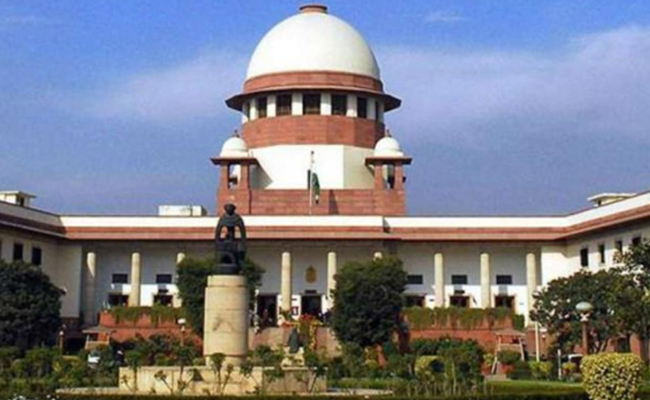
New Delhi (PTI): The government has promulgated an ordinance to increase the strength of the Supreme Court from the present 34 judges to 38, including the Chief Justice of India.
The law ministry notified the ordinance on Saturday, which amended the Supreme Court (Number of Judges) Act, 1956, to increase the sanctioned strength of the top court.
So far, the sanctioned strength of the top court was 34, including the Chief Justice of India (CJI). Now, the number of judges has been increased by four, taking the sanctioned strength to 38.
The top court will now have 37 judges, other than the CJI.
With the apex court having two vacancies at present, and the ordinance coming into force immediately, the Supreme Court Collegium will now have to recommend six names for appointment as judges in the top court.
A bill will be brought in the Monsoon Session of Parliament to convert the ordinance – an executive order – into a law passed by Parliament.
The Union Cabinet had cleared a draft bill on May 5 to increase the number of apex court judges.
The strength of the Supreme Court was last increased from 30 to 33 (excluding the CJI) in 2019.
The Supreme Court (Number of Judges) Act, as originally enacted in 1956, put the maximum number of judges (excluding the CJI) at 10.
This number was increased to 13 by the Supreme Court (Number of Judges), Amendment Act, 1960, and to 17 by another amendment to the law.
The Supreme Court (Number of Judges) Amendment Act, 1986, augmented the strength of judges from 17 to 25, excluding the CJI.
A fresh amendment in 2009 further increased the strength from 25 to 30.
Article 124(3) of the Constitution lists the qualifications required to become a Supreme Court judge.
An Indian citizen who has either served as a high court judge for at least five years, or as an advocate for 10 years, or is a distinguished jurist, can be appointed to the top court.
The strength of the Supreme Court is increased based on the recommendations of the CJI, who writes to the Union law minister. After consulting the finance ministry, the Department of Justice under the law ministry moves the Cabinet with a draft bill.