Siddaramaiah, D K Shivakumar leave for Delhi to discuss Cabinet formation, allocation of portfolios
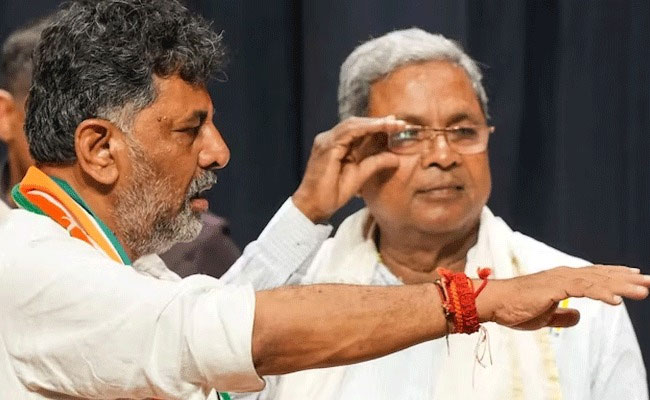
Bengaluru (PTI): Chief Minister-designate Siddaramaiah and his deputy D K Shivakumar left for New Delhi on Friday to discuss with the party's high command regarding the Ministers to be inducted into the new Karnataka cabinet and allocation of portfolios.
A meeting of the Congress Legislature Party (CLP) on Thursday formally elected Siddaramaiah as its leader, following which he staked his claim with the Governor, who invited him to form the government.
Siddaramaiah and Shivakumar would take oath as Chief Minister and Deputy Chief Minister respectively along with a few as Ministers at 12.30 PM on Saturday at the Kanteerava Stadium here.
"Siddaramaiah, Randeep Singh Surjewala (AICC General Secretary) and me will be going to Delhi, we will meet Mallikarjun Kharge (AICC President) to discuss the first stage of cabinet expansion and decide about it," Shivakumar said, before leaving for the national capital.
Speaking to reporters here, in response to a question, he said, "fulfilling the promises made to the people is our first priority. Cabinet, people, all those things we will let you know later, we will not do anything leaving you (media), there is no need for any speculation. We will work unitedly."
The first challenge that Siddaramaiah is expected to face is putting in place a Cabinet with the right combinations that will strike a balance in having representatives from all communities, regions, factions and also from among the old and new generation of legislators.
With the sanctioned strength of the Karnataka Cabinet being 34, there are too many aspirants for ministerial berths.
Stating that the voice of the people will be the voice of the government of Karnataka, Shivakumar said, "All our national leaders are coming (for the swearing-in ceremony). On the first day in the first cabinet we will implement all our 'guarantees', we will keep up our promise."
Several national leaders have been invited for the swearing-in ceremony and most of them are coming, he said, as he invited party workers and supporters across the state to the venue, and asked them to be there much ahead of the scheduled time, to ensure that there is no traffic or any other difficulties.
Shivakumar also invited leaders of the BJP and JD(S) for the event, stating that as public representatives, they too are part of the government machinery.
The DCM-designate also visited Kanteerava Stadium, the venue of the swearing-in ceremony and inspected the preparations there.
Asked whether the guarantees will be with or without conditions, Shivakumar said, "I won't say anything now, we will inform you once we decide. We will walk the talk."
"They are not Shivakumar's or Siddaramaiah's guarantees, they are Congress party's guarantees," he added.
The Congress has promised to implement the guarantees' 200 units of free power to all households (Gruha Jyoti), Rs 2,000 monthly assistance to the woman head of every family (Gruha Lakshmi), 10 kg of rice free to every member of a BPL household (Anna Bhagya), Rs 3,000 every month for graduate youth and Rs 1,500 for diploma holders (both in the age group of 18-25) for two years (YuvaNidhi), and free travel for women in public transport buses (Shakti), on the very first day of assuming power in the state.
Let the Truth be known. If you read VB and like VB, please be a VB Supporter and Help us deliver the Truth to one and all.
Pro-chancellor of St Aloysius University, Fr Melwin J Pinto SJ passes away at 63
_vb_92.jpeg)
Mangaluru: Fr Melwin J Pinto SJ, Pro-chancellor of St Aloysius University Rector of St Aloysius Institutions, and Vice President of Mangalore Jesuit Educational Society (MJES), breathed his last on Friday, April 10. He was 63.
Born in 1963, Fr Melwin Pinto completed his schooling and college education at St Aloysius before joining the Jesuit order on June 20, 1981. He was ordained as a Jesuit priest on April 14, 1997.
Over the years, he held several academic qualifications, including an MA in English, a Master’s degree in Education, and diplomas in psychology and counselling as well as school administration.
He began his career in education as headmaster of St Joseph’s Primary School and High School in Hassan, serving between 1996 and 1999.
He later founded St Joseph’s Indian PU College and served as its principal until 2007. He subsequently served as headmaster of St Aloysius High School, Mangaluru, from 2007 to 2011, and later as principal of St Joseph’s PU College, Hassan, until 2012.
Fr Melwin Pinto also worked with Vatican Communications and Radio in Rome, contributing to its English desk for Asia and Indian languages.
He later served as superior and director of Fatima Retreat House in Valencia for two years from May 2017, before being appointed as superior of the Jesuit study home ‘Vidyaniketan’ in Dharwad.
He was also closely associated with the development of St Aloysius Institutions and played a key role in securing the status of a Deemed-to-be University. His contribution to the education sector and efforts towards innovation were widely acknowledged. He was known for maintaining close relations with people from all sections of society.
Legislative Council MLA Ivan D’Souza, in a statement, said the demise of Fr Melwin J Pinto was a huge loss to the educational and religious fields and had created a significant void in society.
Dakshina Kannada District in-charge Minister Dinesh Gundu Rao also expressed grief, stating that his service and contributions to education would always be remembered.
Details regarding the funeral are yet to be announced.