Siddaramaiah, D K Shivakumar to be sworn in as CM, Dy CM this afternoon
8 legislators likely to take oath as Ministers
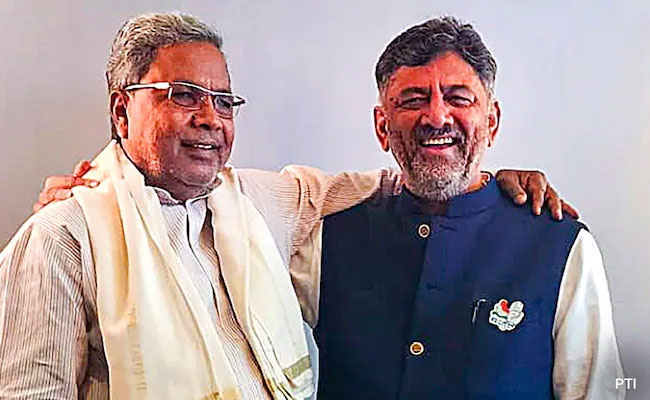
Bengaluru (PTI): Siddaramaiah will be sworn in as Chief Minister for the second term, along with state Congress President D K Shivakumar as Deputy Chief Minister on Saturday afternoon, exactly a week after the party swept the Assembly polls in Karnataka.
According to sources in the Congress, eight legislators are likely to be sworn in as Ministers along with them.
Siddaramaiah and Shivakumar were in Delhi till late Friday night discussing with the party's high command the names of ministers to be inducted into the new cabinet and the allocation of portfolios. While the CM-designate has returned to Bengaluru, the KPCC chief is on his way back.
Sources said those who are likely to be sworn-in as Ministers are: G Parameshwara (SC), K H Muniyappa (SC), K J George (Minority-Christian), M B Patil (Lingayat), Satish Jarkiholi (ST-Valmiki), Priyank Kharge (SC and AICC President M Mallikarjun Kharge's son), Ramalinga Reddy (Reddy), and B Z Zameer Ahmed Khan (Minority-Muslim).
Congress chief Mallikarjun Kharge has invited leaders of several like-minded parties for the swearing-in ceremony, which will see Governor Thaawarchand Gehlot administering the oath of office and secrecy to the Chief Minister and his Cabinet at 12.30 PM at Sree Kanteerava Stadium here.
The venue is the same place where Siddaramaiah took oath in 2013, when he became Chief Minister for the first time.
The event may turn out to be a show of strength for opposition parties amid unity efforts to take on the ruling BJP in the 2024 Lok Sabha elections.
The Congress on Thursday named Siddaramaiah as the next Chief Minister and Shivakumar, a strong contender for the top post, as his only deputy, ending the tense deadlock after prolonged parleys involving its central leadership.
A meeting of the Congress Legislature Party (CLP) later on Thursday formally elected Siddaramaiah as its leader and Chief Minister, following which he staked his claim with the Governor, who invited him to form the government.
The 75-year old Siddaramaiah will become the Chief Minister for the second term after his earlier five-year stint from 2013; while 61-year old Shivakumar, who had earlier worked as Minister under Siddaramaiah, will also continue as the party's Karnataka state president till Parliamentary elections next year.
The first daunting task that Siddaramaiah is expected to face is putting in place a Cabinet with the right combinations that will strike a balance in having representatives from all communities, regions, factions, and also from among the old and new generation of legislators.
With the sanctioned strength of the Karnataka Cabinet being 34, there are too many aspirants for ministerial berths.
Kharge, former Congress Presidents Sonia Gandhi and Rahul Gandhi, also General Secretary Priyanka Gandhi, several Congress Chief Ministers and leaders are expected to attend the event.
Kharge has invited Tamil Nadu Chief Minister M K Stalin, West Bengal Chief Minister Mamata Banerjee, Bihar Chief Minister Nitish Kumar and Deputy Chief Minister Tejashwi Yadav, NCP chief Sharad Pawar, former Maharashtra chief minister Uddhav Thackeray. Invitations have also been sent to National Conference chief Farooq Abdullah and Jharkhand Chief Minister Hemant Soren, among others.
Many of them have arrived or have sent in representatives on their behalf.
Expectations are also that at the first cabinet meeting after the swearing-in, the new government might take measures to implement the five 'guarantees'.
The Congress has promised to implement the 'guarantees' 200 units of free power to all households (Gruha Jyoti), Rs 2,000 monthly assistance to the woman head of every family (Gruha Lakshmi), 10 kg of rice free to every member of a BPL household (Anna Bhagya), Rs 3,000 every month for graduate youth and Rs 1,500 for diploma holders (both in the age group of 18-25) for two years (YuvaNidhi), and free travel for women in public transport buses (Shakti), on the very first day of assuming power in the state.
"Fulfilling the promises made to the people is our first priority," the Deputy Chief Minister-designate Shivakumar said on Friday.
Elaborate security measures have been put in place in and around the venue to ensure that the event goes on smoothly without any hurdles amid the presence of several national level leaders and those from other states, officials said, adding that traffic movement will also have to be managed as the event will take place in the heart of the city.
According to sources, a total of three platforms/ stages have been set up and LED screens have been installed for people to watch the swearing-in ceremony.
Let the Truth be known. If you read VB and like VB, please be a VB Supporter and Help us deliver the Truth to one and all.
Pro-chancellor of St Aloysius University, Fr Melwin J Pinto SJ passes away at 63
_vb_92.jpeg)
Mangaluru: Fr Melwin J Pinto SJ, Pro-chancellor of St Aloysius University Rector of St Aloysius Institutions, and Vice President of Mangalore Jesuit Educational Society (MJES), breathed his last on Friday, April 10. He was 63.
Born in 1963, Fr Melwin Pinto completed his schooling and college education at St Aloysius before joining the Jesuit order on June 20, 1981. He was ordained as a Jesuit priest on April 14, 1997.
Over the years, he held several academic qualifications, including an MA in English, a Master’s degree in Education, and diplomas in psychology and counselling as well as school administration.
He began his career in education as headmaster of St Joseph’s Primary School and High School in Hassan, serving between 1996 and 1999.
He later founded St Joseph’s Indian PU College and served as its principal until 2007. He subsequently served as headmaster of St Aloysius High School, Mangaluru, from 2007 to 2011, and later as principal of St Joseph’s PU College, Hassan, until 2012.
Fr Melwin Pinto also worked with Vatican Communications and Radio in Rome, contributing to its English desk for Asia and Indian languages.
He later served as superior and director of Fatima Retreat House in Valencia for two years from May 2017, before being appointed as superior of the Jesuit study home ‘Vidyaniketan’ in Dharwad.
He was also closely associated with the development of St Aloysius Institutions and played a key role in securing the status of a Deemed-to-be University. His contribution to the education sector and efforts towards innovation were widely acknowledged. He was known for maintaining close relations with people from all sections of society.
Legislative Council MLA Ivan D’Souza, in a statement, said the demise of Fr Melwin J Pinto was a huge loss to the educational and religious fields and had created a significant void in society.
Dakshina Kannada District in-charge Minister Dinesh Gundu Rao also expressed grief, stating that his service and contributions to education would always be remembered.
Details regarding the funeral are yet to be announced.