Siddaramaiah demands reduction in cess, sales tax on fuel prices
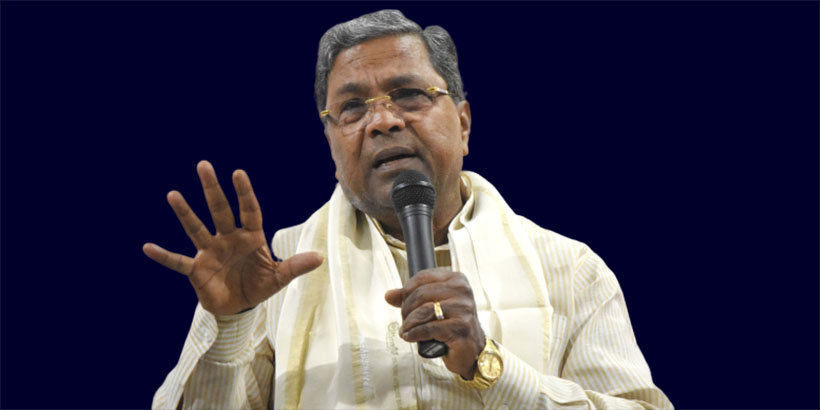
Bengaluru (PTI): Former Chief Minister Siddaramaiah on Wednesday demanded a reduction in the cess and sales tax on petrol and diesel in Karnataka and suggested that the price be brought down more than it was done in Tamil Nadu, to bring relief to the public. "The rise of petrol price from Rs 70 to Rs 130 in a short duration is abnormal. I can still understand if it was Rs 10 or Rs 20. I demand reduction in sales tax from 35 per cent to 15 per cent," Siddaramaiah, who is the Leader of the Opposition, said during a debate on price rise in the Karnataka Assembly.
He added that the taxes on diesel should be reduced from 74 per cent to 50 per cent.
Siddaramaiah cited the example of Tamil Nadu government, which had reduced the fuel prices by Rs three. "Our reduction in fuel prices should be more than it," he said.
The assembly witnessed heated exchanges between the ruling and opposition sides during the debate on price rise, initiated by the LoP Siddaramaiah, who accused the BJP governments in the state and Centre of indulging in "criminal loot".
Siddaramaiah also charged the government with 'neglecting' holding the assembly sessions, pointing out that the legislature session was being held after a gap of six months.
"The prices of all commodities have reached the sky, whether it is rice, pulses, cement, iron, gas, petrol, diesel...Prices have been rising for the last two years continuously. The situation is such that the common man and middle class people are unable to lead their lives," Siddaramaiah said.
The Congress Legislature Party Leader said the price rise was because the Government of India "exponentially" increased additional excise duty on petrol, diesel and gas.
"They (BJP) blame international crude oil prices for the fuel price rise. The price of crude oil is down to USD 69 per barrel from USD 120. Still, a litre of petrol is Rs 106 and diesel will soon touch Rs 100," he said, as he compared the prices when UPA was in power and now.
The Centre did not transfer the benefit of the decline in crude oil prices at the international market to the consumers here, he alleged.
Countering the argument on debt position and oil bonds, he said, "They (BJP) say the previous government had borrowed huge loans/oil bonds. The loans amounted to just about Rs 1.30 lakh crore... From Karnataka alone in seven years, Rs 1.21 lakh crore excise duty has gone to the Centre."
Objecting to Siddaramaiah's line of argument, Law and Parliamentary Affairs Minister J C Madhuswamy questioned the need to discuss the issue in the assembly as the decisions on this are taken by the Centre.
"Is this a Parliament speech or assembly speech? I feel you have forgotten and gone to Parliament. Can we discuss or debate on matters or decisions related to the central government or parliament here? How can the state government answer it?" he asked, leading to another round of verbal sparring between the opposition and treasury benches.
In reply, Siddaramaiah said he was not levelling charges against the Prime Minister or the Centre and was aware they cannot answer in the assembly, but was only placing facts.
"Are over 6.5 crore people of Karnataka not affected by price rise? What should we tell them as public representatives? Is it not our responsibility? Can we keep quiet?" he asked, and said if everyone agreed, he favoured sending a resolution to the Centre on the price rise issue.
Siddaramaiah, during his speech, pointed out that there had been no legislature session for the last six months and accused the government of "neglect" in calling the session to discuss issues faced by the people.
As Madhuswamy cited COVID-19 as the reason for not calling the session, Siddaramaiah asked "how did Parliament function then? You are using Corona as the shield. It is because of your (ruling BJP) internal issues that the session was not called."
Let the Truth be known. If you read VB and like VB, please be a VB Supporter and Help us deliver the Truth to one and all.
Delhi: Father, son held for killing 19-year-old woman in suspected honour killing

New Delhi (PTI): The Delhi Police has arrested a man and his son for allegedly murdering his 19-year-old daughter in west Delhi's Hari Nagar area, an official said on Friday.
The case first came to light on April 1 after a PCR call was received around 2 pm, alleging that a woman had been killed by her family members and her body was being taken for last rites, he said.
The accused, identified as Mohammad Maneer (55), a vegetable vendor, and his son Meraj Ali (19), were arrested in connection with the case, the officer said.
The victim had been in a relationship with a man from her native place for the past two years, which was opposed by her father, Maneer and brother Meraj, he said.
"When the girl did not end the relationship despite objections, the family killed her," the officer said.
On April 1, the police said that when their team reached the spot, they found that the woman's body was being taken for burial.
Acting on the input, the burial process was stopped over suspicion of honour killing.
"Police intercepted the family members and took possession of the body," he said.
Police said that the man who had made the PCR told them that the woman was in love with his cousin.
During the inquiry, police also interacted with the PCR caller, who said his cousin, a friend of the deceased, had informed him about the situation and suspected foul play, prompting him to alert the police control room.
The body of the woman was subsequently shifted to the mortuary of Deen Dayal Upadhyay Hospital for preservation and postmortem.
Police said that both the crime team and the forensic science laboratory (FSL) team were called to inspect the scene and collect evidence.
Police said that, as per the postmortem report, the cause of death was identified as smothering, indicating that the woman was suffocated.
A preliminary inquiry also revealed that the family had initiated preparations for the last rites soon after the woman's death, raising suspicion about the circumstances.
Initial investigation pointed to the family's opposition to the woman's relationship.
"The family members of the woman saw her with the man, and she was taken back home. We got to know that she was beaten up and even locked inside the house for some days," a source said.
Further investigation into the matter is underway, police added.