Siddaramaiah requests Foxconn to further invest in Karnataka, assures gov't complete support
Bengaluru, Aug 16: Karnataka Chief Minister Siddaramaiah on Friday assured Taiwanese electronics major Foxconn of his government's complete support and commitment to ensure it gets all the assistance required and requested the company to further invest in the state.
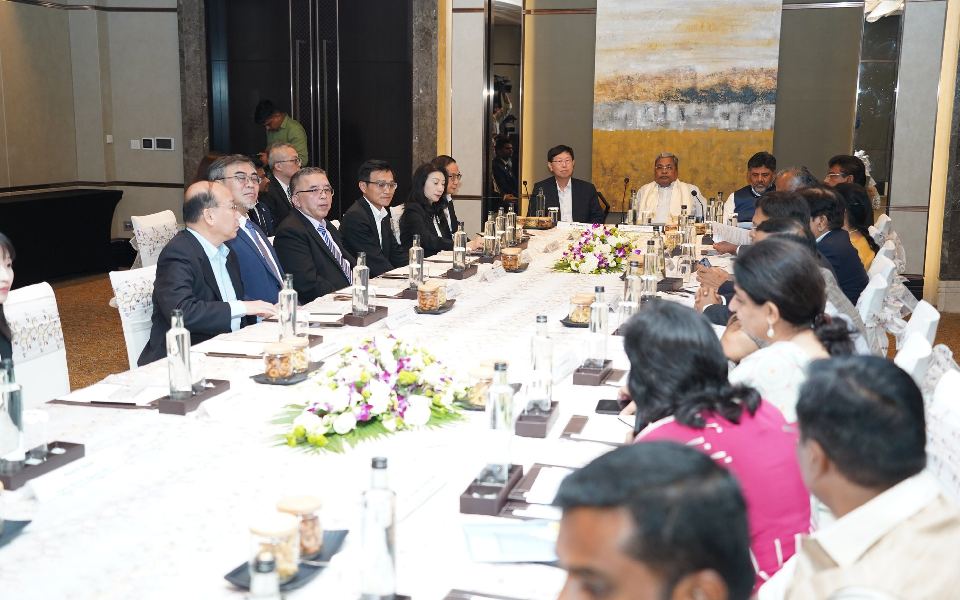
The chief minister held discussions with Young Liu, Chief Executive Officer and Chairman of Hon Hai Technology Group (Foxconn) and his team, during the dinner meeting organised at a private hotel here.
"... we work together to deepen and strengthen the collaborative relationship between Foxconn and our state. This partnership is of immense importance, and I am honoured to be part of an initiative that holds such significant potential for mutual growth and success," Siddaramaiah said.
During his address at the dinner meeting, he said, Karnataka has established itself as a powerhouse in the Electronics System Design and Manufacturing (ESDM) sector.
ALSO READ: Karnataka stands 3rd in country with Rs 54,427 cr FDI during 2023-24: CM Siddaramaiah
"With several leading ESDM players operating within the state, we are proud to be among the top contributors to India's electronics manufacturing output and exports."
Noting that to support and facilitate competitive electronics manufacturing, Karnataka offers a comprehensive range of advantages, the CM said, from efficient logistics and reliable power supply to a skilled workforce and a resilient vendor base, the state is well-equipped to meet the needs of this dynamic industry.
"It gives me immense pleasure to note that your project will create substantial employment opportunities within the state. This not only boosts the local economy but also empowers our workforce and enhances the overall prosperity of the region," he said.
"We (govt) assure you of our complete support and commitment to ensure Foxconn gets all the assistance required in this process. Our government is always ready to support you and I request you to further invest in Karnataka. Karnataka is a beautiful state and it has got the potential for investment," he added.
Foxconn is setting up an iPhone assembly plant (Project Elephant) in Karnataka. The company has acquired 300 acres of land in the ITIR Industrial Area, located in Doddaballapura and Devanahalli Taluk of Bengaluru Rural District. The project, with an investment size of Rs 22,000 crore, is expected to generate employment for 50,000 plus people.
"Currently, the work is progressing well in this project with construction in progress. The C&I (Commerce & Industries) Department, in collaboration with other relevant departments, is actively working on securing all necessary license approvals for the project. Additionally, power and water supply specific to the project are being planned and implemented," the government said.
Additionally, Foxconn is setting up a manufacturing and assembly facility for mechanical components in EV applications (Project Cheetah). The company has leased private land in Bengaluru District for this project.
Deputy Chief Minister D K Shivakumar, Minister for Large and Medium Industries M B Patil, Minister for Information Technology Priyank Kharge, and senior officials were present at the meeting.
Earlier in the day, after receiving Young Liu at the airport, along with Kharge and officials, Minister Patil in a post on 'X' said, "Foxconn's forthcoming investments in the state are poised to significantly contribute to Karnataka's growth trajectory. I look forward to productive discussions."
Had a productive discussion with Mr. Young Liu, Chairman of Foxconn. Karnataka, with its rich cultural heritage and robust law and order, is well-positioned to create a synergy that will drive long-lasting growth and innovation.
— Siddaramaiah (@siddaramaiah) August 16, 2024
We are paving the way for a future where… pic.twitter.com/8A1UnqYgLj
Let the Truth be known. If you read VB and like VB, please be a VB Supporter and Help us deliver the Truth to one and all.
Allen, Raghuvanshi, Green power KKR to 29-run win over GT

Kolkata (PTI): Finn Allen blasted a 35-ball 93, while Angkrish Raghuvanshi hit an unbeaten 44-ball 82 as Kolkata Knight Riders kept their playoff hopes alive with a 29-run win over Gujarat Titans in the IPL match here on Saturday.
Sent in to bat, Allen went on a six-hitting spree, smashing 10 maximums and four boundaries to add 95 off 41 balls with Raghuvanshi (82).
Raghuvanshi then shared another 108 off 53 balls with Cameron Green (52 not out) to power KKR to a challenging 247 for 2.
In reply, GT could manage 218-4, riding on skipper Shubman Gill's 49-ball 85 and a 35-ball 57 from Jos Buttler. Opener Sai Sudarsan was retired hurt but returned to make a 28-ball 53 not out.
Sunil Narine (2/29) claimed two wickets and Saurabh Dubey snapped one for KKR.
For GT, Mohammed Siraj (1/50), Sai Kishore (1/38) were the wicket-takers.
Brief Score:
KKR: 247 for 2 in 20 overs (Finn Allen 93, Angkrish Raghuvanshi 82 not out, Camero Green 52 not out; Mohammed Siraj 1/50).
GT: 218 for 4 in 20 overs (Shubman Gill 85, Sunil Narine 2/29).