Siddaramaiah says guarantee schemes will continue, highlights challenges in Centre-State relations
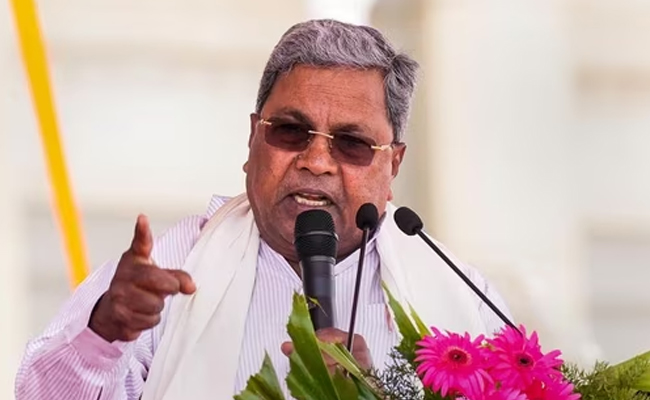
Bengaluru (PTI): Amid pressure from within the ruling Congress to do a "rethink" on the ambitious five guarantees schemes, Chief Minister Siddaramaiah on Thursday asserted that it will continue and highlighted the "Karnataka model" of development with focus on social justice and economic equality, thereby contributing to nation-building.
Accusing the Centre of 'deviating' from the principle of the federal system in recent years, leading to discrimination in the allocation of funds to states, he urged it to understand the fact that the nation can develop only if states are developed and release a fair amount of grants for their development.
In a democratic system, the opposition parties are expected to function responsibly in tandem with the principles of the Constitution, by respecting the mandate given by the people of the state, the Chief Minister noted.
The electorate with their political acumen has made it clear in the last Lok Sabha elections that "democracy cannot be a puppet in anyone's hands".
The CM was delivering his address on the occasion of 78th Independence Day, after hoisting the national flag at the Manekshaw Parade Ground here.
ALSO READ: One person dies, another injured in cooker blast in Bengaluru
"... we are working towards achieving comprehensive development in the state, with a special focus on social justice and economic equality, thereby contributing to nation-building. This is the Karnataka model of development. Our government, which came to power in 2023 with a clear majority, has taken decisive steps in this direction over the past fifteen months," Siddaramaiah said.
Noting that the government's five guarantee schemes have brought relief to the lives of people who have suffered due to the rising financial inequality, he said, "On one hand our government is giving impetus to the redistribution of wealth through these schemes and on the other we have taken up programmes for sustainable economic development of the state with equal commitment."
Referring to the five guarantee schemes - Gruha Lakshmi, Shakti, Gruha Jyothi, Anna Bhagya and Yuva Nidhi, he said each beneficiary family receives direct and indirect benefits amounting to an average of Rs 4,000 to Rs 5,000 per month.
"This is the concept of Universal Basic Income, which provides direct financial assistance to poor families. Karnataka is the only state implementing such a programme in a big way, which is being implemented in developed countries to help the poor and we are proud of it."
"These programmes will continue and we will give a befitting reply through economic growth of the State to those who made the prophecy that the State will go bankrupt by these schemes," he said.
Siddaramaiah said his government is all set to make innovations and help these beneficiaries further. "... we are providing Rs 2,000 to every woman head of the beneficiary families. We are thinking of helping them organize as Stree Shakti women self-help groups and encourage them to take up income generating activities by facilitating assistance from financial institutions."
Siddaramaiah's assertion to continue five guarantee schemes has come amid voices emerging within the Congress government to do a "rethink" on the programme, with calls to exclude 'rich' beneficiaries.
On the challenges in Centre-State relations, the Chief Minister said, "In recent years, the central government has been deviating from this principle (federal system), leading to discrimination in the allocation of funds to states."
By ignoring constitutional principles, there is a tendency to delay the financial share due to the states, which is not in the interest of the people, he said. "Unfortunately, states are compelled to seek legal recourse to obtain their rightful share from the Centre. On this occasion, I urge the union government to understand the fact that the nation can develop only if States are developed and to release a fair amount of grants to States for development."
Pointing out that history has always shown that the people never forgive backdoor politics that disregard the people's mandate, Siddaramaiah said in a democratic system it is expected that opposition parties function responsibly in tandem with the principles of the Constitution, by respecting the mandate given by the people of the state.
Terming the Constitution as protection shield for the dynamic, responsive democracy of the country, he said Ambedkar had forewarned about the situations that may prevent our democracy from being lively and being a substantive part of our life.
"Firstly we must keep away divisive forces that play politics based on caste and creed. Secondly, we must keep people with a mindset to subvert the constitutional institutions and the values away from power and finally he (Ambedkar) had warned that political democracy cannot survive without social democracy," he added.
Stressing on the need to remember the contributions of freedom fighters and national heroes, who laid a strong foundation for modern India based on scientific temperament and secularism, the CM said, "We must be conscious about the fact that failing this, we will end up witnessing disturbing developments like the ones happening in our neighbouring countries."
Let the Truth be known. If you read VB and like VB, please be a VB Supporter and Help us deliver the Truth to one and all.
4 workers die after being buried under coal slurry in Jharkhand's Dhanbad

Dhanbad (Jharkhand) (PTI): At least four workers died after being buried under coal slurry in Jharkhand's Dhanbad district on Saturday, a police official said.
The incident took place at Moonidih coal washery in the command area of Bharat Coking Coal Limited (BCCL).
"Bodies of all four workers were dug out of debris during a rescue operation," Putki police station in-charge Waqar Hussain told PTI.
The incident took place when coal slurry was being loaded into trucks by workers, during which a large chunk of slurry fell and trapped several workers underneath, officials said.
The deceased have been identified as Manik Bauri, Dinesh Bauri, Deepak Bauri, and Hemlal Gope.
Meanwhile, the family members of the deceased and local villagers placed the bodies in front of the washery gate and began a protest.
They demanded compensation, jobs for dependents and action against those responsible for the incident.
Police and administration officials are trying to pacify the protesters, an official said.