Siddaramaiah says Karnataka land reforms ordinance anti-farmers, seeks withdrawal
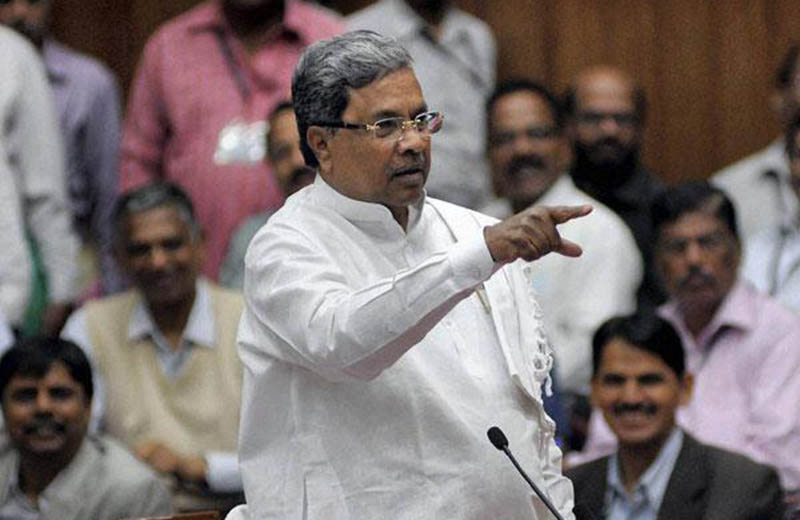
Bengaluru: Former Karnataka chief minister Siddaramaiah on Thursday attacked the BJP government over changes to land reform act that liberalized farmland ownership, alleging there was a scam bigger than the illegal mining during the previous regime of the saffron party.
The changes effected through a recent ordinance amounted to almost repealing the entire act and the protection to poor and small farmers under it had been taken away, the senior Congress leader said, demanding its withdrawal.
Accusing the state government of behaving like 'agents' of corporates and bowing to the pressure of real estate players, he said the Congress will organize a statewide agitation from the village level, along with farmers' organizations and other like-minded parties, against the ordinance.
Denying the charges, state Deputy Chief Minister C N Ashwath Narayan said the amendments were made as the existing act was unique and was in no way useful to farmers and people in general and instead misused for corruption.
Pointing out that Congress legislators had supported the amendments earlier, he expressed surprise over Siddaramaiah criticising the ordinance and ruled out its withdrawal.
The government had on July 13 promulgated the Karnataka Land Reforms (Amendment) Ordinance, 2020, bringing in sweeping changes, including easing restrictions on buying of agricultural land and ceiling on the extend of land one can hold.
"The BJP government in Karnataka has made amendments to the land reforms act and brought out an ordinance on July 13 despite stiff opposition from us," Siddaramiah, Leader of the opposition in the state assembly, told reporters here.
"I had initially thought that the government will not come out with the ordinance at a time when COVID-19 is spreading, but the government did," he said.
He termed as 'dictatorial' the government's decision and the day the ordinance was brought in as 'black day'.
"If the government had good intentions it should have brought it (the measure) during the assembly session and also had a public debate on the issue," the opposition leader said.
The ordinance has repealed Sections 79 (A), (B) and (C) from the original Act, and made way for non-agriculturists to buy farmland.
Siddaramaiah further said the present Karnataka government has bowed down to real estate players and corporates and accused the Centre of supporting such "anti-farmer" policies of the state.
He claimed 13,814 pending cases of violation in land use would get dismissed under the latest ordinance and alleged there was a bigger conspiracy behind it.
"This looks like a scam bigger than the mining scam, as several cases or petitions that were pending under sections 79 (A), (B) are dismissed, and they were related to a violation in the use of land worth about Rs 45,000-50,000 crores," he said.
The mining scam that rocked the previous BJP government in the state in 2008-13 was said to be about Rs 35,000 crore.
To a question as to who was behind this scam, Siddaramaiah said, "I have said it is bigger than mining scam which involved specific people, but in this (scam) the whole government itself is in it and has fallen prey to corporate bodies and real estate..."
Pointing out that the government was giving various reasons for bringing in the ordinance, he alleged the real intention was to help corporates and realtors, among others, which is clear from the fact that they have raised the landholding limit to 80 units.
Also, the Congress leader cautioned that the government's move may cause a threat to the food security of the country.
Ashwath Narayan said that the government will not withdraw the ordinance at any cost.
"While there was one kind of act across the country it was different in Karnataka and was in no way useful to farmers and people. Its misuse had led to a lot of corruption, and the amendments are pro-development," the DCM was quoted as saying by his office in a release.
"It is not anti-farmer and some people for their political benefit were making such comments," he added.
The government had earlier said the amendments were aimed at ending harassment of farmers by officials using the curbs in the parent act and also help the state in attracting investments.
Let the Truth be known. If you read VB and like VB, please be a VB Supporter and Help us deliver the Truth to one and all.
Real Madrid fines Valverde and Tchouaméni half a million euros each for altercation

Barcelona (AP): Real Madrid slapped players Federico Valverde and Aurélien Tchouaméni with half-a-million-euro ($588,000) fines on Friday for their altercation during practice.
The massive fines came a day after the midfielders tussled when the team trained. Valverde said in a post on social media on Thursday that no punches were thrown. But Valverde knocked his head on a table and he suffered a small cut that required a brief hospital visit.
On social media, Valverde initially called it a “meaningless fight” with a teammate and said “everything has been blown out of proportion."
His employers, however, considered it a significant enough breach of team discipline to nail both Valverde and Tchouaméni with fines that bite even the bank account of a top soccer player. The half-a-million euro penalties reflect the reputational damage the club was enduring in a chaotic end to a disappointing season.
In a statement, the 15-time European champion said its disciplinary action was concluded after both players expressed to the club “their complete remorse for what happened and apologized to one another.”
Madrid added they also apologized to their teammates, the coaching staff and club supporters, as well as showing their willingness to accept whatever disciplinary action the club deemed “opportune.”
Tchouaméni was back training with Madrid on Friday, two days before they play at Barcelona in a clasico. Madrid has to win otherwise Barcelona will be crowned La Liga champion.
After being notified of the fine, he posted a public apology to the club and its fans on social media.
“What happened this week in training is unacceptable,” Tchouaméni wrote. "I say this while thinking about the example we are expected to set for young people, whether in football or at school.
“Above all, I am sorry for the image we projected of the club.”
Valverde was not at practice due to the head knock.
Both players are set to play in the World Cup next month, with Tchouaméni playing for France and Valverde for Uruguay.
Chaotic end to a poor season
===================
The run-in between the players, who for seasons have played side by side in Madrid's midfield, came after they argued this week in previous training sessions. But tempers boiled over on Thursday. Spanish media was rife with reports that the players previously disagreed over the club's decision to let coach Xabi Alonso go after just months on the job.
It was not the only altercation involving Madrid players during training this week. Álvaro Carreras confirmed he was in a “minor” incident with a teammate. Spanish media said he and fellow defender Antonio Rüdiger got into a scuffle.
Álvaro Arbeloa, the coach who was promoted from Madrid's reserve team when Alonso was fired in January, will face tough questions on what went wrong inside the changing room when he gives a press conference on Saturday ahead of the clasico at Camp Nou.
Madrid is facing a second consecutive campaign without a major trophy amid rumors in the Spanish media that club president Florentino Pérez is considering bringing back Jose Mourinho to straighten out his underperforming team.