SIT probe in sexual abuse case involving MP Prajwal 'losing track': JD(S) to petition Governor
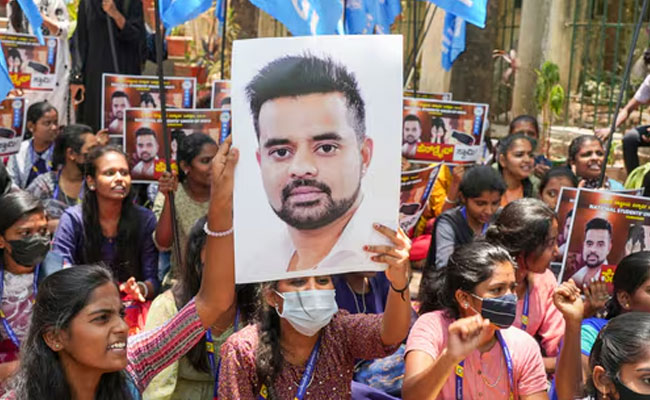
Bengaluru (PTI): JD(S) leader H D Kumaraswamy on Thursday alleged that the Special Investigation Team (SIT) probing into the sexual abuse charges against his nephew, Hassan MP Prajwal Revanna, is "losing track", and said his party would submit a memorandum to Karnataka Governor Thaawarchand Gehlot.
The former chief minister, while maintaining that he wants the guilty to be punished in accordance with the law, raised questions on the progress of the probe by the SIT constituted by the Karnataka's Congress government.
Also raising questions regarding the investigation against Prajwal's father and his brother, MLA H D Revanna, who is facing kidnapping charges, Kumaraswamy asked why the woman who was allegedly kidnapped has not been produced before the court so far, after she was rescued.
"We are giving a memorandum to the Governor as to how the investigation is losing its track... I have been saying since day one that whoever has committed wrong has to be punished. Looking at the way in which things are going on, it looks like none of these people want the guilty punished, but want publicity... What is the achievement (progress) since the investigation began?" Kumaraswamy said.
While speaking to reporters here, he said there is information that the family of the kidnapped woman has been kept here. He questioned why the woman has not been produced before the court till now.
"It has been how many days since the kidnapped woman was brought here? Has her statement been recorded under section 164 of CrPC (statements recorded by magistrate)? Has she been produced before the judge? It has been five days, why has the woman not been produced before the judge? From where was she brought? Was the 'mahazar' done? Was she brought from some farmhouse as claimed and reported in the media?," Kumaraswamy asked.
Further questioning why the SIT has not shared this information so far, the JD(S) leader said it has been five days since the woman was brought here, and they have not said anything on whether Revanna was responsible for the abduction or not.
"Why is the truth not placed before the court? They have sought time till Monday to file their objection. It means they want to keep Revanna in jail for three more days. They (Congress leaders) want to fulfill their hate, that is what they want. They don't want punishment for the guilty," he added. "I don't know whether the issue will die down after June 4 (Lok Sabha polls results)."
Revanna was remanded into judicial custody till May 14 by a magisterial court here on Wednesday.
He was in the custody of the SIT after being arrested in the alleged case of kidnapping a woman.
The case was filed based on a complaint by her son, who also accused the MLA's son Prajwal Revanna of having sexually assaulted her.
According to the police, the abducted woman was subsequently rescued.
The 33-year-old Prajwal Revanna is facing charges of sexually abusing several women. The scandal has raised a political storm with the ruling Congress and the BJP-JD(S) engaged in a slugfest.
Responding to a question on Deputy Chief Minister D K Shivakumar allegedly targeting him, Kumaraswamy sarcastically said, "Yes I'm the producer, director and also I'm the lead of the story... Shivakumar wants me to be the lead of the story right? I'm happy that he has accepted me as the lead of the story."
Shivakumar on Wednesday charged Kumaraswamy with being behind the circulation of videos of the sexual abuse of several women allegedly by Prajwal Revanna, and called the JDS second-in-command the "king of blackmailing" and the "lead, director, and producer of the story."
Let the Truth be known. If you read VB and like VB, please be a VB Supporter and Help us deliver the Truth to one and all.
19-yr-old woman found hanging from tree in UP village; juvenile held

Lucknow/Pratapgarh (UP) (PTI): Police have apprehended a 16-year-old boy for his alleged involvement in the rape and murder of a 19-year-old woman whose body was found hanging from a tree in a village here, officials said on Monday.
Additional Superintendent of Police (West), Brijnandan Rai, said that the body of a 19-year-old woman was found hanging from a tree in an orchard in the Manikpur police station area on Sunday morning. A post-mortem examination subsequently confirmed that she had been raped.
Police registered a case against unidentified persons under sections 103(1) (punishment for murder) and 70(1) (gangrape) of the Bharatiya Nyaya Sanhita, and initiated an investigation.
During the course of the investigation, the police found that the deceased was in contact with a juvenile who was also her relative.
Acting on this information, during a joint checking operation, sub-inspector Amit Kumar Singh of Manikpur police station and SOG In-charge Amit Kumar Chaurasia, along with their team, apprehended the 16-year-old near the Lehdari Ganga River bridge.
The search for other accused persons is ongoing, police said.
According to the police, the woman had gone to sleep after dinner on Saturday night but was found hanging in an orchard nearly 400 metres away from her home the following morning.
Additional Superintendent of Police (West), Brijnandan Rai, had earlier said that the circumstances suggest foul play.
"The victim's slippers and undergarments were recovered 50 metres away from the spot where the body was found. There are visible injury marks on her body," Rai said.
While locals have alleged that the woman was murdered after being raped, the ASP said that it is "prima facie a case of murder."
"Based on the complaint filed by the victim's brother, a case of murder has been registered against unidentified persons," the officer added.
Meanwhile, Samajwadi Party chief Akhilesh Yadav, in a post on X in Hindi on Monday, said, "The news of the heinous murder of a Dalit daughter in Pratapgarh is deeply tragic and condemnable."
"The question remains: why does the spate of murders of 'PDA daughters' continue unabated in Uttar Pradesh? Are the BJP government's claims regarding women's safety merely hollow rhetoric, or is there, in fact, discrimination even in the provision of security for women?" he said.
"Whenever the 'wandering Honourable (ghumantu maananiye)' finds a moment of respite from election campaigning, he should cast a glance at the plight of the daughters of his own Uttar Pradesh. In any case, apart from injustice and oppression, no sister, daughter, or mother of this state holds any hope from you," Yadav added.