Union Power Minister reviews Karnataka’s power sector, emphasises reforms, smart metering
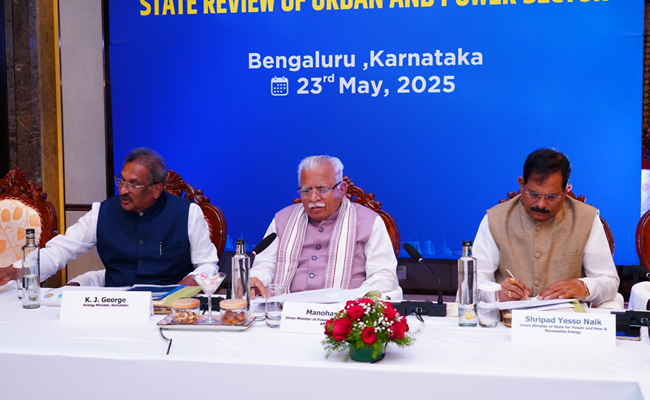
Bengaluru: Union Minister of Power Manohar Lal Khattar conducted a detailed review of Karnataka’s power sector during a high-level meeting held in Bengaluru on Saturday. The session was attended by Union Minister of State for Power and New & Renewable Energy Shripad Naik, Karnataka Energy Minister K. J. George, and senior officials from both the Centre and the State, including representatives from REC Ltd.
The Karnataka government made a comprehensive presentation highlighting the current status of power generation, transmission, and distribution in the state. Key issues discussed included the generation mix, challenges in acquiring Right of Way (RoW) for transmission projects, and the need for Central support to upgrade distribution infrastructure.
Manohar Lal appreciated Karnataka’s growing contribution of renewable energy to the power mix and stated that his visit was aimed at gaining a better understanding of ground-level issues while exploring new initiatives to strengthen the state’s power supply system.
The Union Minister advised the state government to take effective steps to reduce annual financial losses in power utilities and to move towards implementing cost-reflective tariffs. He stressed the importance of clearing dues and subsidies related to various government departments and urged the state to ensure the saturation of prepaid smart meters in all government establishments, including local bodies and residential colonies, by August 2025.
He also called for a centralized payment system to manage government electricity dues efficiently. In addition, he directed the state to fast-track smart metering for commercial, industrial, and other consumer segments in a time-bound manner.
Highlighting delays in transmission infrastructure due to RoW issues, the Minister urged early resolution and suggested adopting the compensation framework notified by the Central government.
Manohar Lal assured that the Centre would extend full support to Karnataka in strengthening its power sector and reiterated the government’s commitment to the overall development and welfare of the state and its citizens.
Let the Truth be known. If you read VB and like VB, please be a VB Supporter and Help us deliver the Truth to one and all.
Ordinance issued to increase number of Supreme Court judges from 34 to 38
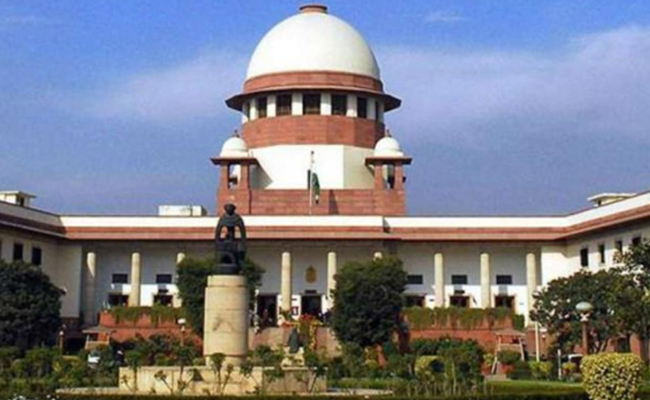
New Delhi (PTI): The government has promulgated an ordinance to increase the strength of the Supreme Court from the present 34 judges to 38, including the Chief Justice of India.
The law ministry notified the ordinance on Saturday, which amended the Supreme Court (Number of Judges) Act, 1956, to increase the sanctioned strength of the top court.
So far, the sanctioned strength of the top court was 34, including the Chief Justice of India (CJI). Now, the number of judges has been increased by four, taking the sanctioned strength to 38.
The top court will now have 37 judges, other than the CJI.
With the apex court having two vacancies at present, and the ordinance coming into force immediately, the Supreme Court Collegium will now have to recommend six names for appointment as judges in the top court.
A bill will be brought in the Monsoon Session of Parliament to convert the ordinance – an executive order – into a law passed by Parliament.
The Union Cabinet had cleared a draft bill on May 5 to increase the number of apex court judges.
The strength of the Supreme Court was last increased from 30 to 33 (excluding the CJI) in 2019.
The Supreme Court (Number of Judges) Act, as originally enacted in 1956, put the maximum number of judges (excluding the CJI) at 10.
This number was increased to 13 by the Supreme Court (Number of Judges), Amendment Act, 1960, and to 17 by another amendment to the law.
The Supreme Court (Number of Judges) Amendment Act, 1986, augmented the strength of judges from 17 to 25, excluding the CJI.
A fresh amendment in 2009 further increased the strength from 25 to 30.
Article 124(3) of the Constitution lists the qualifications required to become a Supreme Court judge.
An Indian citizen who has either served as a high court judge for at least five years, or as an advocate for 10 years, or is a distinguished jurist, can be appointed to the top court.
The strength of the Supreme Court is increased based on the recommendations of the CJI, who writes to the Union law minister. After consulting the finance ministry, the Department of Justice under the law ministry moves the Cabinet with a draft bill.