Will not allow BJP govt to pass anti-conversion bill in Assembly: Siddaramaiah
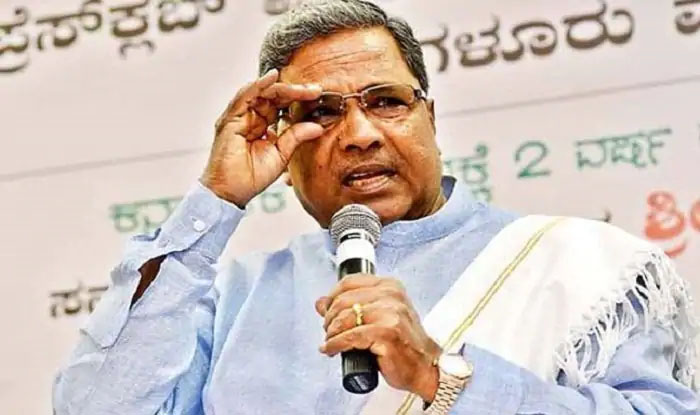
Belagavi, Dec 10: Senior Congress leader Siddaramaiah on Friday accused the ruling BJP in Karnataka of trying to divert the attention of the people from real issues by bringing in emotive ones like "Love Jihad, Anti Conversion" with an aim to implementing its "hidden agenda".
Expressing confidence about the Congress coming to power after the 2023 Assembly polls, the Leader of Opposition in the state assembly also said that his party will not allow the anti-conversion bill, which the government is planning to introduce during the ongoing winter session of legislature, to be passed.
"Hundred per cent we will come back (to power after 2023 assembly polls).
During the MLC polls from local authorities constituencies we got about 44,000 out of total 94,000 votes, while BJP got about 37,000, JD(S) got some 10,000," Siddaramaiah said.
Speaking to reporters here, he said it indicates that people want the Congress to come to power.
Further alleging that to divert the attention of the people from real issues, the government was making attempts such as bringing in anti-conversion law, Siddaramaiah said, "is there a need for it? There is no need. If there is forced conversion, file a complaint against those involved and punish them. There is a law already."
Pointing at Hosadurga BJP MLA Goolihatti Shekhar's claim that religious conversions by force or through inducement have become rampant and that his own mother is a victim of such act, he asked, "did he or his mother file a complaint?"
Accusing the BJP of trying to implement its "hidden agenda" by raising emotive issues like "Love Jihad, Anti Conversion", Siddaramaiah in response to a question whether the Congress would scrap the law on coming to power, said, "we will first stop the law from being passed now....let's see (what is to be done on coming to power if it is passed now)."
The proposed anti-conversion bill that is also being opposed by Christian community leaders is expected to come before the Cabinet on Monday and once cleared there it is likely to be introduced in the legislative assembly and council.
The bill is expected to have penal provisions, and may also insist that the persons who wish to convert to another faith file an application before the Deputy Commissioner two months prior.
Also, the person who wishes to convert is likely to lose the religion of his or her origin and facilities or benefits attached with it, including reservations; however, one is likely to receive the benefits entitled to, in the religion he or she converts to.
Meanwhile defending the proposed anti-conversion bill, BJP national General Secretary and MLA C T Ravi said, religious conversion should not become the mode to garner votes, as he called on Congress leaders including Siddaramaiah to read history and try to know about Mahatma Gandhi's views on it.
Claiming that Mahatma Gandhi too had opposed religious conversion, he said, "the Congress which claims that they follow Gandhi's and not Godse's Hindutva, let them read history and see what Gandhi had to say about conversion, Siddaramaiah please read history once."
Let the Truth be known. If you read VB and like VB, please be a VB Supporter and Help us deliver the Truth to one and all.
Road crash in UP leaves 10 dead
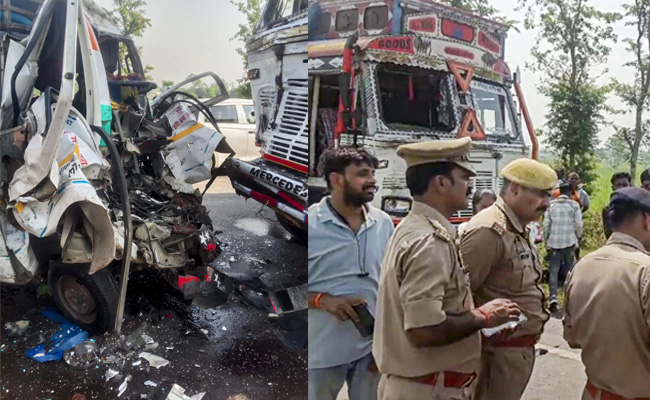
Lakhimpur Kheri (UP) (PTI): Ten people were killed when a van collided head-on with a truck on the Sisaiya-Lakhimpur national highway on Monday, police said.
The van was going to Sisaiya from Lakhimpur when the accident took place between Unchgaon and Bharehta villages.
Circle Officer of Dhaurahra, Shamsher Bahadur Singh, said all nine passengers travelling in the van and the driver were killed.
District Magistrate of Lakhimpur Kheri Anjani Kumar Singh told reporters that the van collided with a truck coming from the opposite direction, leading to nine casualties on the spot, while one succumbed to injuries at the district hospital.
Circle Officer, Dhaurahra, Shamsher Bahadur Singh told PTI, "Efforts are on to establish the identity of other deceased persons."
The seven of the deceased have been identified as Jaideep Singh (25), Pawan (23), Sohan (21), Ram Goyal (42), Sahajram (35), Pappu (18), all residents of Bahraich district and Adnan Khan (15), a resident of Lakhimpur Kheri district, police said.
Condoling the loss of lives in the accident, Uttar Pradesh Chief Minister Yogi Adityanath in a post on X, said, "The loss of life in the unfortunate road accident in Lakhimpur Kheri district is deeply distressing and heart-wrenching. My condolences are with the bereaved families."
"I have directed the local administration to provide prompt and adequate assistance to the injured and the victims. I pray to Lord Shri Ram to grant the departed souls a place at His divine feet and to bestow a speedy recovery upon the injured," Adityanath said on X.
Deputy Chief Minister Keshav Prasad Maurya and Brajesh Pathak too condoled the loss of lives in the accident.
"The loss of lives resulting from the road accident in Lakhimpur Kheri district is deeply tragic and heart-wrenching. My deepest condolences go out to the bereaved families," Maurya said.